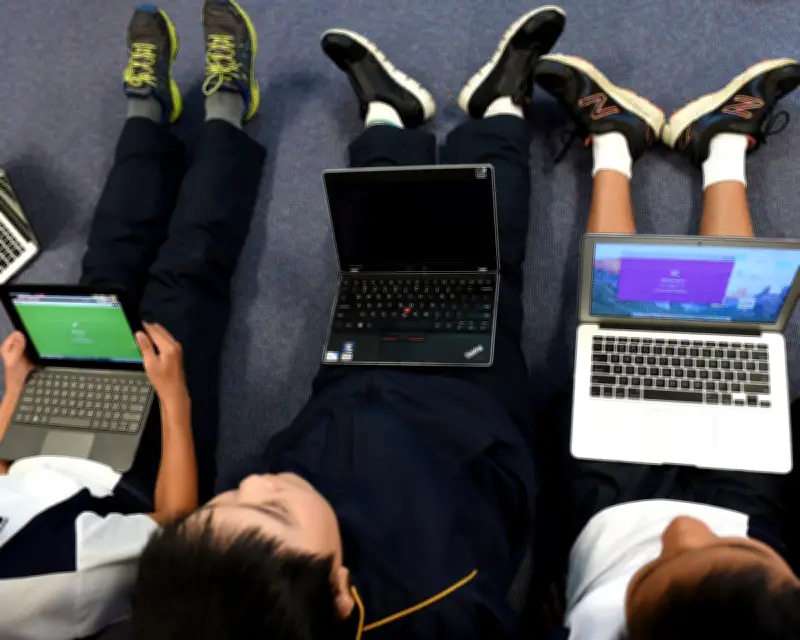
Secondary schools in Victoria will enforce a two-hour daily limit on device screen time, marking a national first. The state education minister announced the policy, which will take effect from term 1, 2027. The initiative, dubbed 'Eyes up, screens down,' aims to reduce reliance on laptops and tablets in classrooms, encouraging traditional methods like pen and paper, group debates, and practical experiments.
Details of the Policy
All state secondary schools must incorporate planned device-free learning time into their teaching programs. This follows an earlier announcement in October 2024 for primary students, where those in years 3 to 6 will be limited to 90 minutes of device use daily, while prep to year 2 students will have minimal screen time. Education Minister and Deputy Premier Ben Carroll stated that final guidelines will be released after consultation with schools. He emphasized that device use should not exceed two hours, saying, 'We want eyes up, screens down.'
Expert Reactions
Melinda Davis, a senior lecturer in education at Swinburne University and former teacher, welcomed the move, noting that technology has 'completely overtaken' traditional learning methods. However, she raised concerns about implementation, stating that abruptly removing screens could lead to negative responses from students. Despite this, she urged other states to follow Victoria's lead.
Exceptions and Broader Measures
Exceptions will be made for students with disabilities or neurodiversity who rely on technology, as well as for specialist subjects. Smartphones have been banned in Victorian state schools since 2020, a policy later adopted nationwide. From 2027, the ban will extend to smartwatches and headphones. Carroll said the measures align with 'world best practice' and criticized tech giants for prioritizing 'eyeballs' over students' well-being.
Support from School Leaders
Anthony Oldmeadow, principal of Ngayuk College in Kalkallo, described the screen limit as a 'really positive step,' acknowledging technology's benefits but also its distracting nature. He supported the government's approach to limit distractions while allowing purposeful use of technology.