Russian Prison Horrors: Ukrainian POWs Endure Systematic Torture in Taganrog Facility
When the initial Ukrainian prisoners arrived at Pre-Trial Detention Facility Number Two in the southern Russian city of Taganrog, they encountered a brutal "welcome reception" that signaled the beginning of a prolonged nightmare. Before the full-scale invasion of Ukraine in February 2022, SIZO-2 primarily housed approximately 400 Russian inmates, including women with children and juveniles. Following Vladimir Putin's invasion, the facility transformed into a systematic torture center for Ukrainian combatants and civilian hostages alike.
The Arrival and Initial Brutality
The first Ukrainian inmates arrived in April 2022, transported blindfolded and bound in military trucks adorned with the pro-Putin "Z" symbol. Upon entry, guards subjected them to ritualistic beatings involving kicks, punches, and baton strikes, establishing a pattern of daily abuse in what survivors describe as a concrete hellscape. Human rights organizations have raised urgent alarms about this infamous facility after former detainees detailed extensive torture methods.
Systematic Torture Methods
Ukrainian prisoners report enduring waterboarding, electric shocks, and being bound with tape to serve as "human furniture" for guards. These sinister techniques recall the horrors of the Chernokozovo detention center from the Second Chechen War, where prisoners faced chemical immersion, agonizing "meat racks," and suffocation using "elephant" masks. Since the war began, Ukrainian inmates have testified about the reappearance of these suffocation masks in filtration camps within occupied Kherson.

"They pulled a gas mask over his head with the valve closed so that air could not enter," recounted a captured law enforcer to Ukrainska Pravda, describing the method used on his cellmate. Danylo, cellmate of soldier Viktor Biletskyi from the 406th Separate Artillery Brigade, suffered a similar fate. "They put a gas mask on Danylo and electrocuted him to make him suffocate faster, but as soon as he started to lose consciousness, they took off the gas mask. They did not let him die: they wanted him to suffer," Biletskyi stated.
Dedicated Torture Chambers
Within SIZO-2, Ukrainian inmates are frequently forced into dedicated torture rooms where they endure specific, brutal techniques. Prisoners are handcuffed upside down in fetal positions with knees strapped to bars, then severely beaten for 10-15 minutes. Others face electric shocks administered using Soviet-era TA-57 field phones, nicknamed "Putin's phone" by prisoners, with wires attached to earlobes, noses, or genitals.
Oleksandr Maksymchuk, a prisoner of war who spent 21 months across two stints in the facility, documented suffocation, incessant beatings, electric shocks, and the "human furniture" method in his testimony. Yelyzaveta Shylyk, a former soldier captured as a civilian, endured baton strikes across her body, electric shocks, rape threats, and dog attacks. She recalled to the Guardian being placed twice in an electric chair with clamps between her toes, overhearing officers complain about keeping electrocution sessions under two hours to avoid paperwork from prisoner deaths.
Psychological and Physical Torment
Volodymyr Labuzov, chief medic of a Ukrainian marine brigade transferred to Taganrog in April 2022, described being forced into a boiler room and pushed waist-deep into a water-heating stove, then threatened with a knife on a kitchen meat-cutting table. Psychological torture included forced indoctrination, compulsory recitation of nationalistic Russian poems, and constant threats of sexual violence.
Ukraine estimates approximately 15,000 civilians have been detained by Russia since 2022, with at least 1,800 remaining in detention facilities where the United Nations has documented evidence of "widespread and systematic torture."

Systematic Starvation and Malnutrition
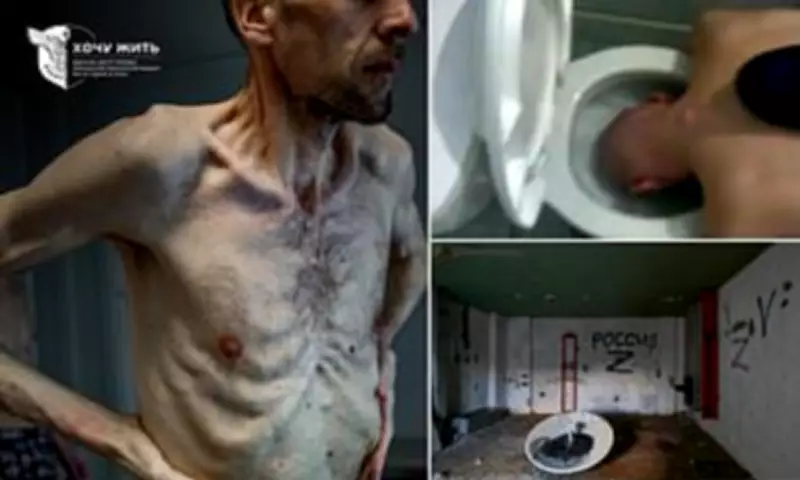
Returning Ukrainian prisoners of war consistently arrive emaciated, with protruding cheekbones and sunken eyes. Roman Vasiliovich Gorilyk, a senior controller at Chernobyl power plant among 74 prisoners exchanged on May 31, 2024, exemplified this brutal treatment after more than two years in Russian captivity. Upon release, every sinew, tendon, and bone was visible beneath his mottled skin, with vertebrae countable at a glance and his head appearing disproportionately large for his shriveled torso.
According to investigators from the Office of the High Commissioner for Human Rights, over 80 percent of returning Ukrainian prisoners complained about food quantity and quality, describing meals as often rotten or containing sand and small rocks. Some received only 250 grams of canned food daily for up to three months, while others reported food being used as torture weapons, including being force-fed burning hot meals that scorched their mouths, tongues, and throats.
Prisoner Testimonies of Captivity
Volodymyr Tsema-Bursov, a former military band tuba player from Mariupol who became a soldier in the 56th brigade, was captured months after Russia's invasion and transferred to Olenivka near Donetsk. "The conditions were terrible. There were no beds," he recalled. "Everything was covered in trash and broken glass. It was cold. We didn't even get drinking water." After severe beatings upon arrival and confiscation of valuables, he was moved to a detention center in Russia's Smolensk region, where he lost 36 kilograms from starvation and endured forced standing for eight hours straight in cells.
"I think they did this to break our will," Tsema-Bursov reflected. "To scare us, to kill our spirit, and to degrade us. They wanted to turn us into these kind of nameless beings." After 20 months of torment, he finally returned to Ukraine following multiple delays.
Long-Term Captivity and Psychological Scars
Yulian Pylepei, a naval infantryman captured in April 2022, spent three years passing through six detention centers before his release in summer 2025. "It took me a month and a half to realise I was really free," he told Le Monde, "but no time at all to realise I would 'never be the same again'." His body bears permanent scars from dog bites, broken bones, and electric shock marks, while his wedding ring was forcibly taken in Olenivka with threats of finger amputation.
Pylepei described SIZO-2 in Taganrog as "the worst of the worst," noting that two out of 100 arrivals died during the "welcome" ritual alone. After transfers through Novozybkov and Mordovia, including five months in solitary confinement, he returned weighing 65 kilograms—29 kilograms less than before captivity—and permanently disabled with a limp. Now, he personally welcomes fellow Ukrainians returning from Russian captivity, stating, "I understand them better than anyone, and vice versa."
Broader Pattern of Russian Torture Practices
Russia's lethal torture methods extend beyond Ukrainian prisoners, with appalling footage of violence becoming increasingly commonplace since the war began. A watershed moment occurred following the March 2024 terrorist attack on Moscow's Crocus City Hall, when video showed security forces slicing off a suspect's ear and forcing him to eat it, while another suspect received electric shocks to his genitals via military radio wires.
"What is different now is the clear demonstrative nature of the torture," explained Tanya Lokshina, Europe and central Asia associate director at Human Rights Watch. "The footage of the torture seems to be shared not by accident, but in order to warn others who are planning attacks on Russia that they will face the same consequences. The Russian authorities are no longer shy about showing that its security services torture people."
Sexual Violence in Russian Prison Hospitals
OTB-1, a prison hospital in the Saratov region near Kazakhstan, has gained notoriety for systematic sexual violence. Video evidence reviewed by the Daily Mail documents at least five inmates being urinated on, raped by male prisoners, and violated with blunt objects. Human rights campaigners assert that inmates were subjected to abuse to coerce false confessions, then blackmailed with footage to abuse other prisoners or become informants.
Activists from Gulagu.net claim that officers from Russia's Federal Prison Service and FSB spy agency oversaw this "conveyor belt" of abuse, employing gangs of rapists as orderlies to provide cover. The rapes, filmed in 2021, were allegedly archived by FSIN and FSB for blackmail purposes. Campaigners believe this operation occurred with senior agency knowledge for up to a decade.
Widespread Documentation of Abuse
Beyond Saratov, clips documenting heinous abuse have emerged from prisons in Vladimir, Irkutsk, Belgorod, Transbaikal, and Kamchatka regions. One harrowing video shows an inmate forced onto his knees before having his head plunged into a toilet bowl, with a guard's boot preventing escape during flushing—effectively waterboarding the detainee. The victim is then whipped, kicked to the floor, and urinated on by prison staff.
Anton Yefarkin, head of the Saratov prison service, subsequently revealed that 18 officials were fired with 11 facing "the strictest" disciplinary measures, yet witness testimony of widespread torture throughout Russia's prison complex remains rampant and largely unaddressed by international bodies.