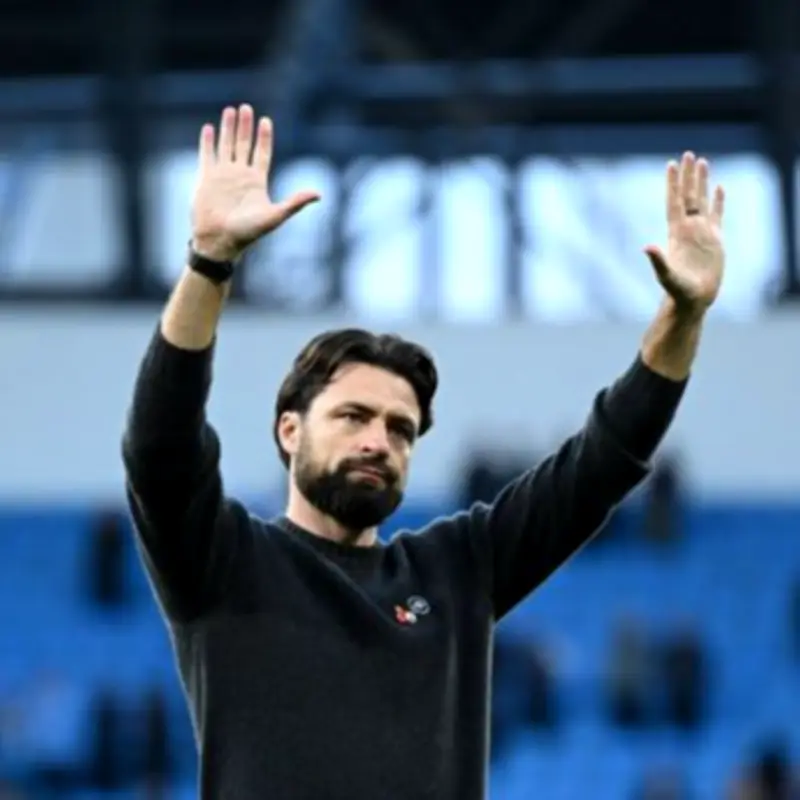
Russell Martin is often described as a "Marmite" figure because his uncompromising, patient, possession-heavy tactical philosophy strongly divides fan opinion. But now he has been tasked with halting fallen ex-Premier League champions Leicester City's slide down the divisions and taking them back to the top of English football.
The 40-year-old, who earlier this year tied the knot with Page 3 icon Lucy Pinder, a Southampton fan who started dating him during his time in charge of the Saints, has been unveiled as the new manager set to spearhead the Foxes' campaign in League One next season.
The ex-Scotland international has previously been on the club's radar, with King Power chiefs known to be fans of his style of play. In the summer of 2025, Martin was one of the top contenders for the role following the club's drop from the Premier League, before he accepted a job at Rangers and Marti Cifuentes stepped in at Leicester instead. Fast forward a year and the two paths that have been aligning for years are finally set to intersect.
Many supporters within the City fanbase have speculated Martin would eventually take the reins at Leicester. Ever since Aiyawatt 'Top' Srivaddhanaprabha appointed Enzo Maresca to mirror an identity similar to Manchester City, Martin has been a potential candidate, reports our sister title Leicestershire Live.
During the Italian's single season at the helm in LE2, only Martin's Southampton had more possession in the Championship. It's a calculated risk for City - at 40, Martin is the club's youngest manager since Paulo Sousa, who was 39. The Portuguese was given the boot after less than three months in charge.
But there are positives with the appointment and the former Southampton manager has demonstrated his credentials in the Football League. He revolutionised Milton Keynes Dons' philosophy of play, restored the passing approach to Swansea City and achieved success with the Saints through promotion to the Premier League. But then came the disappointing period with Rangers.
So what can Leicester anticipate from Martin? What are the widespread misunderstandings? How do his methods appear on the pitch? And what is the individual behind the public persona in football like?
LeicestershireLive spoke to three individuals who monitored Martin closely during his previous three stints at Swansea City, Southampton and Rangers. Radio Solent's Sports Editor, Adam Blackmore, celebrated promotion with the Saints under the new City manager's guidance, while the Daily Record's Scottish football expert Scott Burns, witnessed the alternative side of the former defender.
"Going to Leicester makes absolute sense, for Russell and the club," Blackmore explained. "He needs a project where he can rehabilitate his reputation and Leicester need someone who knows what he's doing in the Football League."
He added: "It's a big and difficult job. He's going to have a huge turnover of players at the King Power Stadium and that in itself is a real art to get that done without creating more upset in the dressing room. It's really difficult to bring back a dressing room and make it united when the players have their own agendas through the summer."
"He had a bloated squad at Southampton, which didn't help. People underestimate how difficult that is so that was an achievement in itself at Southampton, which is quite a daunting one at Leicester."
"I'm not surprised because Russell still did a good job in England," Burns told LeicestershireLive. "I know that things didn't end up well at Southampton in the Premier League and that was down to his playing style and leaving himself too wide open. But he's done well at other clubs."
Martin will spend the forthcoming two weeks gearing up for the commencement of pre-season at the month's end. At the top of his extensive list of priorities is evaluating his squad and swiftly trimming it.
Speaking to Blackmore, who had the opportunity to observe Martin instil his concepts into his Southampton players in 2023 during a pre-season camp in Turkey, it's clear that fostering a high-spirited dressing room is one of his strong suits. "Russell is very good at building a dressing room and a team of players," he said.
"That's something that's not thought about much because he does divide opinion with the way that he is - he's a bit marmite. The biggest misconception is that he's all about himself, I don't think he is. But because he tends to say things and has a mantra about how he plays, people think there's an arrogance in that.
"That's something that's an opinion and can be debated, but the players at Southampton bought into it for a long period of time. That tells you that he's a better squad building and a decent coach. The biggest misconception is that he is all about himself."
He continued: "What Leicester need is someone in a tracksuit doing stuff on the training ground. Because Russell plays a very defined way with instructions being fairly detailed, the players need to use their brains [to know] where they need to be at any one time to create the overloads, I think he's more of a coach.
"He's good at that. I went on pre-season tour with them and I watched him with the players and he's all up and at them. He can have that effect of being a catalyst when he comes into a club because he gets on with the players.
"Ultimately, some people think he's too pally with the players, but as a coach, you can't be too pally with the players really. He'll always bat for his players and he might have his favourites, the ones he plays and the ones he doesn't, but he will do what he thinks is right.
"That's the biggest challenge, he's got to get the players to buy into how he wants to play. Once he's done that and he's convinced them, he's good at that, they'll do the stuff for him."
His tenure at Southampton is the most notable part of Martin's CV, having guided the club back to the Premier League immediately. Prior to his stint at St. Mary's, he spent two seasons at Swansea City, where he secured 36 victories in his 99 matches at the helm.
"First impressions were fairly good, although there were quickly concerns over whether his Swans squad were actually capable of playing the way he wanted to play," said Tom Coleman, who reported on Swansea City for WalesOnline during Martin's two-year spell in Wales.
"When they were good, they were sensational to watch. In fact, in my opinion, Swansea played some of the best football seen since relegation from the Premier League under him. It was intense, it was high-octane and really entertaining."
When asked about the main frustrations, he added: "The main problem was Swansea were incapable of grinding out results, which is something you kind of need at this level. To win games, Swansea would have to produce these flawless, picture-perfect performances. But the flip-side was that his system increased the likelihood of individual errors, many of which were costly.
"In his defence, however, recruitment was really poor during his tenure. There was that famous January window where the club didn't sign anyone, despite some pretty clear and obvious shortcomings in the squad. But the flip-side of that argument is perhaps that he could have maybe shown a little more pragmatism."
Alongside a 25-match unbeaten streak, the Saints bounced back from a slight stumble at the campaign's conclusion to defeat Leeds United at Wembley. The subsequent season, Martin's unwillingness to alter his playing philosophy denied him the opportunity to complete the term - a problem that also risked becoming troublesome at Swansea.
"Some supporters felt his brand of football bordered dangerously close to possession for the sake of possession," Coleman said. "Martin values keeping and protecting the ball, and effectively believes that if you dominate possession, the rest will sort of fall into place.
"But I think some felt it came at the expense of real attacking intent at times. I don't think the fanbase ever fully turned against him, however. There were, and probably still are, plenty of fans here that really believed in what he was trying to do."
Blackmore added when asked about criticism directed to Martin: "That would be my biggest criticism [not changing his system] of Russell and it's an obvious one because he gets it from a lot of quarters. But ultimately, your job as a coach is to help your players and if things are not working, that's on you to change how you do things, in my opinion.
"What occurred at the beginning of Southampton was that he had to take over a squad that had been relegated, he had players like [James] Ward-Prowse and [Carlos] Alcaraz, who were about to leave, so it required time. They made a brilliant start, securing 10 out of a possible 12 points, then they experienced a dip in September (four consecutive defeats including City's 4-1 victory).
"Players require time to perform how he wants to perform and once they did, they embarked on a 25-match unbeaten streak either side of Christmas so he demonstrated he could get them to operate how he desired them to, almost machine-like.
"I understand the frustration from people [his style], he will say it works if people follow it. I would say if you can't beat a low block, do something different rather than passing it around the pitch endlessly, but that's not what he wants to do. I have to respect him for believing in his belief, I just don't think he's doing himself any favours when he does that because a good coach adapts. You can't knock him for that.
"At the end of the day, he is who he is, but I hope he learns to adapt and have new ways of playing because you should play to suit the players you've got - that's cheaper for a club rather than signing 15 players to suit a manager.
"In the Championship, they got beaten twice by Leicester but ended up getting promoted. So I can understand why Leicester fans think it was hopeless or they didn't like what they saw from Russell Martin as Southampton manager.
"When Southampton got it right in the Championship under him, they were sweeping teams aside from November to February and they were irresistible to watch. It was great football and the players clicked.
"It takes a bit of time, you've got the turnover of the squad, you've got to get everyone to believe in what you're doing and then you need the fans onboard because it makes a massive difference with the players because they won't play those great passes he wants if they feel like they're going to get moaned at by supporters when they go wrong.
"That's the biggest challenge for players to understand, if you take those risks with the ball, sometimes it works."
Martin's stint at Rangers bears little resemblance to the same glowing praise from those familiar with the circumstances, primarily because it endured merely 17 matches and the outcomes never materialised. "People talk about his playing style, that he plays good football but he doesn't know how to change things," Burns remarked.
"His reluctance to deviate from his playing philosophy has been his downfall, in my view. He's overly rigid in his approach and tactics. He's got a plan A and it's essentially plan A, there's no plan B, C, D or E. He's too inflexible and if he had altered his tactics, he probably would have remained in employment at Rangers."
He added: "At Southampton in the Premier League and Rangers in the Scottish Premiership, they're two different animals. Rangers fans still expect to win every week and do so in style. It's different at Southampton where they're a reasonably sized club but they're probably not expected to win every week in the Premier League.
"Looking at it, a lot of it was the same mistakes that he made at Southampton to the ones he made at Rangers. Leaving himself too wide open for example. At times, they struggled to score goals. Also, there's a pressure at Rangers of playing in front of 50,000 fans a week and some of the players he brought in just struggled to show they can play in that environment at times."
At every club he has managed, Martin's pattern in recruitment has been assembling a British core with players that have experience in the region. He also favours bringing players from previous roles (he took Ryan Manning and Flynn Downes to Southampton with him after working together at Swansea), something that is already being discussed with Will Smallbone and Gavin Bazunu linked with moves.
"He had a big influence because he worked closely with Jason Wilcox to start with before he went off to Manchester United," Blackmore said. "You think about his influence with players like Ryan Manning and Nathan Wood coming from Swansea with him so he knew what he wanted in that regard.
"He does like a British core of players and that surfaced after he was sacked by Southampton because when they brought in [Ivan] Juric, you could see that a lot of the English players weren't having him and that made it difficult for him.
"I've never known players to be so pro a manager and defensive of him. Normally when a team starts losing, usually players are all about themselves but actually, it made Juric's job harder because the players had such a loyalty to Russell and what they had been through with him. They found it difficult to adjust to a different manager."
One of the biggest worries for Leicester and Martin is the sentiment amongst certain sections of the fanbase. For various reasons, confidence in the former Norwich City centre-back to revitalise the football club isn't at its peak. But for Martin, that's nothing unusual. "He can be prickly, there's no doubt about it, but that's based on his stubbornness and believing in what he does," Blackmore told LeicestershireLive.
"You can't argue with someone's faith. If that's what he wants to do, that's what he wants to do.
"At the same time, he has to accept that other people are going to see fault in that. He will be defensive and he will be prickly, but it's because of his passion in what he believes in and I shall respect him for that.
"He has to be given a fair crack of the whip at Leicester. There's no point in the fans starting with a negative vibe about him because then he's going to be defensive. What the club needs is everyone to come together and not add more divisiveness because it doesn't add anything.
"They've got to give him a chance. Give him six months because look what happened at Southampton, they were nowhere in January and then suddenly they were in the play-offs. Leicester could take the first half of the season in League One to adjust to the new squad, Russell's ways and the division. Then in the second half of the season they could go unbeaten and be at the top of the table. If everyone gets behind them, I think he'll do a good job."
Burns admitted that Rangers supporters never warmed to Martin, even when his name was initially mentioned at Ibrox, though conceded some of the criticism directed at him was unjust. "Even when he was first linked they didn't want him," he said.
"It was the small things like it's Rangers tradition for the manager to wear trousers, shirt, tie and blazers. Russell didn't wear that and he wore more fashionable stuff. He was criticised for not wearing a shirt and tie on the touchline and he explained by saying he gets hot and sweaty and it wouldn't be a great sight. Even then it turned into a figure of fun and something to beat him with.
"It was definitely over the top. Regardless of what happened at Southampton, you can still look at his time there and he did a good job. He's a good manager who will do well given the right stridence, but Rangers had a mad time when he stepped in with the new ownership.
"At the end of the day, you live and die by your results but it was probably his relationship with the fans that brought him down and forced the hierarchy to make a decision quicker than they wanted to."
There is a distinct 'brand' of Martin as the football manager and what he stands for, but how does he differ as an individual? Claudio Ranieri and Nigel Pearson were favourites while Claude Puel's blandness meant he never recreated that sense of unity of the previous two.
"I found him good to get on with," Blackmore responded when asked about Russell away from football. "He's open, he was always willing to have a debate with you on something you said to try and explain something to you - which I really liked.
"It was always good that he was willing to engage. He did a session with the fans at St Mary's, he invited a couple fans in and talked through how he wanted to play, to get his philosophy across to the supporters. He's very open to connecting with people.
"A lot of fans at Southampton, despite what happened in the Premier League, really loved him. Sometimes that strut and swagger of his, when you're winning it's irresistible, it's when you're losing that you start getting criticised for being like that.
"We all know what happened in the Premier League, it was historically bad. But actually, they didn't get better when he left and he was two or three moments away from having twice as many points as he did when he was sacked. Ultimately, at the top level, if you tactically don't get it right, you get slaughtered and that's what happened."
The perception of Martin in Scotland, as an individual, doesn't vary from the one down south. "I had a few dealings with him before he was Rangers manager and what I would say is that he's a genuine nice guy," Burns added. "A brilliant human-being.
"When you're a football manager, it's very different when you're sitting there in the line of fire. Obviously he came in for a lot of criticism when he came in at Rangers so every other week he was getting questions on different things and the final few months was always about his future which was very difficult.
"We actually felt for him because nobody from the hierarchy at Rangers was helping him out or coming out to back him up. Everything was fired towards him and nobody was getting access to the chairman or the CEO. Every week it was 'do you think you'll lose your job if you lose?' So it was difficult for him. Most managers would struggle in that environment."