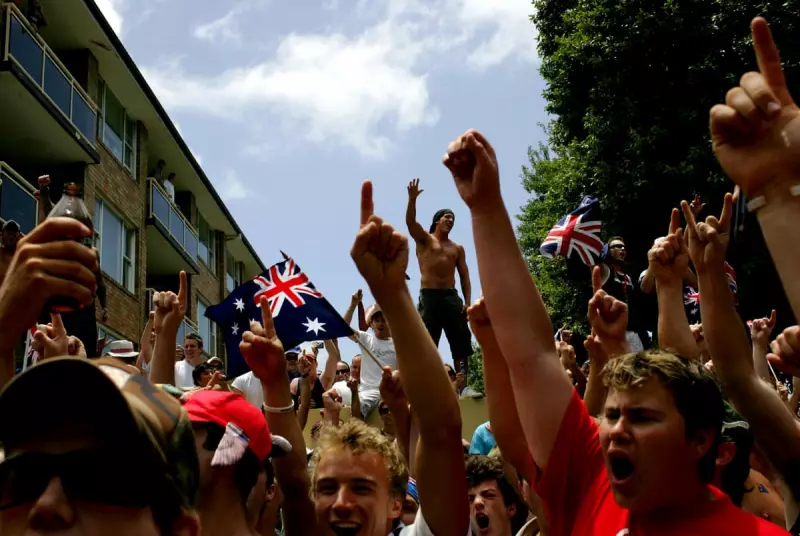
Two decades have passed since a hot December day in Sydney's south saw racial tensions explode into Australia's largest race riots since the 1860s. The Cronulla riots of 11 December 2005 remain a searing national memory, a moment when simmering prejudice erupted into violent, public spectacle. As the 20th anniversary approaches, a pressing question lingers: have Australian attitudes fundamentally changed, or does the hostility that fuelled the violence simply manifest in new, digitally amplified forms?
A Day of Shame: The Violence Erupts
For retired teacher Julie Cutbush, then living in Cronulla, the day began with an ominous sound. On 11 December 2005, she heard chanting from the nearby beachside park. What she witnessed upon investigating has haunted her since. "I turned the corner at the surf life saving club and I saw this mass of young males," she recalls. Hundreds, then thousands, of mostly young, bare-chested men, many draped in Australian flags, streamed from the train station. Fuelled by alcohol, the crowd's chants grew aggressively racist.
"It just erupted," Cutbush says. "Violence, bottles, cans, whatever, were being thrown. It was a melee." She saw groups of white men targeting individuals perceived to be of Lebanese or Muslim background—many were neither—and she saw retaliatory attacks. Police battled to control mass fights as the cry "Fuck off, Lebs" echoed along the shore. "I didn't think I would ever witness something like that," the 68-year-old reflects. "I thought, 'Oh, that's the stuff of overseas. It's not Australia.' Well, no, we're not. We're ugly."

The Simmering Tensions That Boiled Over
The violence was not a spontaneous event but the culmination of years of rising racial tension. Author and academic Dr Michael Mohammed Ahmad, a teenager in Sydney's south-west at the time, remembers the period leading up to Cronulla, where Lebanese Australians were cast as "folk devils" in media narratives dominated by stories of "Lebanese gangs" and amplified by global Islamophobia after 9/11 and the Bali bombings.
The immediate trigger was a fight a week earlier between three volunteer surf lifesavers and a group of young men of Middle Eastern ancestry outside North Cronulla Surf Club. This incident drew intense media coverage, including from talkback radio host Alan Jones, whom a court later ruled had incited hatred. 270,000 text messages were subsequently sent, drumming up support for an "Aussie pride" rally on that fateful Sunday.
By 1pm on the 11th, a man of Middle Eastern appearance was chased into a hotel for safety. In a park, a crowd sang Waltzing Matilda while two others were kicked and punched. The train station became a frontline where "vigilantes" set upon people based purely on their appearance. Cars and buildings were attacked, and police used batons and pepper spray against the rioters. Reprisal attacks erupted in suburbs like Maroubra and Brighton-Le-Sands that evening and into the following days.
A Legacy of Scars and a Persistent Problem
A New South Wales police report stated the "whole nation … looked on in shame." In total, 104 people were charged. Yet, two decades on, many argue the underlying issues remain unresolved. "We might like to all think that we're educated and tolerant—but I don't think attitudes have changed that much," says Julie Cutbush. A local retiree near Cronulla beach concurs, noting an "underlying racist attitude" persists.
Dr Ahmad believes the situation has deteriorated. "I don't think it's improved, I don't even think it's the same—I actually think it's worse," he states. "Cronulla has gradually expanded into a national problem." Race Discrimination Commissioner Giridharan Sivaraman points to a continuum of racist events since: the 2019 Christchurch mosque massacre by an Australian, anti-Asian sentiment during COVID-19, increased racism during the Indigenous Voice referendum, and recent surges in antisemitism and Islamophobia.
Technology has evolved the threat. Where text messages and talkback radio mobilised people in 2005, today's social media and encrypted messaging apps like Telegram allow outrage to be amplified and organised with far greater speed and less scrutiny. "It's become a talismanic event for the far right," says writer and academic Shakira Hussein.

Glimmers of Hope Amidst Enduring Division
There are some signs of progress. Cronulla's state MP, Mark Speakman, calls it "an extraordinarily relaxed place" and notes increasing, though still limited, diversity. Both Ahmad and Hussein point to greater representation of diverse voices, particularly Muslim women, in public life as a positive shift. "If Cronulla happened today, you'd have so many people in the mainstream speaking out," Ahmad suggests.
Yet, for Hussein, personal caution remains. Even now, her decision to visit a beach involves careful calculation: "It depends which beach… It depends how many other people are there, it depends what day." This lingering apprehension underscores a sobering reality. While the physical battleground of Cronulla may be calm, the ideological and social fissures it revealed twenty years ago are still actively—and sometimes violently—exploited across Australia. The nation's journey in confronting the racism laid bare on that hot December day is far from complete.