
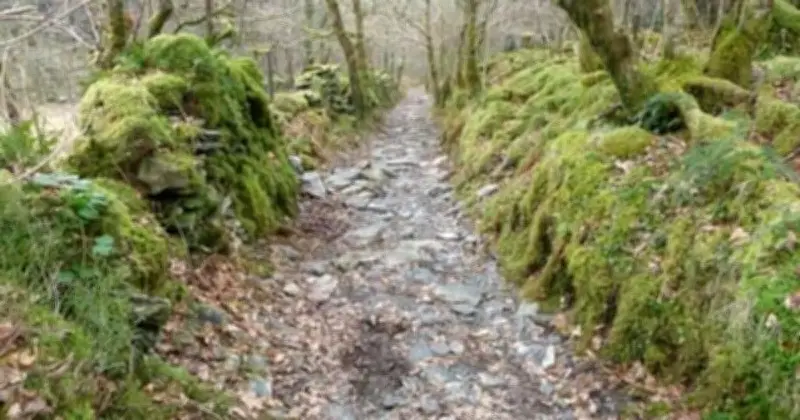
One of Wales' best-kept secrets is a living piece of history hiding in plain sight — yet even those who live along its route remain unaware of its existence. This ancient Roman road, stretching from Neath in the south to Conwy in the north, is a remarkable, semi-hidden treasure. Sarn Helen, among the most well-preserved Roman roads in Wales, reveals its cobbled stone remains in certain spots, laid bare by centuries of erosion.
A Path Through Time
A firm favourite with walkers, Sarn Helen was built nearly 2,000 years ago. It is widely believed to be named after Celtic princess Elen Lwy-ddawg — or Saint Elen, an early founder of churches in Wales — who was wed to Magnus Maximus, the formidable Roman emperor who arrived in Britain around 368AD. As the daughter of Romano-British ruler Octavius, legend has it that she persuaded her husband to build roads throughout the country, allowing his troops to defend it more efficiently against invaders.
Ancient Stones Along the Route
Towering standing stones, some reaching as high as 13ft and predating the Roman occupation of Britain, are dotted along certain stretches of the road. One such stone, known as Maen Madoc, still bears an ancient Latin inscription that reads: "Dervacus, son of Justus. Here he lies." Nestled within the Bannau Brycheiniog National Park, it is perfectly aligned with the region's largest standing stone, Maen Llia, which stands at the head of the Llia Valley. Were it not for the intervening forestry, one stone would be clearly visible from the other, despite being separated by roughly two miles.
Maen Llia is thought to date back to the Bronze Age. Given that a quarter of the stone lies buried deep beneath the ground, the sheer effort required to erect this enormous monolith must have been extraordinary. The purpose of these ancient stones remains hotly debated among historians, with theories spanning from rudimentary route markers and Stone Age boundary signs to gravestones commemorating those who perished along the roadside. Yet while the theories surrounding them are as well-worn as Sarn Helen itself, the truth likely remains just out of reach, tantalisingly buried beneath the surface.
A Modern Journey
In 2020, author Tom Bullough took on the challenge of walking the entire length of Sarn Helen, setting off from Neath. At the former starting point stands Roman Way, a modern housing estate, whose residents appeared largely unaware of the area's rich historical significance when Tom approached them. Alongside the present-day road sits a modest fragment of stone wall enclosed by railings — all that remains of the ancient Roman fortification that once stood proudly on that very spot.
Bullough recounts his experience in his book, aptly titled 'Sarn Helen', writing: "It is not until you reach Hirfynydd, the hill running north-east away from Neath, that you first encounter Sarn Helen. A grass-stripped track framed by broken walls, it follows the ridge through puddles and swamps, over occasional passages of stone once laid down by Roman legionaries. Some of them still have a distinct surface, with neat kerbs to either side." He expands upon the paths that meander gently through wildlife and sheep, dating back to the very beginnings of Roman rule in Britain.
Historical Significance
The battle for dominance over South Wales was brutal, with the indigenous Silures tribe putting up fierce resistance for decades. Ultimately, following their defeat of the second legion, the Romans established Neath's fort around AD74, placing the road's origins at approximately that period. The road stretches in straight sections, now bearing the tracks of bicycles and off-road vehicles. The road concludes at the Conwy estuary, as Bullough pens: "Here, 1,900 years ago, the Roman galleys would ride the tides to land or collect their supplies and men. Here it was that Sarn Helen ended and the rest of the world began."




