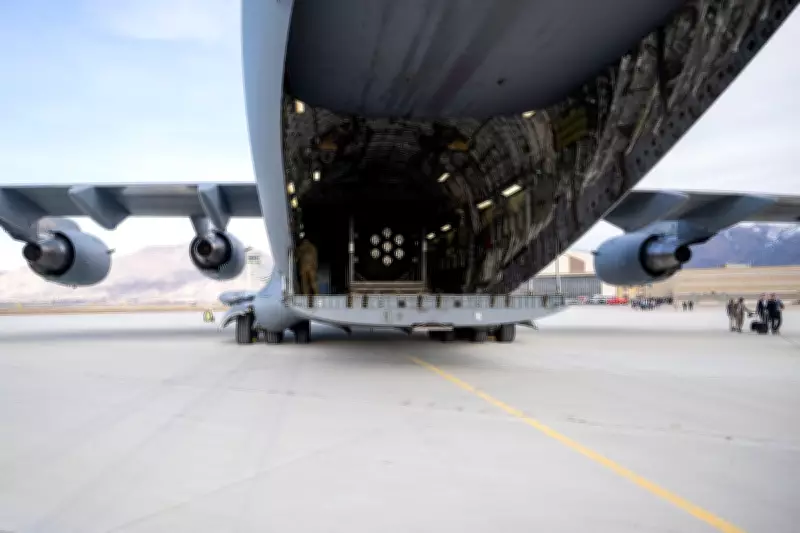
The United States military has executed a landmark airlift operation, transporting a compact next-generation nuclear reactor across three western states. This significant move directly advances former President Donald Trump's strategic initiative to expand and modernise America's nuclear energy capabilities nationwide.
Historic Transport for a Compact Power Source
On Sunday, the "next-generation" Valar Atomics Ward 250 nuclear reactor, comparable in size to a large truck, was loaded onto a C-17 Globemaster III transport aircraft at March Air Reserve Base in California. The aircraft then flew the reactor approximately 700 miles to Hill Air Force Base in Utah. According to the Pentagon, the reactor will subsequently be transferred to a specialised energy laboratory within the state for comprehensive evaluation and rigorous testing protocols.
A Reactor with Substantial Capacity
This compact, 5-megawatt reactor represents a significant step in portable power generation. The Pentagon announced that the unit possesses the theoretical capacity to supply electricity for up to 5,000 American homes. Alternatively, it could provide a reliable and secure energy source for remote military installations, enhancing operational resilience.

Aligning with Presidential Policy Directives
The airlift operation is a tangible manifestation of policy directives established under the Trump administration. In May, President Trump signed a series of executive orders aimed at revitalising the nation's nuclear power infrastructure. One order explicitly states, "It is the policy of the United States to expedite and promote to the fullest possible extent the production and operation of nuclear energy to provide affordable, reliable, safe, and secure energy to the American people."
Senior Officials Hail a Monumental Step
Michael Duffy, the Undersecretary of Defense for Acquisition and Sustainment, praised the joint operation conducted by the Defense and Energy Departments. "Powering next generation warfare will require us to move faster than our adversaries, to build a system that doesn't just equip our warfighters to fight, but equips them to win at extraordinary speed," Duffy stated. He characterised the day as "a monumental step toward building that system," highlighting how supporting the industrial base accelerates the delivery of resilient power.
Secretary of Energy Chris Wright outlined an ambitious goal for the administration: to have a trio of these small modular reactors operational by the upcoming July 4th holiday. "The American nuclear renaissance is to get that ball moving again, fast, carefully, but with private capital, American innovation and determination," Wright affirmed.
The Broader Context of Nuclear Energy in America
This development occurs within a specific national energy landscape. Currently, the United States operates 94 nuclear reactors, which collectively generate roughly 20 percent of the country's total electricity, according to data from the World Nuclear Association.
Public Opinion Remains Broadly Supportive
Despite historical accidents, recent polling indicates sustained public support for nuclear energy. A Gallup survey conducted last year found that 61 percent of Americans favour the use of nuclear power, a figure nearing record highs. The survey also revealed a notable partisan divide, with Republicans demonstrating significantly stronger support for nuclear energy compared to Democrats.
The successful airlift of the Valar Atomics reactor marks a concrete step in deploying advanced, decentralised nuclear technology. It underscores a concerted push by federal agencies to translate policy directives into operational reality, aiming to bolster both national energy security and military logistical capabilities.