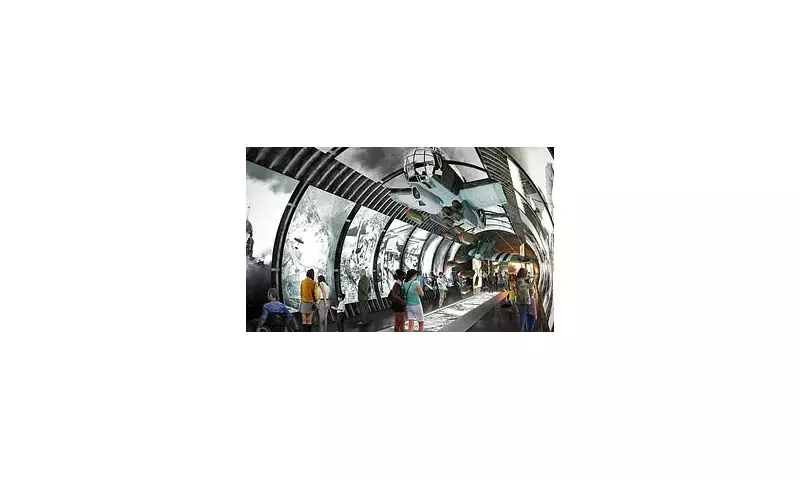
For the first time since the end of the Second World War, a labyrinth of secret government tunnels hidden deep beneath London's streets is set to be unveiled to the public. The historic site, long shrouded in secrecy, is believed to have inspired author Ian Fleming as he created the world of James Bond.
From Wartime Shelter to Spy Centre
The London Tunnels, located 100 feet below High Holborn, were constructed beginning in 1940 as a deep-level air-raid shelter designed to protect up to 8,000 people. However, their role evolved significantly during the conflict. The complex later became a crucial government communications centre and a base for a clandestine unit that dispatched agents on espionage missions into Nazi-occupied territory.
For almost 70 years, the existence and purpose of these tunnels were protected from public knowledge under the Official Secrets Act. Their location, directly beneath the London Underground's Central line, remained a closely guarded secret of the British state.

The James Bond Connection and Ambitious Revamp
The site's most captivating claim to fame is its link to 007 creator Ian Fleming. Fleming worked for the Naval Intelligence Division during the war, and it is believed he was familiar with the High Holborn complex. Historians and project leaders suggest the labyrinthine tunnels served as direct inspiration for the hidden lair of Q, the ingenious gadget-master in the Bond novels.
"This truly is the Q Branch of James Bond," Angus Murray, chief executive of The London Tunnels, told AP News, emphasising the site's unique heritage.
Following approval from the City of London Corporation's Planning and Transportation Committee, a monumental £150 million redevelopment is now underway. The 90,000 square-foot Kingsway Tunnel site will be transformed into a major visitor attraction, promising a blend of history and modern experience.
A Multi-Faceted Tourist Destination
The planned attraction, as outlined by The London Tunnels Company, aims to be three distinct experiences in one. Firstly, it will feature a large-scale immersive heritage experience dedicated to the site's history. Secondly, it will offer a selection of permanent and temporary exhibition spaces. The ground floor will serve as the main entrance to a permanent 'Heritage Experience' and a flexible cultural space for rotating exhibitions.
Finally, the project plans to install one of the world's deepest underground bars beneath a capital city, adding a unique social element to the historical tour. The entire attraction is designed to be fully accessible and to appeal to visitors of all ages.
James Loxton, director of investor relations, confirmed the vision: "We are going to create an attraction that is three things in one... it will have the world's deepest bar under a capital city." The development will also include an intelligence museum and an interactive Second World War memorial.
With its unique blend of clandestine history, literary legend, and ambitious modern design, The London Tunnels are poised to become the capital's next major tourist destination, finally bringing a hidden chapter of British wartime and espionage history into the public eye.