
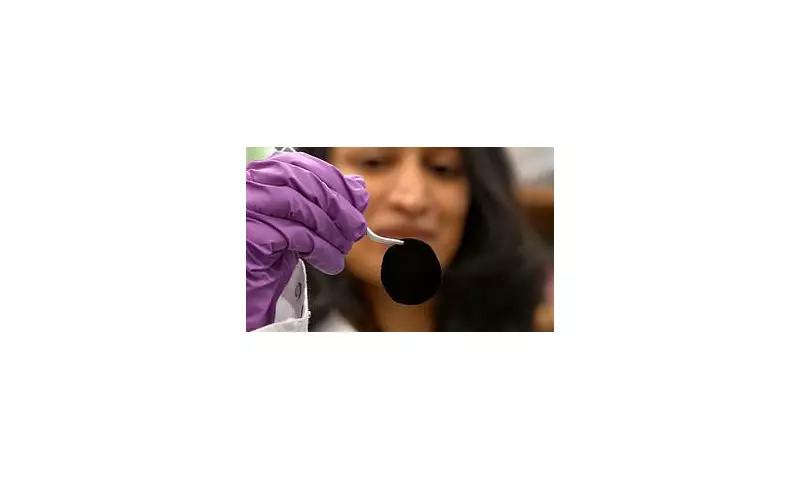
Scientists have unveiled the darkest fabric ever created, a material so profoundly black it absorbs 99.87 per cent of all light that strikes it. This breakthrough, achieved by researchers at Cornell University in the United States, promises to transform fields from high fashion to advanced solar technology and military camouflage.
Nature's Blueprint: The Magnificent Riflebird
The project took direct inspiration from the natural world, specifically the magnificent riflebird (Ptiloris magnificus) of New Guinea and Australia. This bird's extraordinarily dark, velvety plumage results from a combination of melanin pigment and unique, light-trapping microscopic structures. The Cornell team sought to replicate this effect in a textile, using a synthetic melanin called polydopamine as a dye for a white merino wool knit.
To achieve the ultra-black effect, the researchers had to ensure the dye penetrated every fibre. They then etched the material in a plasma chamber, creating a forest of tiny, spiky nanostructures called nanofibrils. These structures trap light by scattering it inward, preventing almost all reflection.
Performance and Practical Applications
The resulting fabric is not just a laboratory curiosity. Rigorous analysis confirmed it reflects an average of only 0.13 per cent of light, comfortably qualifying it as 'ultra-black' (defined as reflecting less than 0.5%). Crucially, it maintains this deep black appearance across a wide 120-degree angular span, meaning it looks consistently black even when viewed from sharp angles—a significant advantage over existing materials.
The team has already demonstrated its wearability. Fashion design student Zoe Alvarez created a strapless dress incorporating circles of the ultra-black fabric alongside iridescent blue, mirroring the riflebird's aesthetic. The scientists report the material is wearable, scalable, and easy to manufacture, and they have applied for a patent.
Beyond the Catwalk: Solar, Camouflage, and Telescopes
While evening wear is a striking application, the fabric's potential extends far beyond fashion. Its exceptional light-absorption makes it ideal for solar thermal systems, where converting sunlight to heat energy is paramount. It could also be used for thermo-regulating camouflage, hiding people or equipment from infrared detection. Other uses include improving the performance of scientific instruments like telescopes and reducing stray light in cameras.
"From a design perspective, I think it’s exciting because a lot of the ultra-black that exists isn’t really as wearable as ours," said Larissa Shepherd, assistant professor of fibre science at Cornell. "It stays ultra-black even from wider angles."
However, this fabric, while the blackest reported for textiles, is not the absolute blackest material ever made. That record is held by a foil developed by MIT researchers in 2019, made from carbon nanotubes, which absorbs at least 99.995 per cent of light. The Cornell team's achievement, detailed in the journal Nature Communications, proves that conventional natural fabrics can be transformed into high-performance, ultra-black materials with vast commercial and scientific potential.




