The Essex Supercomputer Dream: A Scaffolding Yard Amid AI Hype
It typically requires 18 to 36 months to construct a hyperscale AI facility, such as what could be one of the world's most powerful supercomputers. Yet, in Loughton, Essex, a promised technological marvel has yet to rise from the ground.
From Press Release to Scrap Metal Site
Press releases depicted a gleaming supercomputer on the outskirts of north London, with a glass and concrete building set against tree-lined streets, accompanied by images of glowing blue robot faces. This vision was meant to symbolise a technological revolution by the end of this year.
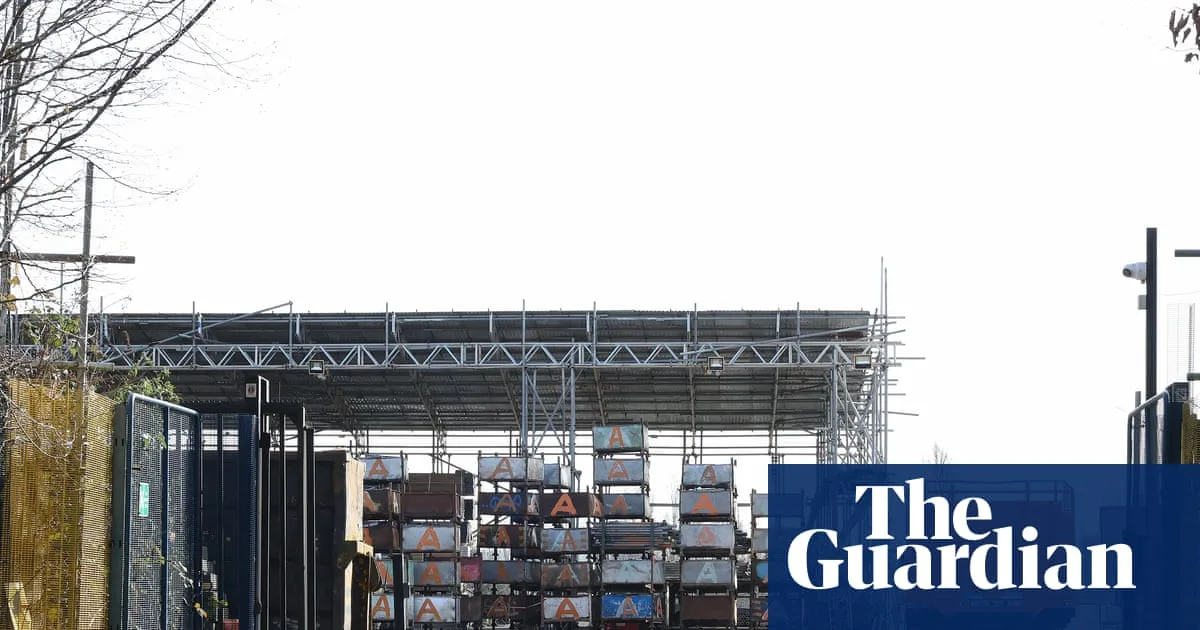
However, a recent visit by the Guardian revealed a starkly different scene. The four-acre plot in Loughton remains a depot stacked with pylons and scrap metal under a corrugated roof, with flatbed lorries transporting poles in and out. Nine months before the project's completion date, it is still operational as a scaffolding yard.
The story of the Loughton supercomputer offers insight into the lofty ambitions for artificial intelligence as an economic driver in the UK and globally, and how such hopes can fade into a less thrilling reality.
Global AI Ambitions and UK Promises
Worldwide, billions of dollars and the fortunes of governments, banks, and pension funds are invested in the promises of major companies to rapidly build AI infrastructure and reshape the global economy. Nvidia's CEO, Jensen Huang, expressed confidence in the UK as a hub for AI investment during visits in June and September 2025, praising the UK's tech ecosystem as "the envy of the world" and urging investment for wealth creation.
Yet, key UK investments scrutinised by the Guardian do not match their public portrayals. Significant financial commitments often lack substance, and "new" datacentre projects may merely involve old buildings with updated chips. A recent report indicates that half of the world's datacentre projects scheduled for this year could face delays, with issues like stakeholder disputes affecting initiatives such as OpenAI's $500bn Stargate project in the US.
Cecilia Rikap, a professor of economics at University College London, notes, "There has been a lot of narrative crafted by tech companies that links AI to economic growth. Companies claim they are making big investments, but this narrative doesn't hold water."
The Loughton Supercomputer: A Closer Look
The UK government announced the Loughton supercomputer in 2025 as part of a plan to "turbocharge" the economy, with reports claiming it would be three times as powerful as the fastest US supercomputer. The developer, Nscale, is a small London startup with no prior datacentre construction experience.
Nscale bills itself as an "AI hyperscaler" and lists 11 datacentres on its website, including sites in Portugal and Loughton, all of which appear to be under construction or acquired from other entities. The government stated Nscale had "signed a contract" to build the supercomputer by 2026, investing $2.5bn and creating 750 jobs. A later announcement in September mentioned Microsoft as a partner, with suggestions that $15bn of Microsoft's $30bn UK investment was earmarked for this project.
However, the Guardian found that Nscale's "contract" and the combined $17.5bn "investment" from Nscale and Microsoft are not formal commitments to the UK government or economy. The contract referenced is between Microsoft and Nscale, and the government admitted it has no mechanism to audit the $2.5bn, which may include equipment and capital funding without a formal agreement.
Delays and Uncertainties
Nscale, like CoreWeave—another key player in UK AI plans—originated as a bitcoin mining company. Nscale's investment is primarily in Nvidia chips, and Microsoft clarified it is not building the supercomputer but will become a customer once it is operational. Thus, the $17.5bn represents a plan for a UK company to purchase Taiwanese-made chips, install them in Loughton, and lease them to a US tech firm.
When asked about job creation, Nscale could not explain how the 750-job figure was calculated. Land records suggest Nscale has not been registered as the site owner over a year after the claimed purchase, with the company stating ownership or a pending sale but providing no transaction date. Planning permission was filed in late February after Guardian inquiries, with construction said to begin "very soon," though completion this year seems unlikely given typical build times of 18 to 36 months for such facilities.
Broader Implications and Financial Windfalls
An essential aspect of the global AI economy may be that regardless of whether datacentres are built, companies like Nscale and their shareholders can profit significantly. CoreWeave, involved in a £1.5bn AI hub in Lanarkshire, faces a US lawsuit alleging it concealed construction delays, impacting its market valuation after going public.
Nscale raised $1.1bn in funding in September, with Nvidia acquiring a stake through a £500m investment. The company has yet to file accounts, but in October, it allotted over 2.9 million shares at 1 pence each. A recent $2bn funding round boosted its valuation to $14.6bn, making those shares potentially worth hundreds of thousands of times their original price. Investors include Nvidia, Aker SA, and Blue Owl Management.
Alvin Nguyen, an analyst at Forrester, commented, "It's kind of a 350,000% return on investment. There's very few things that will give you that, right?" This highlights the potential for massive financial gains even as physical projects lag behind.
In summary, the Loughton supercomputer project exemplifies the gap between AI hype and reality, with delays, unclear investments, and financial speculation overshadowing tangible progress in the UK's tech ambitions.