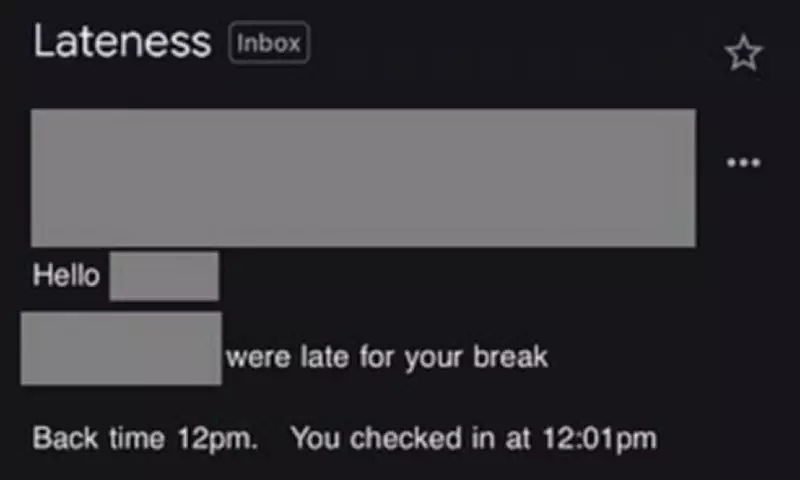
A retail employee has ignited a significant online debate after disclosing they received a formal written reprimand for returning from their lunch break merely one minute late. The worker shared the email from their manager, which triggered a flood of reactions concerning workplace expectations and the rigidity of attendance policies in the retail industry.
The Formal Warning Over a Single Minute
The email from the manager stated clearly: 'Hello. You were late for your break. Back time 12pm. You checked in at 12:01pm.' It proceeded to instruct the employee to 'adhere to the attendance policy,' detailing expectations regarding punctuality, shift start times, and the necessity of notifying managers about any lateness.
The employee expressed being 'shocked' to receive such a written warning over what they perceived as a minor delay, especially since the break in question was unpaid. 'Just to be clear, this is an unpaid break,' they emphasized in their online post.

Contextual Challenges and Broader Frustrations
Explaining the circumstances, the worker noted they had arrived at the clock-in machine approximately five minutes before 12pm, but were delayed by a queue of colleagues all attempting to log into their accounts simultaneously. 'I was at the clock-in machine like five minutes earlier than 12. It takes time to log into your account and clock in,' they explained. 'They just said it's my responsibility to be there first … tough doing that when there's five people ahead of you.'
This incident was not isolated, according to the employee, who pointed to broader frustrations with their role. Relying on public transport, they often left home more than an hour before their shift, only to occasionally be informed while already en route that the shift had been cancelled. 'There have been times I'm already on the bus at 8:20am and get told my 9am shift is cancelled,' they revealed.
Additionally, they alleged that shifts were frequently shortened at short notice. 'Even when I come in for a full eight hour shift, they often cut it down to four hours the same day if the store is slow.' Against this backdrop of unpredictable scheduling, the one-minute warning was viewed as disproportionately harsh. 'When I'm working, I give 100 per cent. When I'm on break, that time is mine - so why should I have to come early and use my break just to clock in on time?' the employee questioned.
Mixed Reactions from the Online Community
The post drew a varied response from commenters, with many arguing that the manager's approach was excessive. One commenter wrote, 'Even if it was paid, one minute is crazy to cry about. Start looking for a new job.' Another added, 'If they're going to officially reprimand you in writing over something this minor instead of just talking to you, it's just going to get worse.'
Some suggested the warning could indicate a more formal performance management process is underway. 'You're already on their radar and they want you gone, so they are building a case with documented incidents,' one person claimed.
However, not all responses were sympathetic. Others contended that strict adherence to schedules is standard across retail roles, regardless of how minor the delay might appear. 'You won't find a retail job that doesn't care about this,' one commenter asserted. 'If you are due back at 12:00pm you should clock in at 12:00pm. The schedule exists for a reason.' A second commenter stated, 'This isn't even that bad. Fairly reasonable policy.'
Highlighting Broader Workplace Tensions
This incident has underscored a wider issue facing many Australians in casual and retail positions, where stringent workplace policies often clash with unpredictable working conditions. Shared clock-in systems, last-minute roster changes, and fluctuating hours are commonplace across the sector, even as expectations around punctuality remain firmly enforced.
Workplace experts note that while employers are within their rights to enforce attendance rules, adopting a hard line on minor issues can significantly impact staff morale. This is particularly relevant in industries already grappling with high staff turnover rates. For employees managing unstable hours and tight schedules, small incidents like a one-minute delay can quickly become a tipping point.

In today's competitive job market, where workers have more employment options than in previous years, experiences such as these may be sufficient to prompt some individuals to begin seeking alternative opportunities elsewhere.