
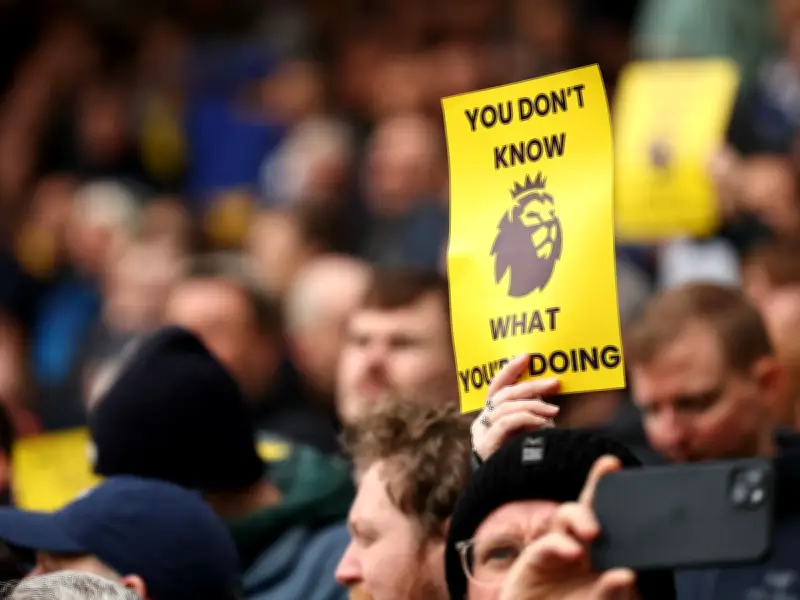
If anyone thought the days of the Premier League anthem being booed by Everton fans might soon come to an end, they are sorely mistaken. The club’s anger and frustration at the latest landmark ruling to go against them is, in fairness, primarily directed at the findings of the independent commission that ruled the Blues should pay Burnley £35m in compensation and interest for staying up ‘at their expense’ in 2022. But that panel was operating under the rules of the Premier League and it is quite clear those regulations are a shambles. This is a system that lost its integrity a long time ago.
That much is clear in the latest unprecedented judgement Everton have been subjected to – the 124 pages that set out the arguments in this case provide as many questions as answers. Everton breached the spending rules (PSR) by £19.5m at the end of the 2021/22 season and there is no dispute they gained a sporting advantage from that breach. Burnley’s claim centred on the argument the advantage was so great that, had Everton not had it, the Clarets would have survived the drop instead of what were then Frank Lampard’s Blues.
One of the most troubling parts of the argument is whether it is relevant at all. There were six weeks between the end of the season and the June 30 deadline for financial compliance. That is a six-week window in which Everton could have sold another player (they did sell Richarlison to Tottenham Hotspur in this window) to bring in £19.5m and make themselves compliant even having had the benefit of that player all season. That might not sound particularly fair but it is a loophole within the rules and one that surely undermines the findings of the panel that Everton should be viewed as having been in breach through the season in question and not just at the end of the financial year. A club’s final PSR position cannot be calculated before July 1 – after the full 12 months is over, after all.
In this case, the view has been taken that, because Everton were on a pathway to breaching the rules during the season, the breach should be treated as having been almost inevitable and therefore a direct cause of Burnley’s relegation. Burnley argued the “concept of a breach” could be established before the offence actually occurred and that is enough to show a link between Everton’s wrongdoing and the Blues' Premier League survival. There may be some sense in that but this is a conclusion that feels remarkably out of step with what has happened in the four years since. In that period we have seen the emergence of a new June 30 transfer deadline day as clubs worried they would meet the fate of Everton traded players ahead of an artificial deadline in order to improve their chances of PSR compliance.
It goes further than that. Chelsea offloaded hotels to a sister company and Aston Villa sold their women’s team to their parent company to support their respective efforts to comply with PSR. The argument Everton essentially broke the spirit of the law feels redundant given the integrity of the regulations has long been dead. Neither Chelsea nor Villa – nor indeed Everton, whose new owners oversaw the sale of the women’s team within the wider group last year, faced any action for what were effectively financial slights of hand, albeit within the rules, intended to help comply with PSR.
For a better understanding of the messiness of this matter, likely to be Everton’s most compelling argument in their appeal, look no further than the case against Leicester City. The Premier League pursued the club for a PSR breach after it was relegated in 2023. Leicester’s fall into the Championship was confirmed in May and their PSR breach stemmed from a calculation taken after the completion of the financial year on June 30. The club argued by that time it was no longer in the top flight and so had fallen out of the jurisdiction of the Premier League. The first independent commission dismissed that argument. Leicester then won an appeal. Then a third panel overturned that call. The situation is, therefore, a grey area of significant proportions. Can Everton really be held responsible for the relegation of a rival before their offence was actually committed?
That is not the only area in which Everton’s frustration is legitimate. This is a case that was played out on counterfactuals and hypotheticals, with weight attached to simulations of hundreds of thousands of Everton games over anywhere between a four and 12 year period. What if Everton had sold an extra player to conform to the rules? What value does every extra million pound spent have on performance? In almost every scenario, the worst is assumed of Everton – assumptions reached include that Everton would not or could not have sold players to comply had they been aware they were about to breach PSR. Remember – reckless as Everton may have been, it has been accepted from the very start that the club did not deliberately breach the rules. The assumptions also include that the cumulative impact of the £19.5m overspend should be judged over just the year of the breach and not spread across the four seasons in question. Much is said of how poorly Everton spent their money but serious weight is also given to the idea that, despite most of those players struggling so much the panel did not believe the club could have sold them had it wanted to, they were still good enough to have definitely saved Everton at Burnley’s expense.
Let me be clear – Everton breached the spending rules and deserved punishment for a catalogue of problems that were largely self-inflicted. This is not a piece that seeks to downplay the club’s leading role in its slump into crises on and off the pitch. But in this case, as in so many others, there is a feeling Everton are being held to a higher standard than others. It feels the worst is always assumed when it comes to assessing Everton’s missteps while others are given greater benefit of the doubt.
Nottingham Forest breached PSR by almost twice as much as Everton and rejected bids for Brennan Johnson that would have taken it within compliance, making a calculated decision to break the regulations. They received a four point deduction. Chelsea used £47m of secret payments to help build a team that enjoyed immense success for years – titles, domestic glory and two Champions League triumphs. They got a £10.75m fine and a transfer ban that is unlikely to come into effect. Six clubs sought to form a breakaway European Super League that would have destroyed the competitive integrity of the Premier League and were handed tiny fines. Chelsea and Villa sold infrastructure and a women’s team to help prevent their own spending from falling under regulatory scrutiny. They were successful. Everton unwittingly breached PSR by £19.5m and have since received the highest points deduction given to a top flight club and the greatest financial penalty ever handed out under Premier League rules. They were deducted six points (plus two more for their second breach), plunged into a relegation fight they narrowly won, lost millions in merit payments through dropping to a false league position and now, four years after their breach, face another £35m penalty for causing the relegation of a club six weeks before they officially breached the rules.
It is little wonder Everton are furious. The boos will be as vociferous as ever when the Premier League anthem is played at Hill Dickinson Stadium in August.




