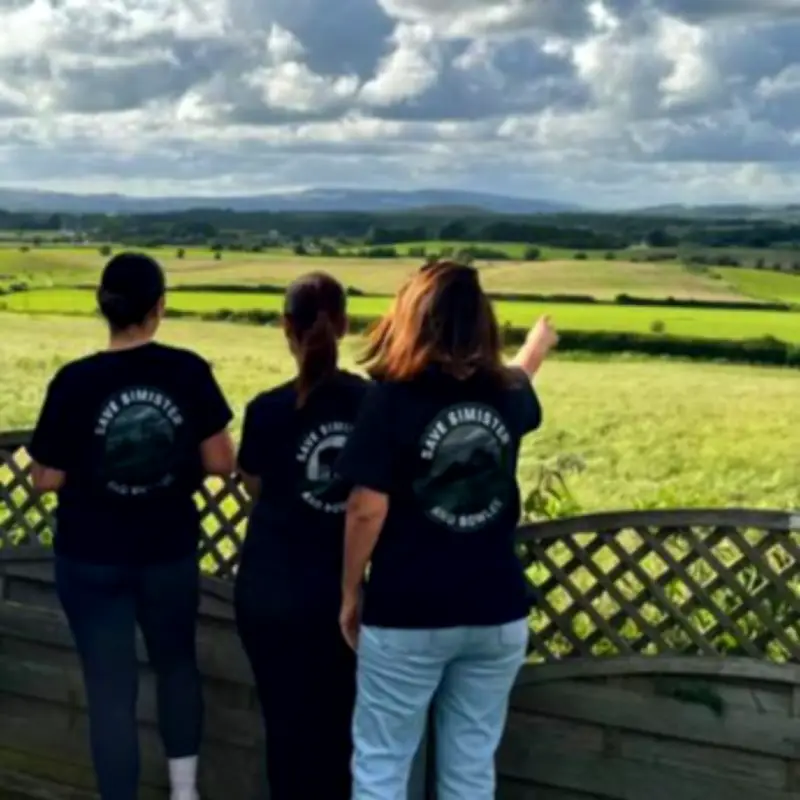
Campaigners are fighting to protect their rural life in the most unexpected locations – next to one of the busiest motorway junctions in the north west. Simister and Bowlee are countryside-like villages situated on the edge of the M60 motorway, near Simister Island junction 19. A large section of green space there has been eyed up for 1,550 homes, shops and a healthcare facility.
This plan would effectively see a new village built off Heywood Old Road to support the incoming Atom Valley scheme. The Atom Valley vision is to build 7,000 new homes, create 20,000 ‘high-quality’ jobs and carve out 17m sq ft of employment land. The Simister and Bowlee scheme falls under the ‘Northern Gateway’ section of the project.
But the people who formed Simister Bowlee Residents for Safety Coalition (SBRS) were already aggrieved by the scale of the Atom Valley scheme. When they learned of plans to build 1,550 homes in their back yard to support the giant project, it was a step too far. Overdevelopment without the local infrastructure is their biggest concern. With congestion on the roads already bad, GP waiting lists long and poor public transport connections, SBRS feels adding hundreds of new homes before this is sorted could cause carnage.

A spokesperson for SBRS said: “We understand why a vision of 20,000 jobs and billions of pounds of investment sounds attractive. Everyone wants good jobs, thriving local high streets and opportunities for young people. But for those of us who actually live here, what’s missing is a clear, honest picture of what this means for our day-to-day lives – and a genuine say in the process. Residents are already living with major infrastructure pressures. The roads around Simister and Bowlee are dangerous and congested. One resident has already had to be airlifted to hospital after a serious incident. The M60 at Simister Island is being remodelled and expanded over the next four years, pushing even more traffic onto our local roads. At the same time, we’re being asked to accept large-scale housing and employment development. It feels like everything is being piled on at once, without the basics being sorted first. We are repeatedly told there is an ‘infrastructure-first’ approach, but that is not what residents are experiencing. Our questions on traffic, drainage, road safety and local services are too often left unanswered or deferred to a future planning process. By the time we reach lengthy documents, the key decisions feel already made. That doesn’t feel like meaningful engagement.”
The housing scheme has gone out to public consultation, with engagement events being organised by local authorities. No planning application has been submitted to Bury or Rochdale councils yet, but further consultation will be sought when permission is requested. Alongside the houses and community centre touted, new roads, transport stations and connections to walking and pedestrian routes are all included in the framework designed by local authorities. The framework was signed off by town hall bosses in Rochdale and Bury in February.
When the Manchester Evening News spoke to locals earlier this year, there was a mixture of views and emotions about the 1,550-home plan. Some were avidly against the scheme, others seemed to be accepting their fate. Christine Crolla only moved to the area in June 2025. She said: “Absolutely fantastic – NOT. We’re going to have no green belt whatsoever. This road is now so busy. This is a rat run already. Developers take no notice of what we think. The locals aren’t even considered. I came to live here last June and the girl I bought it off said the plans had been shelved. I wouldn’t have moved here if I knew all these houses were going to be built; I’d move again if it goes through. I just don’t want it, and I don’t think anyone else does. It’s the countryside now but if this happens it won’t be that anymore.”

There was a feeling of inevitability in the air in both villages of Simister and Bowlee, with those remaining accepting the need for more houses. Some moved out as soon as the plans were first mooted a few years back. Steve Murphy, from Bowlee, said: “We’ve been here since the 1990s. When the framework came out, about three or four households moved out. As soon as they saw the plans they moved out. We bought the views as well, but that will change. We are settled and we’ll live with it. With the trees I feel we don’t have the views anyway. We’ve got to build houses for people, we’ve just got to accept it.”
The fate of Simister Lane – a country road that connects Simister and Bowlee – is the biggest sticking point for many, with villagers questioning whether it would be blocked off. The route can only be legally used outside of peak traffic hours but is riddled with potholes. Tony Prince bemoaned 'rat running', but still wants to be able to use the route, suggesting a permit for residents and cameras to punish those using Simister Lane unlawfully. Tony said: “I’m not against them building homes there because we need them. The problem is that this becomes a rat run. That’s supposed to be cut off at certain times and the police don’t do anything. When construction starts how can they get trucks down that single track lane? Residents here say they’re going to block that down there. We go to the gym and the driving range in Bowlee down that road and it takes five minutes. The other route takes 30 minutes if that gets blocked off. It’s just painful thinking about it. Think about the building process and the trucks dropping off. It’ll be like a car parking lot here. We have lived here for 30 years. We shouldn’t suffer for the benefit of more homes.”
Flooding, drainage and safety has also been flagged as an issue by campaigners. With more extreme weather and existing localised flooding, residents want detailed, independent assessments of flood risk and drainage before building on green space. A spokesperson for SBRS added: “We hear big numbers on jobs and homes, but little clarity on how many jobs will go to local people, what training will be provided, or whether ‘affordable’ housing will be genuinely accessible to residents on local wages. History in other motorway-adjacent developments shows this rarely happens in practice – the excellent connectivity often turns new housing into commuter accommodation for people working elsewhere, rather than truly integrated communities that benefit those already living here. What frustrates residents most is the consultation process. It often feels like decisions are made first and explained later. We are not against positive change or new jobs – but transformation must happen with communities, not to them. The headline vision for Atom Valley looks very different when you’re the one sitting in the traffic, struggling to cross the road to access your car or visit a neighbour or worrying about flooding your home, or struggling to get a GP appointment. Residents are not asking to stop progress – we are demanding a fair, honest, evidence-based conversation about the real impacts on our safety, homes and communities before irreversible decisions are pushed through. Anything less risks turning this vision into a painful reality for local families.”
The plans for ‘high-quality’ new homes form part of the Greater Manchester-wide Places for Everyone (PfE) plan, which would see thousands of new homes built across the city-region over the next two decades. The idea behind the Simister Bowlee site is to help to meet a critical local housing need and address the affordability crisis for housing key workers and first-time buyers. The agricultural land is already situated next to big employment sites, with more expected over the next two decades as part of the wider Atom Valley scheme. Atom Valley is one of six growth locations in Greater Manchester and includes significant parts of Bury, Oldham and Rochdale.
New transport links are seen as key to connecting the new homes to what is expected to become the largest and most accessible employment and innovation hubs in the region, driving substantial investment into Greater Manchester. Outline plans for the Northern Gateway’s giant industrial park were tabled last year by Northern Gateway Development Vehicle (NGDV) – a 50/50 partnership between land and property giants Russell LDP and Harworth Group plc. Work has already started on the new Sustainable Materials and Manufacturing Centre (SMMC).
When he officially launched the project last November, Greater Manchester mayor Andy Burnham described this as the start of a ‘decade of growth’ for the northern section of the city-region. Speaking to a crowd at the ground breaking of the SMMC facility at Kingsway Business Park in Rochdale, Mr Burnham said: “This is a major milestone on our journey to be a world-leading city-region in every respect. I think in the future, we will remember being gathered here in the rain on a bleak looking day, hopeful of what today symbolises. This is a huge statement about how Rochdale has changed. I arrived on this building site and I saw a bowl of rocket and guacamole, if that doesn’t tell you Rochdale is changing, nothing else will. We’ve had 10 years of devolution in Greater Manchester. In that time we’ve achieved something others thought we wouldn’t, we’ve become the fastest growing city-region in the country. We’ve not seen enough change in Rochdale, Oldham, Bury, Wigan and Leigh – that’s why this is significant. Because the next decade of growth in GM is going to be a decade of good growth, where we lift every person and every place.”
Work has already started on the Simister Island upgrade project, which will be essential to help deal with the increased transport activity created by Atom Valley. Five lanes of traffic and a new link road will be created at Junction 18 in a bid to ease congestion, following official confirmation by the Department for Transport (DfT) last year. But Mr Burnham said a better public transport network would still be needed. That’s why the Atom Valley project already includes a plan to extend the Metrolink tram service in the area – but only after new houses are built. Back in November, Mr Burnham added: “You can’t be here and ignore the congestion on the M60 and M62. The congestion is a drag on productivity and it’s too hard to get across the country in that part and around the city-region. The Simister Island (junction 18) investment is good, but going into the budget my message to the government is that you can’t take GM’s growth for granted. We’ve got growth but to keep ahead of that you have to put in the infrastructure to support further growth. We’re still waiting to hear about the big infrastructure to support our railways. I don’t think we can carry on with the M60 as it is, because it’s overly congested all the way around. We need a plan for road and rail to support the level of ambition that is Atom Valley.”