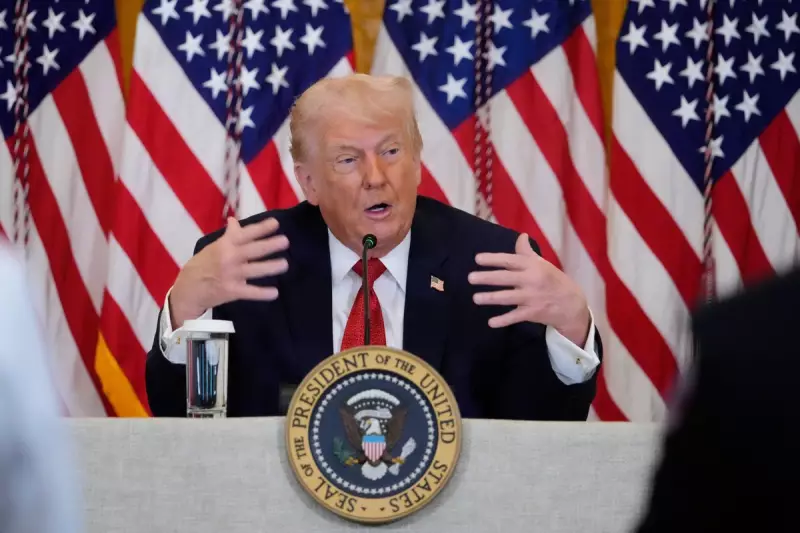
Market Turmoil Follows Trump's Tariff Ultimatum
US stock futures plunged sharply on Monday, 19 January 2026, following a stark warning from former President Donald Trump to levy additional tariffs on imports from eight European countries. The threat, a retaliatory measure for their opposition to a US takeover of Greenland, sent immediate shockwaves through financial markets and drew a swift, unified condemnation from European capitals.
European Allies Issue Forceful Joint Condemnation
The targeted nations—Denmark, Norway, Sweden, France, Germany, the United Kingdom, the Netherlands, and Finland—responded with a notably robust joint statement. They asserted that Mr Trump's threats "undermine transatlantic relations and risk a dangerous downward spiral." This marked the most forceful criticism from European allies since Mr Trump's return to the White House nearly a year ago.
On the markets, the future for the S&P 500 fell 0.9%, while the Dow Jones Industrial Average futures dropped 0.8%. Stephen Innes of SPI Asset Management commented that Trump's moves are testing the strategic alignment and institutional trust with Europe, the US's largest trading partner. "In a world where geopolitical cohesion within the Western alliance is no longer taken for granted, the willingness to recycle capital indefinitely into U.S. assets becomes less automatic," Innes said.

Global Markets React to Geopolitical and Economic Data
The ripple effects were felt in Asia, where shares traded mixed. China reported its economy expanded at a 5% annual pace in 2025, though growth slowed in the final quarter. Key Asian indices showed varied performance:
- Hong Kong's Hang Seng index lost 1.1%.
- The Shanghai Composite gained 0.3%.
- Tokyo's Nikkei 225 declined 0.7%.
- South Korea's Kospi jumped 1.3% to a record high.
This comes after a subdued close on Wall Street the previous Friday, where the S&P 500 and Dow industrials edged lower as the first week of earnings season concluded.
Investors are now scrutinising upcoming earnings from firms like United Airlines, 3M, and Intel for clues on consumer spending and business resilience amid persistent inflation and higher tariffs. All eyes are also on the Federal Reserve, which will receive a key inflation update this week with the release of the Personal Consumption Expenditures (PCE) price index—its preferred gauge. The Fed's next policy meeting is in two weeks.
In other early Monday dealings, gold prices resumed their upward climb, gaining 1.8%, while silver jumped 5.3%, signalling a flight to safe-haven assets. Oil prices saw modest adjustments, with US benchmark crude slipping to $59.06 per barrel.