Financial markets across Asia traded predominantly in the red on Tuesday, 20 January 2026, taking their cue from a sharp sell-off in Europe as former US President Donald Trump's renewed trade threats sparked fresh fears for global commerce.
Market Reaction to Trump's Tariff Warning
The downturn followed a turbulent Monday session in Europe, which occurred while US markets were closed for the Martin Luther King Jr. Day holiday. The trigger was a statement from Trump on Saturday, in which he declared an intention to impose a 10% extra tariff on imports from eight European countries starting in February. The nations targeted—Denmark, Norway, Sweden, France, Germany, the UK, the Netherlands, and Finland—were cited for their opposition to American control of Greenland.
European leaders swiftly condemned the move, arguing it "undermines transatlantic relations and risks a dangerous downward spiral." In early Tuesday trading, US stock futures pointed to significant losses, with the S&P 500 contract down 1% and the Dow Jones Industrial Average future falling 0.9%.

Political Turmoil Weighs on Japanese Markets
Japan's benchmark Nikkei 225 index dropped 1.1% to close at 52,988.24, pressured by domestic political uncertainty. Prime Minister Sanae Takaichi called a snap election for 8 February, aiming to capitalise on her strong approval ratings. Her proposals, including a temporary suspension of the food tax, have raised expectations of increased government spending.
This prospect has revived concerns over Japan's national debt, triggering a dramatic sell-off in government bonds. The yield on the 40-year Japanese government bond surged to a record 4%, with other long-term bond yields also hitting multi-decade highs. As bond yields rise, their prices fall, indicating heightened investor worry.
Mixed Picture Across Asia and Commodities
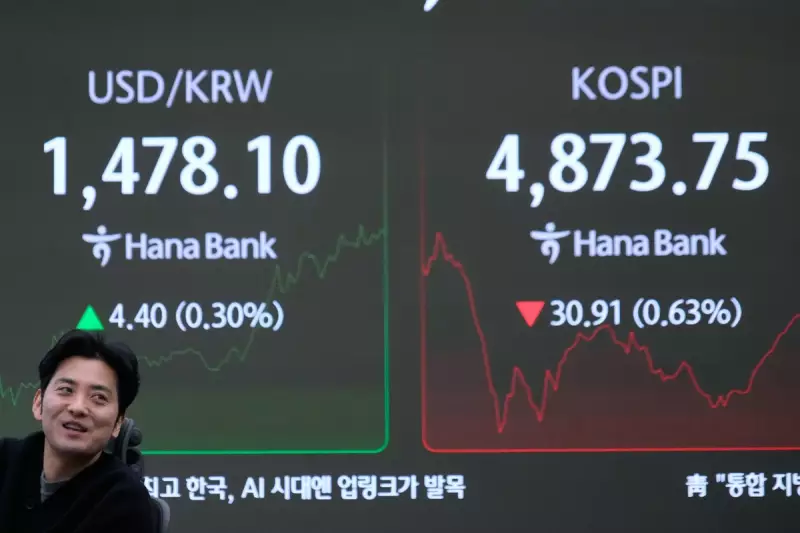
Other major Asian markets also struggled. Hong Kong's Hang Seng edged down less than 0.1% to 26,552.57, while the Shanghai Composite fell 0.3% to 4,101.62. Australia's S&P/ASX 200 lost 0.6%. South Korea's Kospi was a rare bright spot, gaining 0.3%.
In commodity markets, oil prices held relatively steady. US benchmark crude rose marginally by 4 cents to $59.38 per barrel, and Brent crude added 12 cents to $64.06. In currency trading, the US dollar slipped slightly against the yen to 157.98, while the euro gained ground to $1.1658.
Central Bank Watch and Ongoing Concerns
Investors are now looking ahead to a busy week for economic data and central bank activity. The US will see more corporate earnings and a key inflation update favoured by the Federal Reserve. The Fed's next policy meeting is in two weeks, where it is expected to hold interest rates steady as it navigates a slowing jobs market and persistent inflation above its 2% target.
The Bank of Japan also concludes a monetary policy board meeting later this week. The European market declines that set the tone were substantial: Germany's DAX lost 1.3%, France's CAC 40 fell 1.9%, and Britain's FTSE 100 declined 0.4% to 10,190.26.
The combination of geopolitical trade tensions and domestic political shifts continues to create a volatile environment for global investors, with many adopting a cautious stance.