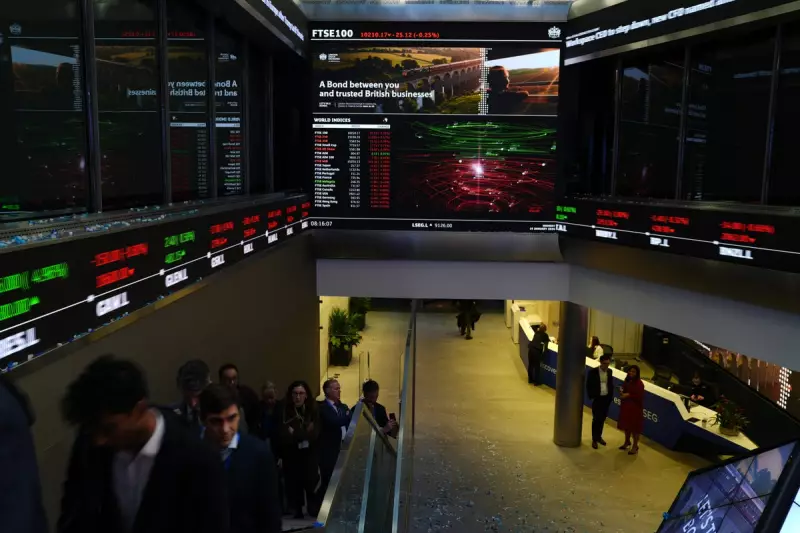
European and American equity markets experienced significant declines on Tuesday, as ongoing geopolitical tensions and a sharp sell-off in Japanese government bonds created a perfect storm of investor anxiety. The primary catalyst was the renewed threat of tariffs from US President Donald Trump, specifically targeting European nations unless Denmark agrees to cede control of Greenland.
Market Indices See Widespread Losses
The London stock market closed deeply in the red. The benchmark FTSE 100 index fell by 68.57 points, a decline of 0.7%, to settle at 10,126.78. The FTSE 250 mid-cap index mirrored this drop, losing 153.94 points, also 0.7%, to finish at 22,957.87. The AIM All-Share index closed down 2.35 points, or 0.3%, at 801.14.
Continent-wide, the situation was similarly bleak. In Paris, the CAC 40 closed down 0.6%, while Frankfurt's DAX 40 ended the session 1.0% lower. Across the Atlantic, Wall Street trading resumed after a public holiday to a sea of red screens. At the London close, the Dow Jones Industrial Average was down 1.3%, the S&P 500 had fallen 1.4%, and the Nasdaq Composite had faltered by 1.5%.

Trump's Tariff Ultimatum Sparks Diplomatic Row
The market unease was directly fuelled by comments from President Trump over the weekend. He declared that from February 1, Britain, Denmark, Finland, France, Germany, the Netherlands, Norway, and Sweden would face a 10% tariff on all goods exported to the United States. This punitive measure is contingent on Denmark refusing to cede Greenland to US control.
The announcement has triggered a fierce diplomatic backlash. European Commission President Ursula von der Leyen warned that Trump's actions risked plunging US-EU relations into a "downward spiral." French President Emmanuel Macron condemned what he called "unacceptable" threats and warned against American attempts to "subordinate Europe." Reports suggest European leaders are actively pondering countermeasures, including retaliatory tariffs and a coordinated strategy to offload US Treasury bonds.
Analysts Highlight Diverging European Responses
Market analysts noted a clear split in the European response. David Morrison, Senior Market Analyst at Trade Nation, observed, "Trade concerns are now front and centre. While UK Prime Minister Starmer pursues a softly-softly approach, insisting that jaw-jaw is better than war-war, President Macron favours a more aggressive stance and wants to fight US tariffs with European ones."
Morrison added that the potential use of the EU's Anti-Coercion Instrument has heightened market unease, particularly for export-heavy sectors like automotive and luxury goods.
Japanese Bond Market Sell-Off Adds to Global Jitters
Compounding the tariff-related worries was a dramatic sell-off in the Japanese government bond market. Kathleen Brooks, an analyst at XTB Research, highlighted that while the sell-off in long-end bond yields was a global phenomenon, the most severe move was witnessed in Japan.
The yield on the 30-year Japanese government bond surged by 26 basis points. Brooks pointed out that investors are fretting about the potential for an expansionary fiscal policy if PM Sanae Takaichi wins the upcoming election on February 8. "Japan is central to global capital flows," Brooks cautioned. "Disruption in Japanese financial markets could have a knock-on effect on global capital flows and overall risk sentiment."
She warned of the risk that the bond sell-off could cause "something to break," drawing a parallel to the Silicon Valley Bank crisis of 2023.
Currency and Commodity Movements
In currency markets, the pound strengthened slightly to $1.3462 at the London equities close, up from $1.3428 on Monday. The euro also gained ground, standing at $1.1733 compared to $1.1643. The dollar weakened against the yen, trading at 157.95 yen, down from 158.11.
In the commodities space, Brent oil traded at $64.89 a barrel, up from $64.13. Gold saw a more pronounced rise, quoted at $4,742.56 an ounce, up significantly from $4,671.76 on Monday.
UK Labour Market Data Shows Signs of Cooling
Domestic economic data released on Tuesday pointed to a cooling UK labour market. The Office for National Statistics reported the unemployment rate held steady at 5.1% for the three months to November, slightly above market expectations of 5.0%.

More notably, annual growth in regular earnings, excluding bonuses, slowed to 4.5% in the three months to November, down from 4.6% in the prior period. Analysts at Barclays stated, "Today's labour market data showed easing wage pressures, weak employment and rising redundancies. We judge this to be consistent with our view that the labour market continues to ease and has further to go in coming months."
Notable Stock Movers in London
Amid the broad market decline, several individual stocks posted significant moves. On the FTSE 100, Informa led the risers, gaining 4.6% after reporting strong fourth-quarter trading and raising its full-year revenue guidance.
On the FTSE 250, recruitment firms PageGroup and Hays fell 3.8% and 0.3% respectively, weighed down by the weak labour market statistics. In contrast, Funding Circle surged 14% after reporting stronger-than-expected revenue and profit growth for 2025. Similarly, Wise Group jumped 15% as analysts raised profit forecasts following robust third-quarter trading.
The biggest fallers on the FTSE 100 included Mondi, Beazley, and Pershing Square Holdings.
Looking Ahead to Wednesday
All eyes now turn to the World Economic Forum in Davos, where President Trump is scheduled to speak on Wednesday. Market participants will be scrutinising his tone for any sign of escalation or de-escalation in the trade standoff. "Escalation or softening in tone seems likely to set the direction for European risk assets in the days ahead," concluded David Morrison of Trade Nation.
The Wednesday economic calendar features key UK inflation figures and Canadian producer price data. Corporate updates are expected from Burberry, JD Sports, Currys, and JD Wetherspoon.