

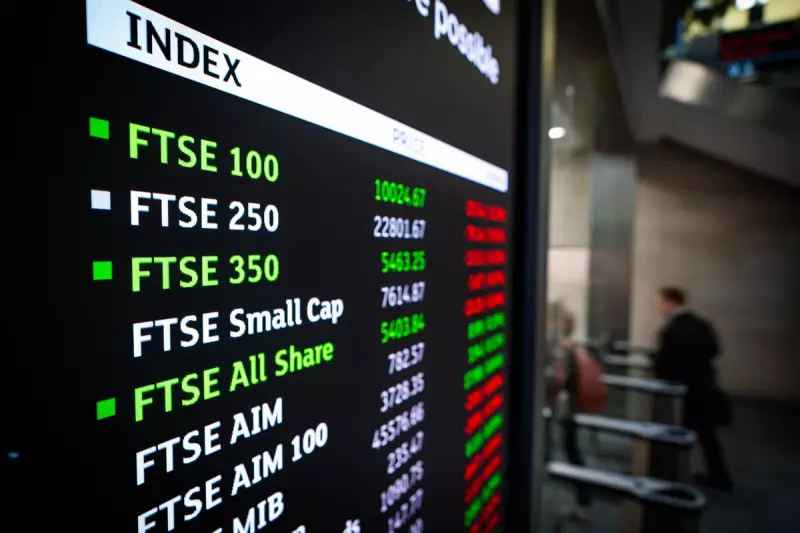
The FTSE 100 index made cautious gains on Monday, buoyed by a significant rally in mining stocks as precious metals prices soared to unprecedented levels. The blue-chip index closed up 5.41 points, or 0.1%, at 10,148.85, while the FTSE 250 added 34.13 points, or 0.2%, to reach 23,351.66. The Aim All-Share index also advanced, closing up 5.74 points, or 0.7%, at 828.49.
Mining Giants Lead the Charge
Miners were the standout performers on the FTSE 100, with Fresnillo, Antofagasta, and Endeavour Mining leading the risers. Fresnillo surged by 6.7%, Antofagasta climbed 5.3%, and Endeavour gained 4.0%. This robust performance was underpinned by remarkable strength in metals markets, particularly gold and silver.
Record-Breaking Precious Metals Rally
Gold prices reached a new record high, quoted at $5,095.11 per ounce on Monday, up from $4,984.07 on Friday. Meanwhile, silver experienced an explosive rally, leaping 10% and pushing well above the $100 per ounce milestone it had only recently breached. Russ Mould, investment director at AJ Bell, highlighted that bullion has more than doubled in value in less than 18 months, driven by central bank demand, global turmoil, dollar weakness, and the diminished appeal of other defensive assets.

Tom Stevenson, investment director at Fidelity International, described gold as the "ultimate risk-off safe haven," noting that investors have found plenty to worry about this year. He pointed out that with government bonds falling out of favour due to concerns about high global borrowing levels, gold has become the preferred choice for risk-averse investors.
Political Uncertainty and Dollar Weakness
The precious metals rally unfolded against a backdrop of increased political uncertainty in the United States. Wells Fargo noted that the odds of a US government shutdown starting on January 31 have risen sharply, with Polymarket traders pricing the probability at roughly 80%. This uncertainty, combined with speculation about potential intervention to support the yen, contributed to further dollar weakness.
ING reported widespread discussion late on Friday that the Federal Reserve had begun asking banks in New York about their position sizes in USD/JPY, akin to a "rate check." This activity has led to suggestions that the US might be on the verge of joint intervention with Japan to support the yen.
Currency Movements and Inflation Concerns
The pound strengthened to $1.3704 at the time of the London equities close on Friday, compared to $1.3567 on Thursday. The euro also gained ground, standing at $1.1884 against $1.1758. Against the yen, the dollar traded lower at 153.99 yen, down from 157.99 yen.
Kathleen Brooks at XTB noted that a stronger yen means a weaker dollar, which is inflationary for the US. While this could help inflate away some of the US debt pile, it may create significant challenges for the Federal Reserve. The central bank's meeting this week is expected to discuss yen intervention and the future of Fed independence.
Federal Reserve Meeting and Market Expectations
The Federal Reserve is widely expected to leave interest rates unchanged on Wednesday after three successive cuts. Analysts at Goldman Sachs described the January FOMC meeting as likely to be uneventful, with no change to the fed funds rate and only minor adjustments to the statement. Goldman anticipates the next rate cut will occur in June, followed by another in September.
European and US Market Performance
In European equities, the Cac 40 in Paris closed down 0.2%, while the Dax 40 in Frankfurt ended up 0.1%. In New York, financial markets were higher at the time of the London close, with the Dow Jones Industrial Average up 0.4%, and both the S&P 500 and Nasdaq Composite gaining 0.5%.
Government bond yields showed slight movements, with the yield on the US 10-year Treasury quoted at 4.22%, trimmed from 4.25% on Friday, and the 30-year Treasury yield at 4.81%, narrowed from 4.84%.

UK Inflation Expectations and Corporate Moves
Back in London, a report from Citi/YouGov showed that short-term inflation expectations increased in January. Year-ahead expectations rose to 3.8% from 3.6% on a single-month basis, reversing the last two months of prospective disinflation and reaching the highest level since October 2025. However, on a three-month rolling basis, year-ahead expectations fell to 3.7% from 3.8%.
On the FTSE 100, 3i fell 4.9% after RBC Capital Markets downgraded the stock to "underperform" from "sector perform." The broker expressed concerns that 3i's key investment, discount retailer Action, might face diminishing returns due to macroeconomic pressures and increased competition.
FTSE 250 Highlights and Commodity Prices
On the FTSE 250, Spire Healthcare surged 18% after confirming early-stage discussions for a potential buyout, with Bridgepoint Advisers and Triton Investment Advisers named as suitors. Ninety One soared 8.4% following an upgrade to "buy" from Bank of America, while Costain climbed 7.0% after striking a new agreement with its pension scheme trustees, paving the way for increased shareholder returns.
In commodity markets, Brent oil traded lower at $65.43 per barrel on Monday, down from $65.76 late on Friday.
Market Leaders and Laggards
The biggest risers on the FTSE 100 were Fresnillo, up 280.00p at 4,448.00p; Antofagasta, up 191.00p at 3,775.00p; Endeavour Mining, up 176.00p at 4,542.00p; Segro, up 22.40p at 752.00p; and Pershing Square Holdings, up 96.00p at 4,646.00p.
The biggest fallers were 3i, down 160.0p at 3,129.0p; Autotrader, down 19.4p at 549.0p; Experian, down 97.0p at 2,932.0p; BT Group, down 5.45p at 182.8p; and BAE Systems, down 54.0p at 1,973.0p.
Looking Ahead
Tuesday's global economic calendar features the start of the two-day Federal Open Market Committee meeting and US house price data. In the UK corporate calendar, trading statements are expected from accountancy software provider Sage, boot maker Dr Martens, and betting operator Evoke.





