

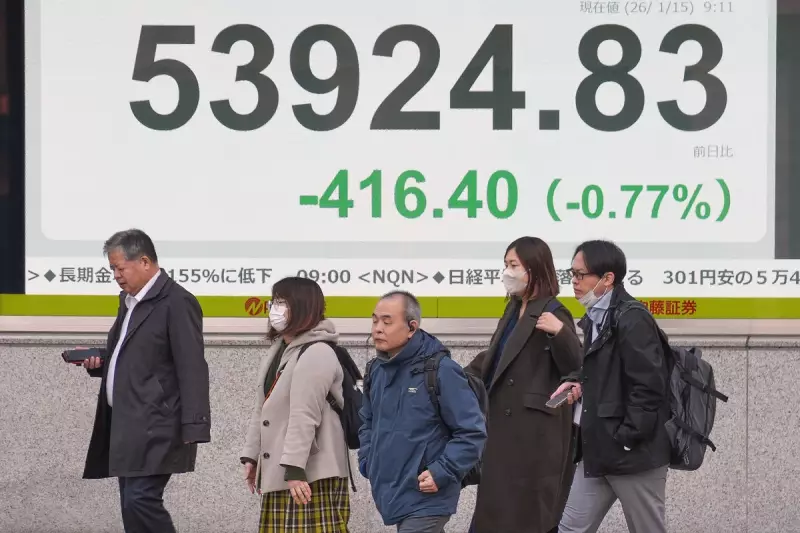
Stock markets across Asia traded predominantly lower on Thursday, 15 January 2026, while the price of oil plunged by more than $2 a barrel. The moves followed a retreat on Wall Street and comments from former US President Donald Trump regarding Iran's internal affairs.
Geopolitical Remarks Rattle Oil Markets
The energy sector saw significant volatility after Donald Trump stated he had been informed "on good authority" that plans for executions in Iran had been stopped. This came despite signals from Tehran of fast-track trials and executions amid a crackdown on protesters. In response, US benchmark crude oil fell by $2, or 3.3%, to $59.88 per barrel. The international standard, Brent crude, dropped by $2.12, or 3.2%, settling at $64.40 per barrel.
Asian Trading Session Sees Broad Declines
In regional equity trading, Japan's Nikkei 225 index slipped 0.9% to close at 53,863.84. Technology-related stocks were a particular drag on the market. Notable losses included a 5.6% fall for SoftBank Group, a 4.1% drop for testing equipment maker Advantest, and a 3.3% decline for chip manufacturer Tokyo Electron.

Hong Kong's Hang Seng index dropped 0.6% to 26,850.78. Shares of Chinese online travel giant Trip.com, listed in Hong Kong, collapsed by more than 20% after Beijing authorities announced an antitrust investigation into the company. Mainland China's Shanghai Composite also fell 0.6%, ending the session at 4,101.52.
South Korea's Kospi was a rare bright spot, gaining 0.5% to 4,747.85. Australia's S&P/ASX 200 climbed 0.3% to 8,851.00. Taiwan's Taiex fell 0.6%, even as its leading chip maker, TSMC, was anticipated to report strong quarterly profits later in the day.
Wall Street's Tech-Led Retreat Weighs on Sentiment
The negative tone in Asia followed a downbeat session on Wall Street. On Wednesday, the S&P 500 dipped 0.5% to 6,926.60, marking its second consecutive loss. The Dow Jones Industrial Average slipped 0.1% to 49,149.63, while the tech-heavy Nasdaq composite fell 1% to 23,471.75.
Big Tech stocks were a primary source of weakness, even as a majority of stocks on Wall Street rose. Investors appeared to be dialling back from the recent artificial intelligence frenzy, with some critics warning that valuations had become stretched. Shares of Nvidia declined 1.4%, while chip maker Broadcom fell 4.2%.
The banking sector also faced pressure. Wells Fargo sank 4.6% after reporting quarterly profit and revenue that missed analysts' expectations. Bank of America shares dropped 3.8%, and Citigroup slipped 3.3%.
Losses on the S&P 500 were tempered by gains in the energy sector, buoyed by earlier strength in oil prices. Exxon Mobil advanced 2.9% and Chevron rose 2.1%.
Investors Seek Safety Amid Uncertainty
Amid elevated geopolitical concerns, investors moved towards assets perceived as safer havens. The yield on the benchmark US 10-year Treasury note fell to 4.14%, down from 4.18% late Tuesday, indicating rising bond prices. The price of gold, after recent record levels, fell back by 0.8% on Thursday.
In currency markets, the US dollar strengthened slightly against the Japanese yen, trading at 158.63 yen compared to 158.46 yen previously. The euro edged lower against the dollar, trading at $1.1636.
AP Business Writer Stan Choe contributed to this report.






