Asian Markets Mostly Fall as Yen Surge Hits Japanese Exporters
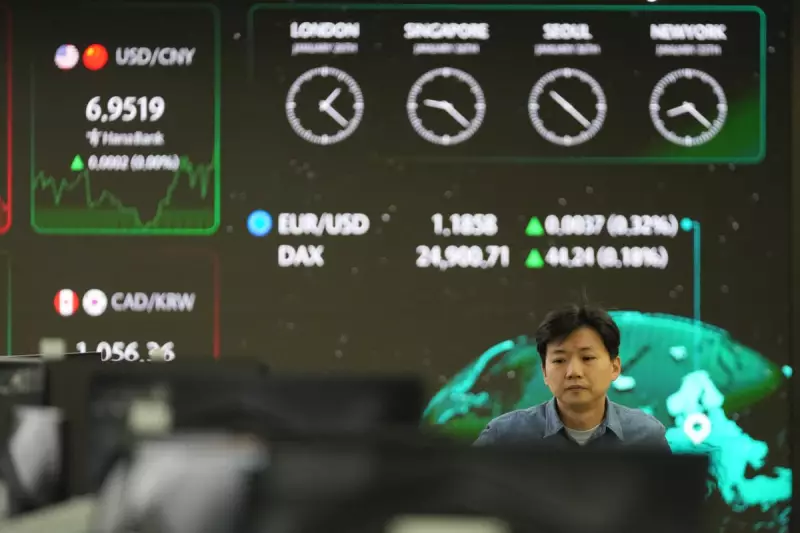
Asian shares experienced a predominantly downward trend on Monday, with Japan's benchmark index taking a significant hit following a sharp appreciation of the yen against the U.S. dollar. The currency movement triggered selling pressure on major export-oriented companies, contributing to broader market declines across the region.
Japanese Market Reacts to Yen Strength
Japan's Nikkei 225 index dropped by 1.9% to close at 52,812.45 points, driven by substantial selling of large exporters. Notably, shares in Toyota Motor Corporation fell by 3.2%, reflecting the adverse impact of a stronger yen on companies that rely heavily on overseas earnings. Typically, a weaker yen benefits Japanese exporters by boosting the value of their foreign income when converted back to the local currency.
In recent months, the dollar had been gaining ground against the yen, but this trend reversed sharply in the past few days. The shift occurred after officials from both Japan and the United States indicated their readiness to intervene in currency markets to support the yen. Consequently, the dollar slipped to 154.26 Japanese yen from 155.01 yen, having traded around 158 yen just last week.

Mixed Performance Across Asia
Elsewhere in the region, market movements were varied. South Korea's Kospi index dipped by 0.6% to settle at 4,961.58 points. Hong Kong's Hang Seng index inched down by 0.1% to 26,722.89 points, while the Shanghai Composite in China added 0.1% to reach 4,141.10 points. Trading was suspended in several major markets, including Australia, New Zealand, India, and Indonesia, due to local holidays or closures.
U.S. Futures and Trade Policy Concerns
U.S. stock futures edged lower, reflecting persistent uncertainty surrounding American tariff policies and other economic issues. Futures for the S&P 500 and the Dow Jones Industrial Average were both down by 0.3%. This cautious sentiment follows recent developments in international trade relations.
A threat by U.S. President Donald Trump to impose a 100% tariff on goods from Canada was met with a firm response from Canadian Prime Minister Mark Carney. Trump had warned of potential tariff hikes if Canada proceeded with a free trade agreement with China. Carney clarified that Canada has no plans for such a deal, aiming to alleviate tensions.
In 2024, Canada aligned with the United States by implementing a 100% tariff on electric vehicles from Beijing and a 25% tariff on steel and aluminum imports. China retaliated by imposing 100% import taxes on Canadian canola oil and meal, along with a 25% tariff on pork and seafood products.
Breaking with the United States earlier this month during a visit to China, Prime Minister Carney reduced Canada's 100% tariff on Chinese electric cars. This move was made in exchange for lower tariffs on those specific Canadian products, highlighting ongoing diplomatic manoeuvres in global trade.
Previous U.S. Market Session and Precious Metals
On Friday, the S&P 500 edged up by less than 0.1% to close at 6,915.61 points, yet it recorded a second consecutive week with a modest overall loss. The Dow Jones Industrial Average dipped by 0.6% to 49,098.71 points, while the Nasdaq composite rose by 0.3% to 23,501.24 points. Most stocks on Wall Street declined, with Intel notably weighing on the market after tumbling by 17%.
Attention now turns to the U.S. Federal Reserve, with its next opportunity to adjust short-term interest rates scheduled for Wednesday. Market expectations are that the central bank will maintain the current rate, holding steady amid ongoing economic assessments.
In early Monday dealings, benchmark U.S. crude oil rose by 2 cents to $61.09 per barrel, while Brent crude, the international standard, edged up by 3 cents to $65.10 per barrel. Gold gained 2% to nearly $5,100 per ounce, and silver jumped by 6.4% to approximately $108 per ounce. The value of precious metals has surged in recent months as investors increasingly seek relatively safe havens for their investments amid market volatility.