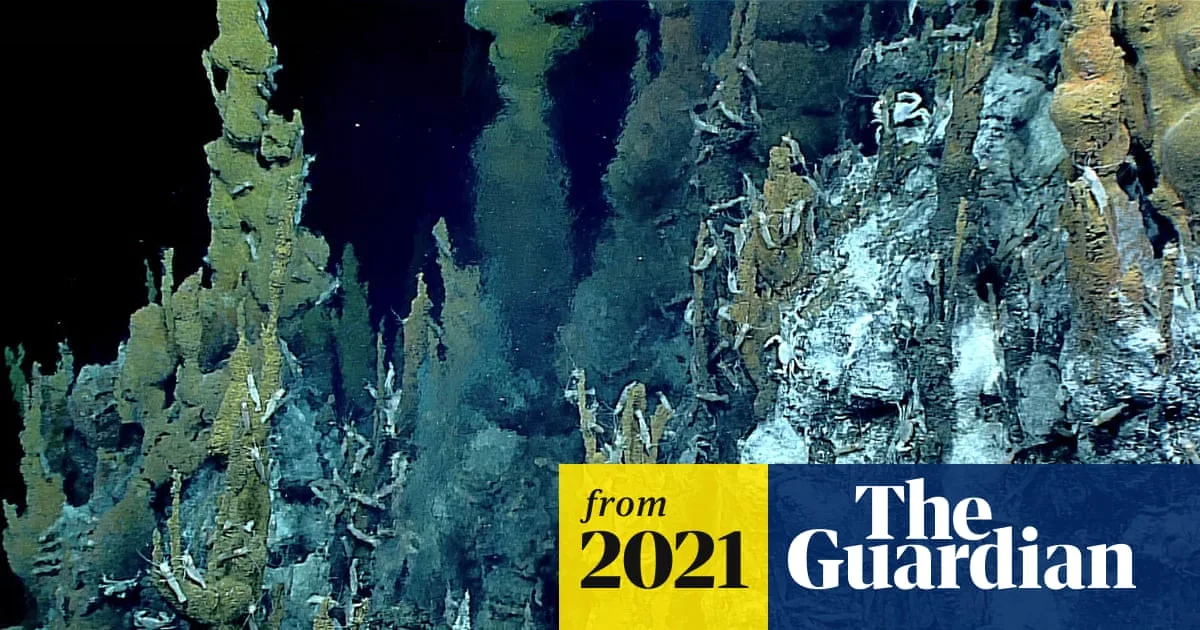
Rare species found around volcanic vents or seamounts on the ocean floor could be put at risk of extinction by deep-sea mining, scientists have found in a sweeping review of studies published over the last 50 years.
What is Deep-Sea Mining?
Deep-sea mining involves extracting minerals such as cobalt, nickel and copper from the seabed to supply resources for laptops, phones, weapons, green technologies, electric vehicle batteries and infrastructure. Extraction is currently not taking place at a commercial scale as policymakers, regulators and scientists scramble to understand the potential damage the practice could have on different habitats found on the ocean floor.
Review of Over 200 Studies
To help create a more cohesive picture, researchers from the Natural History Museum analysed more than 200 studies on the environmental impacts of deep-sea mining together for the first time, looking at what is currently known about their impacts on particular habitats. This included hydrothermal vents, which make up a tiny proportion of the ocean floor but are rich with copper – a mineral that is essential for the energy transition.
These “active” fissures on the seabed – usually near volcanic areas or tectonic plate boundaries – host rare ecosystems rich in unique species that can be found nowhere else. Studies have found that mining at these sites will likely lead to irrevocable biodiversity loss and put species at risk of extinction, according to the review.
Incompatibility with UN Biodiversity Targets
The scientists concluded that major disturbance at these sites would not be aligned with UN policies on protecting biodiversity, to which most nations have agreed, and which include the target to protect 30% of land and sea for nature by 2030. The researchers also said mining on seamounts, which have cobalt-rich crusts, could also not be compatible with the UN framework. While there is very little data on seamounts, the prevailing theory is that they also have unique species and vulnerable marine ecosystems that could be at risk from disturbance, they said.
Abyssal Plains and Unknown Risks
Mining exploration is also taking place on large flat areas of the seabed called abyssal plains, where cobalt and nickel-rich “nodules” can be found. Unlike active vents and seamounts, these areas are vast, covering over 50% of Earth’s surface, and are formed by thick layers of sediment in which thousands of species live. After reviewing the studies, the scientists said the risk of biodiversity loss at these sites from deep-sea mining remains largely unknown, but species could be widespread across ocean floors beyond those ringfenced for exploration.
Expert Commentary
Prof Adrian Glover, merit researcher at the Natural History Museum, who led the review, said: “Contrary to general thoughts that we don’t know anything about the impact of a mining machine and the sea floor, we do actually know quite a lot.” He said experiments over the years have produced useful data and that the findings are “not actually that surprising”.
“If you drive a six-to-10m wide giant vehicle over the seafloor … not surprisingly, you see decadal scales for any kind of recovery whatsoever. If you drive a large ploughing vehicle over a grassland habitat in the south-east of England it will take many decades to recover.”
While no more research is required to understand extraction’s damaging impact on active vents, Prof Glover indicated that species found across abyssal plains could be present beyond sections identified for mining but this is “extremely difficult to prove”, and introducing protected areas can help to mitigate the risk.
Mr Glover suggested the next steps would be to recognise that mining rare ecosystems would not be compatible with existing policy. “In other areas, such as polymetallic nodule regions, scientific data can support the creation and refinement of protected areas, helping policymakers determine whether mining could be considered sustainable,” he added.
Biodiversity in the Clarion-Clipperton Zone
Working alongside colleagues in the global scientific community, the Natural History Museum has been leading efforts to identify and describe as many deep-sea species as possible to better understand these ecosystems. In the Clarion-Clipperton Zone (CCZ), a six million square kilometre area of deep ocean between Hawaii and the west coast of Mexico which is being explored for mining, is estimated to be home to 6,000 to 8,000 species. But only around 436 have been named, with the Natural History Museum team describing more than 50, including a worm found living inside the nodules and two new species of hydrothermal vent tubeworm.
Mr Glover said making data on species and their DNA available “is critical to understanding the risks of biodiversity loss” across these habitats. For now, steps to mitigate the unknown risk to species in the CCZ has already been taken, with the international regulator protecting 30% of the area targeted for development. The teams say, however, that there remains little understanding of how well this protected system will work to prevent ecosystem damage because of a lack of data from these sites.