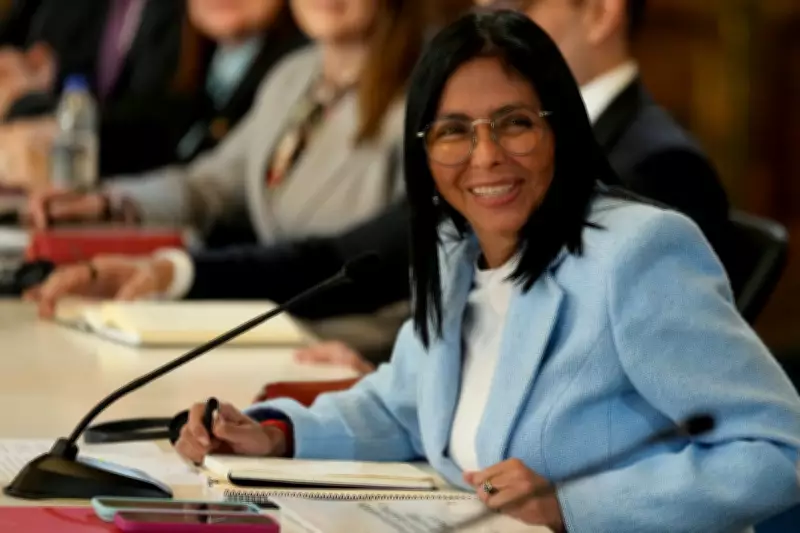
Venezuelan acting President Delcy Rodríguez has made a direct appeal to the nation's workforce, urging both public and private sector employees to exercise patience as her administration strives to implement economic improvements. The address, delivered during a nationally televised broadcast on Wednesday, comes at a critical juncture for a country grappling with profound financial instability.
A Promise of Incremental Relief
In her speech, Rodríguez formally committed to implementing a wage increase effective May 1, though she deliberately withheld specific figures regarding the adjustment. She emphasized that this forthcoming raise would be structured responsibly to mitigate the inflationary surges that have historically accompanied previous minimum wage hikes in Venezuela.
"This increase, as we have indicated, will be a responsible increase," Rodríguez stated authoritatively. "Likewise in the near future, as Venezuela enjoys more resources that allow for the sustainability of salary improvements and workers’ income, we will continue moving forward on this path."

The Stark Reality of Venezuelan Wages
The context for this announcement is one of extreme economic hardship. Many public sector workers currently subsist on approximately $160 per month, while the average private sector employee earned only about $237 throughout the previous year. The official monthly minimum wage remains frozen at a mere 130 bolivars, equivalent to just $0.27, a rate that has not been adjusted since 2022.
This places Venezuelan workers far below the United Nations' threshold for extreme poverty, defined as living on less than $3 per day. The wage stagnation has rendered basic necessities increasingly unaffordable for the majority of the population.
Hyperinflation and Economic Pressures
Compounding the wage crisis is Venezuela's astronomical inflation rate. According to International Monetary Fund estimates, the country's inflation currently stands at a staggering 682%, the highest figure recorded for any nation in their dataset. Recent data released by Venezuela's central bank—the first such disclosure since November 2024—revealed that the annual inflation rate for 2025 soared to 475%, a dramatic increase from the 48% recorded the previous year.
This hyperinflationary environment has precipitated a sharp escalation in living costs, particularly for food items, placing them beyond the financial reach of many Venezuelan families.
Timing and Calls for Unity
Rodríguez's televised appeal was strategically timed, occurring just one day before planned worker demonstrations in the capital city of Caracas, where labor groups were expected to protest and demand immediate wage improvements. In her address, the acting president acknowledged that meaningful economic change would not materialize overnight.
She called for collective effort, urging both employees and employers across all industries to collaborate with her government "to begin a sustained recovery and maintain this path of growth." Rodríguez framed this collaborative approach as essential for national progress, stating, "It must be done with prudence, with awareness, with patience, but with a profound spirit of optimism about what the future holds for Venezuela."
The acting president's message represents a delicate balancing act: offering immediate hope through the promised May wage adjustment while managing expectations about the gradual nature of economic recovery in a nation facing one of the world's most severe financial crises.