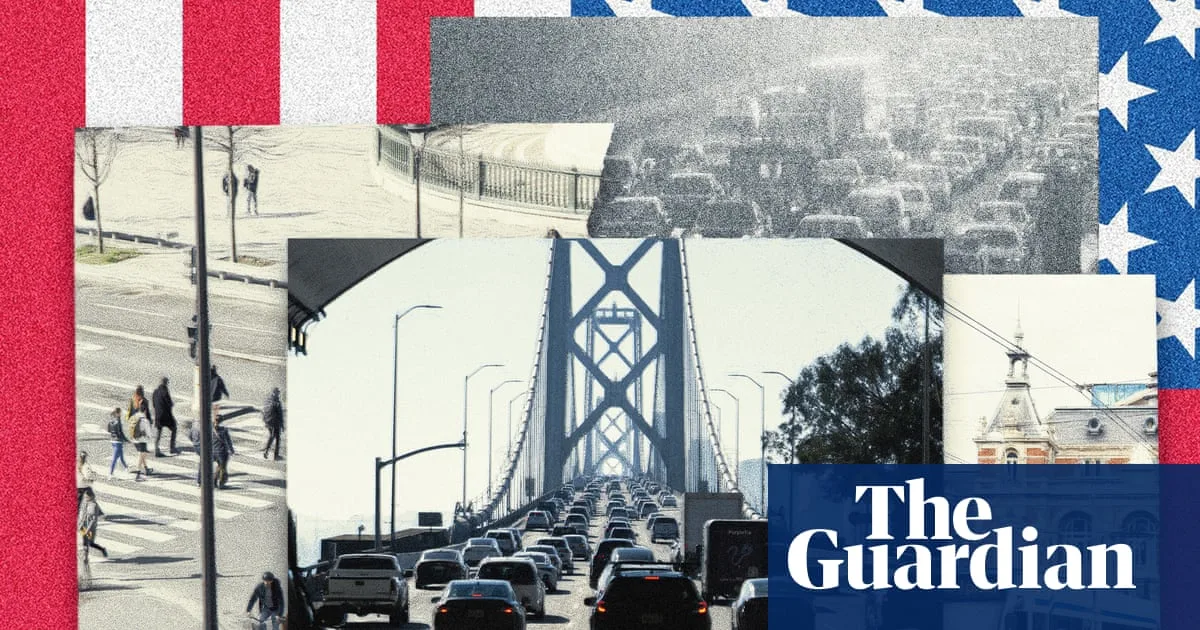
US Public Transit Lags Behind Global Peers, $4.6 Trillion Needed
US Public Transit Lags, $4.6 Trillion Needed to Catch Up

To catch up with other major cities around the world, the United States would need an enormous investment in public transportation. A recent report found that bringing major American cities up to 'world-class' status would cost an estimated $4.6 trillion over the next 20 years, requiring 7,500 miles of new dedicated infrastructure for trains and buses.

Stark Contrasts in Transit Provision

The only train station in Houston, the fourth-largest city in the US and one of the fastest-growing conurbations, is a diminished sight. Intercity trains arrive at a squat, shed-like Amtrak building three times a week, serving a metropolitan area of about 7 million people. This stark symbol illustrates how car-dominated US cities have fallen behind global peers with extensive, high-quality public transport.

American cities languish badly compared with global leaders such as Sydney, Hong Kong, and Barcelona, based on the number of transit vehicles per 100,000 residents, according to the Transportation for America study. Houston has just 16 transit vehicles per 100,000 people via its bus and light rail system, compared with 118 in Paris – a city with a similar population that has embraced cycling and walkability. Detroit has eight, Indianapolis has seven, and Oklahoma City has just six. Frisco and McKinney, a combined urban area of 500,000 people near Dallas, has none at all. By comparison, Vienna has 120 buses and trains per 100,000 residents, while Montreal has 107.

Wide Pickt banner — collaborative shopping lists app for Telegram, phone mockup with grocery list

Only New York Nears World-Class Standards

Only New York City, boasting the premier subway system in the US, approaches world-class standards, but still has fewer transit vehicles proportionally than Tehran. Ridership per capita in New York lags below that of Bengaluru, Santiago, and Warsaw, according to a separate 2023 study. Across the world, large disparities exist: east Asian cities like Hong Kong and Taipei rank highly, while several big African cities such as Johannesburg and Lagos struggle. Within Europe, there is a gap, too – cities such as Moscow and Budapest perform well, while Lisbon lags.

Car Dependence vs. Public Transit

Car dependence permeates rural regions in Europe, but most major cities are served by public transport networks that stretch deep into the suburbs. In recent years, densely populated capitals such as London and Paris have taken steps to catch up with frontrunners like Copenhagen, Amsterdam, and Vienna, where cars account for fewer than one in four journeys. Unlike in much of Europe, people in the US often have little choice but to rely on cars. Those unable to drive due to age, disability, or rising costs face a laborious gauntlet of patchy public transport options.

'Essentially, you are forced to live like a second-class citizen without a car,' said Kari Watkins, a transit expert at the University of California, Davis. 'It will take you twice as long to get anywhere, and it probably won’t be a nice experience.'

Funding Priorities Misaligned

While the $4.6 trillion needed appears astronomical, it pales compared with the $6.3 trillion the US will spend on highways over the next 20 years, Transportation for America points out. Transportation funding invariably means road funding in the US, with about 80% of all federal transport dollars going towards highways. 'Steering just a portion of highway funding to public transit would be transformational for the economy,' said Corrigan Salerno, policy manager at Transportation for America.

Decades of decisions have led the US to this place. Since the interstate highway system was started in the 1950s, vast roads have laced the country, plowed into the heart of cities, severing communities and attracting traffic. While other countries zipped ahead with high-speed rail, the US opted to link cities by highways and air travel. Zoning laws separated amenities from places people live, resulting in sprawling suburbs that lack density where public transit works best.

Pickt after-article banner — collaborative shopping lists app with family illustration

Costs of Car Fixation

American cities break from a pattern seen elsewhere: when they expand, they don’t add new public transit, with trains and buses accounting for just 1.5% of total trips taken in the US. The cost of this car fixation is high – about 40,000 people a year die in car crashes, and drivers spend hundreds of billions of dollars while emitting fumes that sicken those nearby and overheat the planet. Globally, transportation accounts for about a third of all planet-heating emissions, with the sector’s emissions doubling since 1990.

Political Headwinds

While advocates have pushed for more walkable, transit-available cities, the period since the pandemic has ravaged public transportation. Revenues for public transit systems nosedived as Covid-19 spread and struggled to rebound as more people switched to working from home. The Trump administration has turned sharply against public transport, depicting the New York subway as a nest of crime and attempting to kill off the city’s congestion charge. A spokesperson for Sean Duffy, the US secretary of transport, focused on safety, saying, 'Secretary Duffy is focused on making public transit safer for American families.'

The administration has also attempted to slash federal transit funding and axed support for planned high-speed rail projects in California and Texas. Currently, there is no train between Dallas and Houston, despite the uncomplicated route – instead there is an infrequent Amtrak train from Houston to San Antonio, a trip that takes about five hours (a similar distance is covered in half the time between London and Paris).

Hope Amid Challenges

Polling shows most Americans would like better public transport options to help spend less time sitting in gridlocked traffic. Even in Harris county, home to Houston, voters approved a big upgrade to its Metro light rail and rapid bus system in 2019. That plan has since been wound back by Houston’s mayor, who has taken to ripping up cycling and bus lanes, but the city still has an impressive, speedy light rail system at its heart. This network will be ramped up in the summer when Houston hosts World Cup games and is inundated with fans from overseas.

Peter Eccles has lived without a car for a decade in Houston and admits some people are shocked. 'I don’t think I’ve converted anybody to sell their car, but I’ve been able to explain how much money it’s saved me and how it’s removed a lot of stress from my life,' he said. The World Cup will be an opportunity for 'more Houstonians to find out that they like public transit very much and they’re going to expect that level of service to continue.'

Like in many US cities, traveling beyond downtown without a car becomes more challenging and can involve waiting with little shelter beside huge highways for several connecting buses that arrive frustratingly infrequently. Houston would need to increase its fleet of buses and trains by 435% to have comparable levels of public transit with many European cities, the report found. 'This isn’t the best experience,' Eccles acknowledged as he got off the bus and was faced by an eight-lane highway with no pedestrian crossing. 'OK, we are just going to have to cross here, quickly.'