

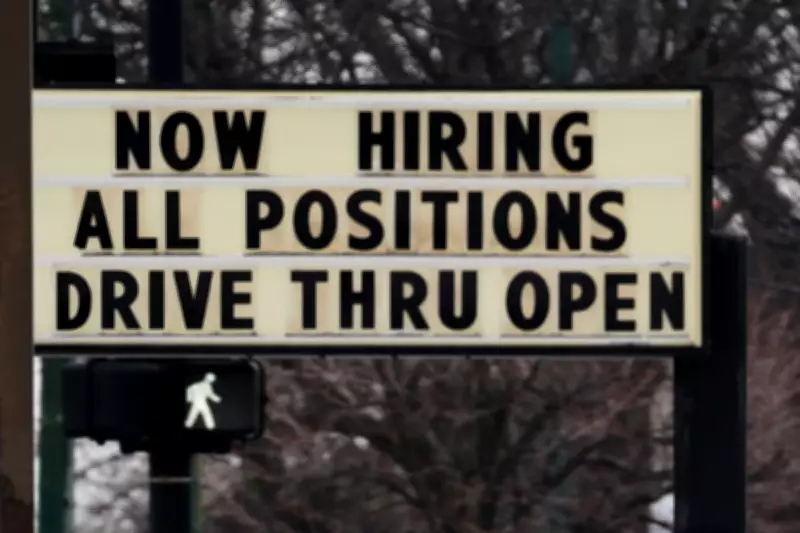
US Economic Boom Fails to Ignite Robust Job Market Growth
The United States economy is currently experiencing a period of remarkable expansion, yet this vigorous growth has not translated into a corresponding surge in employment opportunities. This puzzling disconnect between economic performance and labour market vitality is raising significant questions among analysts and policymakers alike.
Disappointing Employment Figures Amid Economic Strength
According to forecasts from data firm FactSet, the Labor Department is expected to report that American employers added approximately 75,000 positions during January. While this represents an improvement from December's modest 50,000 job additions, it remains inconsistent with the broader economic picture and falls well short of the hiring boom witnessed just a few years ago.
More concerning still, these January numbers are likely to be overshadowed by substantial downward revisions to 2025 employment data. Preliminary estimates suggest these revisions could erase nearly 911,000 jobs from the year ending March 2025, with economists anticipating significant reductions when final benchmark revisions are released.

Multiple Factors Contributing to Labour Market Weakness
The job market's persistent sluggishness reflects several converging factors. The lingering impact of elevated interest rates continues to constrain hiring, while uncertainty stemming from former President Donald Trump's unpredictable trade policies has left many businesses hesitant about future economic conditions.
Additionally, billionaire Elon Musk's extensive purge of the federal workforce last year has contributed to employment challenges. These elements combine to create an environment where economic growth fails to generate proportional job creation.
Concerning Indicators Preceding Official Report
Several troubling employment indicators have emerged in advance of Wednesday's official report. Employers posted just 6.5 million job openings in December, representing the lowest figure in over five years. Payroll processor ADP reported that private employers added a mere 22,000 jobs in January, substantially fewer than economists had predicted.
Furthermore, outplacement firm Challenger, Gray & Christmas documented that companies eliminated more than 108,000 positions last month, marking the most significant January job cuts since 2009. Several prominent corporations announced substantial layoffs, including UPS cutting 30,000 jobs, Dow eliminating 4,500 positions through increased automation and artificial intelligence implementation, and Amazon ending 16,000 corporate roles in its second major workforce reduction within three months.
Stark Contrast Between GDP Growth and Employment
The labour market's underperformance stands in stark contrast to the broader economy's robust expansion. From July through September, America's gross domestic product surged ahead at a 4.4% annual pace, representing the fastest growth rate in two years. This followed solid 3.8% growth from April to June, driven by strong consumer spending, rising exports, and declining imports.
Economists are now grappling with whether job creation will eventually accelerate to align with this strong economic growth, potentially as tax cuts translate into increased consumer spending through larger tax refunds. Alternative scenarios suggest GDP growth could slow to match the weak labour market, or that advances in artificial intelligence and automation might enable economic expansion without substantial job creation.
Significant Data Revisions Complicate Analysis
Current Labor Department figures indicate that US employers added an unimpressive average of 49,000 jobs monthly throughout 2025, a dramatic decline from the 400,000 monthly average during the 2021-2023 hiring boom. However, these already lacklustre numbers are expected to be revised downward significantly when the government releases annual benchmark adjustments.
Bank of America economist Shruti Mishra believes additional revisions reflecting business openings and closures likely reduced job creation by 20,000 to 30,000 positions monthly from April 2025 onward. Federal Reserve Chair Jerome Powell has suggested current numbers may overstate job creation by approximately 60,000 positions each month.

Stephen Brown of Capital Economics noted that these combined revisions could indicate the American economy actually lost jobs during 2025, which would represent the first annual decline since the pandemic lockdown year of 2020.
Unemployment Rate Provides Alternative Perspective
As hiring data becomes increasingly muddled by revisions, the unemployment rate offers a clearer gauge of labour market conditions. Mishra anticipates the rate remained low at 4.4% in January, despite recent high-profile layoffs.
This apparent contradiction between weak hiring and low unemployment partially results from former President Trump's immigration restrictions reducing foreign-born competition for available positions. Consequently, the number of new jobs needed to prevent unemployment from rising has plummeted from approximately 250,000 in 2023 to as low as 20,000 currently, according to Brookings Institution researchers.
Mixed Implications for American Workers
The combination of sluggish hiring alongside low unemployment creates a complex employment landscape. Most American workers currently enjoy reasonable job security, but those seeking employment—particularly young people competing with artificial intelligence and automation at entry levels—often face significant challenges securing positions.
This economic paradox continues to perplex analysts as they monitor whether job creation will eventually align with robust GDP growth or whether fundamental structural changes in the economy have permanently altered the relationship between economic expansion and employment generation.





