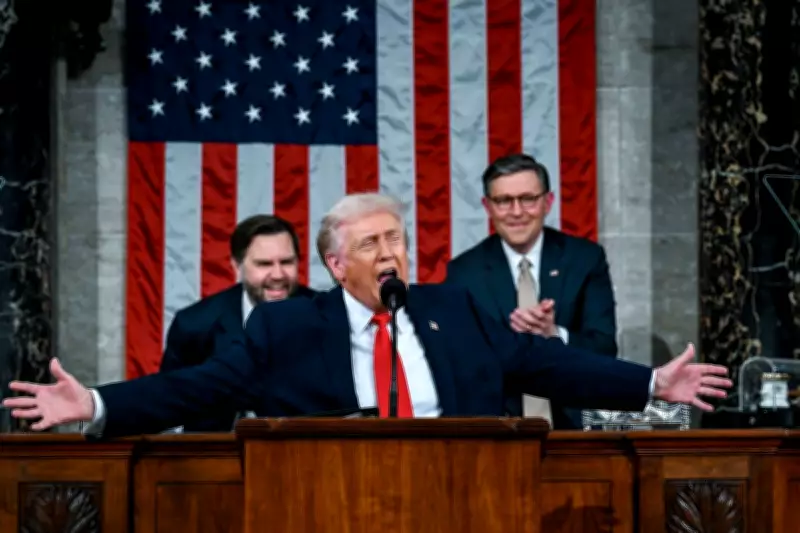
In a significant policy announcement during his State of the Union address this week, President Donald Trump revealed plans for a new federal retirement savings initiative aimed at American workers currently lacking access to employer-sponsored 401(k) plans. The proposal, which could reshape retirement planning for millions, includes a government match of up to $1,000 annually on individual contributions.
A New Retirement Option for Forgotten Workers
"I'm announcing that next year my administration will give these oft-forgotten American workers, great people, the people that built our country, access to the same type of retirement plan offered to every federal worker," Trump declared during his Tuesday evening speech. "We will match your contribution with up to $1,000 each year."
The announcement targets employees who don't receive 401(k) benefits through their workplace, potentially offering them a federally-administered alternative. While specific details remain limited, a Trump administration spokesperson later clarified to CNN that the proposed plans would feature universal eligibility and portability - meaning accounts could seamlessly transition between employers without requiring complex rollover procedures.

How This Compares to Existing Retirement Options
Currently, workers without employer 401(k) access typically rely on Individual Retirement Accounts (IRAs) for their retirement savings. According to investment expert Chris Carosa, who has two decades of financial industry experience, "Workers have always had the option to place their retirement savings into their personal IRAs. Relatively recent IRS restrictions have made it difficult to qualify to do this if you already have a 401(k) plan, but those without 401(k) plans have had no restrictions."
Twelve states have already implemented various forms of state-sponsored IRAs, including California, Colorado, Connecticut, Delaware, Illinois, Maine, Maryland, Massachusetts, New Jersey, Oregon, Virginia, and Washington, as reported by payment processor Paychex. However, these state programs typically don't include employer or government matching funds, unlike Trump's proposed federal plan.
The Portability Advantage
One significant distinction between traditional 401(k)s and IRAs lies in their portability. Traditional 401(k) accounts are typically employer-managed, requiring administrative paperwork and potential complications when changing jobs. In contrast, IRAs are opened in an individual's name, allowing them to maintain the account regardless of employment changes.
Carosa expressed particular appreciation for the portability feature suggested in Trump's proposal. "This could be structured so that it is no different than current state-sponsored IRAs," he explained. "By making the account in the employee's name rather than the company's name, it wouldn't matter who the employee works for. Think of it as 'auto-portability.'"
Unanswered Questions and Expert Advice
Despite the announcement, numerous details about the proposed federal 401(k) program remain unclear. The Trump administration spokesperson indicated that more information would be released "soon," but experts caution that without specific terms and conditions, it's impossible to determine whether these government-sponsored plans would be superior to existing alternatives.
Carosa emphasized that workers shouldn't delay retirement savings while awaiting potential government programs. "Don't wait. Open up an IRA and start saving now," he advised. "If a future federally-sponsored plan is created that offers matching (i.e., free money), do that first, then contribute to your personal IRA."
For self-employed individuals, several retirement options already exist, including SEP IRAs, self-employed 401(k)s, and SIMPLE IRAs, according to financial services firm Fidelity. These alternatives provide retirement planning pathways for those operating outside traditional employment structures.
The proposed federal retirement initiative represents a potentially significant expansion of government involvement in personal retirement planning, though its implementation details, funding mechanisms, and ultimate impact on American workers' retirement security remain to be fully revealed as the administration develops the program further.