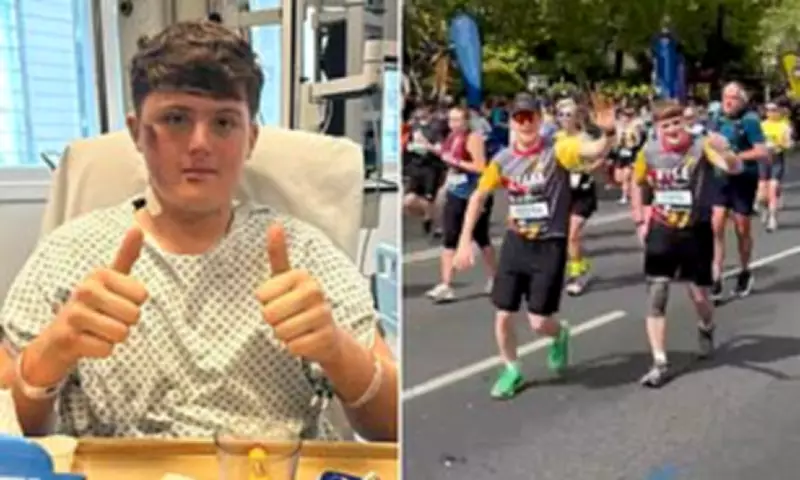
Few 17-year-olds leave home on a Friday expecting their evening to end with a police escort to hospital. Even fewer could recover from their heart stopping for 13 minutes to complete a marathon within 18 months. Indeed, Mike Angland is one of very few.
As he crossed the finish line by Buckingham Palace on Sunday, Mike's effort had raised almost £19,000 through his GoFundMe page for the air ambulance team that saved his life.
The Accident
The apprentice plumber, now 18, had been with friends in Wembley, north-west London, on the evening of November 15, 2024, and was travelling with a group to a party in Watford, Hertfordshire. Their Metropolitan Line train terminated at Moor Park station and Mike made a dash for the toilet before the next service. As he ran from the train on one side of the platform, he tripped and fell off the other onto the tracks.

'I came off the train on one side and fell face-first on to the one opposite,' he told the Daily Mail. Mike fell onto the live third rail, which carries 750 volts of electricity: 'easily enough to kill you' according to Network Rail. The rail is designed to power trains passing above, but falling on it means the body conducts electricity 'to a level which is sufficient to give an electric shock that can kill you or give you severe burns'.
Rescue and CPR
Dara Peyton, a 24-year-old electrician who was on the train with Mike, jumped down after him and pulled him off the track within seconds of his fall. Essex and Herts Air Ambulance crew would later reflect on how vital such quick action had been. 'They basically said if he didn't pull me off in that time, I wouldn't be alive,' Mike said. 'Dara knew that it would be dangerous to touch my skin, so he grabbed my jacket and pulled me up.'
Daniel McCasey, 24, also climbed down to the track and helped return Mike to the platform. At that point the group began CPR - quantity surveyor Tommy Goonan, 25, had taken a first aid course two days before through his employer. 'Tommy knew exactly what to do and I think he was guiding everyone on how to do it,' Mike said. The three men who saved Mike have since been recognised by the Royal Humane Society, of which King Charles is patron.
Mike received CPR in ten-second bursts, punctuated with mouth-to-mouth, for 13 minutes before an ambulance arrived. His heart was not beating throughout that period. Paramedics used the station's defibrillator when they arrived - it restarted Mike's heartbeat but not at the correct rhythm. Some 18 minutes after his fall the air ambulance crew reached Mike, having landed on Moor Park Golf Course two minutes earlier.
Hospital Recovery
Their defibrillator stabilised his heart but he was too ill to be airlifted and was instead driven in the ambulance to St Mary's Hospital, Paddington, accompanied by a police escort, such was the severity of his condition. He was placed into an induced coma over the weekend and has no memory of working on the day he fell or of waking up in hospital. 'I spent the whole day working and I can't remember a thing the whole day. Not a memory of anything at all. Obviously my parents and my family were scared: what if I wake up and I'm not the same?'
After waking from the coma Mike had temporary short-term memory loss. 'I literally couldn't remember a thing and I kept asking the same questions. My memory loss was really bad, even when I got home, I just couldn't remember people's names.' But after a couple of weeks in bed his memory returned - he then had a full-body MRI scan which came back clear.
Meeting the Crew and Marathon Training
After making a full recovery he visited the air ambulance base to meet the crew who saved his life: Dr Chris Cann, Dr Niall Owens and paramedic Chris Keeliher. Mike said: 'They told me: "We remember everything because of how serious your thing was, not many people survive falling on the train tracks."' They told Mike the next train was three minutes away when he fell - electricity in the tracks intensifies as a train approaches so if it had been nearer, Mike may have suffered a more intense shock. 'I'm lucky again,' Mike said.

The air ambulance crew said it was 'really good' to see patients after cases like his 'because normally they don't survive the shock that they get'. After learning about the crew's work Mike applied with his brother Liam to run the marathon in London to raise money for them - each callout costs around £2,800 funded entirely through charitable donations. Mike and Liam were two of five runners raising money for the charity on Sunday - all three others ran in memory of someone they had lost.
'It just shows how lucky I am,' Mike said. He began training for the marathon in November - a year after the accident - and has run an average of 80km a month since January.
Finish Line and Fundraising
As Mike and Liam crossed the finish line Charlotte Evans, senior fundraising co-ordinator at Essex & Herts Air Ambulance, told the Mail: 'I'm so impressed by anyone who would run a marathon but it's particularly special to see a former patient like Mike taking on this challenge after all he's been through. It was amazing to see him and Liam at mile 23 with smiles on their faces. We are all so proud of Mike, Liam and all our marathon runners who have raised an incredible amount between them. As a charity we rely solely on donations to keep our helicopters flying so efforts like this make all the difference.'