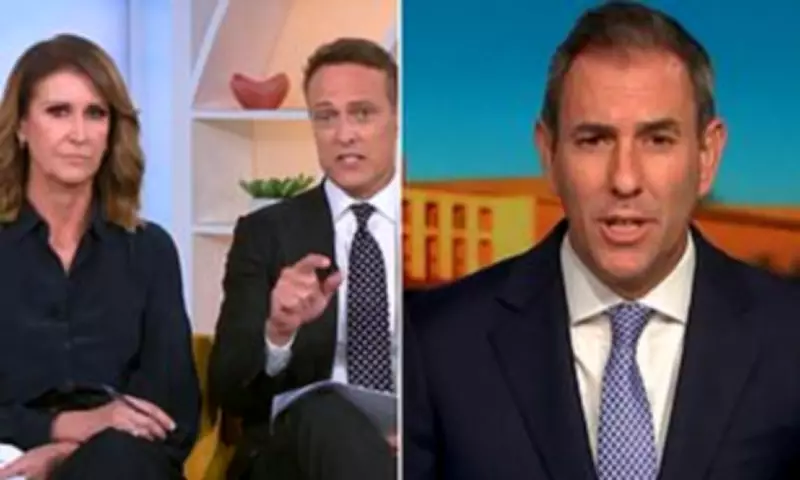
Sunrise Hosts Confront Treasurer Over Inflation Remarks Ahead of RBA Decision
Sunrise presenters Nat Barr and Matt Shirvington have launched a pointed critique of Treasurer Jim Chalmers, following economic analysts who have identified government expenditure as a probable contributor to escalating inflation rates.
Chalmers addressed journalists on Tuesday morning, preceding the Reserve Bank of Australia's scheduled meeting where an increase in interest rates is widely anticipated.
Heated Exchange Over Past Inflation Statements
During the interview, Shirvington directly questioned the Treasurer on comments he made in June, where Chalmers asserted that "the worst of the inflation challenge is well and truly behind us." The host queried whether this declaration was "a bit irresponsible," given the current economic climate.

"People are making decisions based on statements you make," Shirvington pressed. "You frequently discuss responsible fiscal policy, yet that remark appears somewhat irresponsible now, considering the challenges we currently confront."
In response, Chalmers stood by his earlier assessment, maintaining that the peak of the inflation crisis occurred in 2022.
"My statement at that time was absolutely and objectively accurate," the Treasurer argued. "The most severe inflation we experienced in recent years was in 2022, shortly after we assumed office. Inflation was galloping at a rate beginning with six, eventually peaking at 7.8 percent that year."
Defending Fiscal Policy Amid Economic Pressure
Chalmers further rebutted criticisms from economists suggesting that government spending has fuelled the recent inflationary spike.
"There is no unanimous consensus among economists regarding the primary drivers behind the latest inflation increase," he stated. "Examining the data reveals that this recent uptick is largely attributable to holiday expenditure, the conclusion of energy rebates, and ongoing issues within the housing sector."
He acknowledged the presence of both temporary and persistent factors influencing inflation, conceding that "people are under significant pressure."
Barr interjected, highlighting a broader international comparison: "Jim, other nations have also experienced holiday periods. Australia now reportedly has the highest inflation in the developed world. What specific missteps are occurring?"
Chalmers countered by emphasising Australia's relative economic strengths, noting "lower unemployment than most comparable countries and faster economic growth than all except the United States."
Imminent Rate Hike and Financial Implications
Financial markets are bracing for action, with derivatives trading on the Australian Securities Exchange indicating a 72 percent probability of a rate increase on Tuesday. Expectations suggest the RBA may raise its cash rate target from 3.6 percent to 3.85 percent.
Should this occur, the RBA would become the sole major central bank globally to reverse course and implement monetary tightening to curb inflation.
The potential hike carries substantial consequences for homeowners. If banks fully pass on the increase, mortgage holders with an average new home loan of $694,000 could see monthly repayments rise by approximately $109, reaching $4,025. Economists warn this could accumulate to around $1,300 in additional repayments over the next twelve months.
Expert Predictions and Future Outlook
Macquarie University economics specialist Geoff Kingston anticipates the RBA may need to implement two rate increases this year to effectively combat inflation, citing robust government spending as a key factor.
This view is echoed by analysts from several major financial institutions, including NAB, Citi, RBC Capital Markets, UBS, and Barrenjoey Markets, who have also forecast a potential second hike later in the year.
The Reserve Bank of Australia is scheduled to outline its monetary policy decision at 2.30pm AEDT on Tuesday, a announcement that will be closely scrutinised by markets and households alike.