

Lebanon's Gold Reserves Spark Debate Amid Economic Crisis and Soaring Prices
Cash-strapped Lebanon finds itself sitting on a gold mine as precious metal prices surge dramatically. The tiny nation holds one of the largest gold reserves in the Middle East, with its government now weighing whether to use that substantial stockpile to restore a crippled economy. Meanwhile, Lebanese citizens are increasingly looking at gold as a way to revive their battered finances and protect their remaining assets.
The Economic Backdrop: A Nation in Crisis
Lebanon's economy hobbled into 2026 with ongoing inflation, state decay, and no meaningful reforms to combat corruption in sight. The country's banking system collapsed in late 2019 during a crippling fiscal crisis that evaporated depositors' savings and plunged approximately half of its 6.5 million population into poverty. This disaster followed decades of rampant corruption, waste, and mismanagement that left deep scars on the nation's financial stability.
The country suffered staggering losses totaling about $70 billion in its financial sector, further compounded by approximately $11 billion in damages from the 2024 war between Israel and the Hezbollah militant group. These compounded crises have created one of the most challenging economic environments in the Middle East, with citizens struggling to maintain basic living standards.

Gold Prices Reach Historic Highs
The price of gold recently soared to an unprecedented all-time high of $5,354 per ounce before dropping back below $5,000. This remarkable surge has been sparked by geopolitical instability and questions surrounding U.S. President Donald Trump's desire to lower interest rates, which would ultimately devalue the dollar. Global central banks have been among the most avid buyers during this period of uncertainty.
Silver prices have also experienced significant surges due to increased industrial demand and the attractiveness of its much cheaper price compared to gold. This precious metals boom has created both opportunities and dilemmas for Lebanon as it grapples with its economic challenges.
Lebanon's Substantial Gold Reserves
The central bank in Beirut has maintained a substantial reserve of 286 tons of gold—approximately nine million ounces—since the 1960s. This positions Lebanon with one of the most significant gold holdings in the region, surpassed only by Saudi Arabia's central bank. At one point, the value of Lebanon's gold reserves reached an astonishing $50 billion, which was over double the country's own GDP.
After years of economic crisis and pushback against meaningful reforms to make the country viable again, some are raising a sensitive question: Is it finally time to dig into this goldmine? The government is considering using some of its gold reserves to bail out the banks and pay back depositors who were wiped out during the financial collapse.
Legal and Historical Barriers to Using Gold
Using the gold reserves presents significant challenges. Doing so would not only go against historical precedent but also violate a 1980s-era law. Lebanon banned the sale of its gold in 1986 during the country's civil war to protect state assets during a time of extreme instability. Remarkably, the gold reserves have never been touched—not after the 15-year civil war ended in 1990, and not after multiple wars with Israel.
A senior banking official told The Associated Press that some banks are proposing to dig into the gold reserves to help pay back depositors whose money was lost during the country's currency crisis. This would essentially partially bail out the banks with the country's only viable public asset. The officials spoke on condition of anonymity in line with regulations.
Political Resistance and Public Distrust
Parliament would have to vote to allow the use of the gold reserves in any capacity. This represents a largely unpopular move that is not expected to be made anytime soon, especially months before general elections. When gold was brought up in a parliamentary session last week, Speaker Nabih Berri quickly interjected to shut down the conversation, stating sternly: "Not feasible."

A draft fiscal gap law that offers a framework for returning some depositors' losses is languishing in parliament amid a debate over who would absorb the losses: Lebanon's battered banks, largely reluctant to hold themselves accountable, or an indebted and wasteful state. Most Lebanese distrust the authorities, who for years have dodged implementing meaningful reforms to fight corruption, reduce waste, and improve public services.
Given this track record, many say the gold should remain untouched for future generations. Some economists have proposed using a small percentage of the gold, in tandem with wholesale reforms, to fix Lebanon's ailing electricity sector or to breathe life back into the country's devastated education and healthcare system for the public good.
Citizens Turn to Gold for Financial Security
While authorities debate the future of the country's gold, many Lebanese depositors who lost most of their savings in the banks are now turning to gold and silver to own something more tangible while hoping it might even make up for some of their losses. Crowds of people were recently lined up outside of Lebanon's key metals trader on the northern outskirts of Beirut, desperate to get inside and buy gold and silver coins, medallions, and bars.
They no longer trust the banks and are trying to get by in the middle of a messy cash economy beset with uncontrollable inflation and no meaningful reforms on the horizon. "For those making up for losses, gold is not a safe haven—it's the only haven," said Chris Boghos, the managing director of Boghos SAL Precious Metals. Business is booming, as customers are now paying in advance to get their metal months later due to high demand.
Cultural and Psychological Significance of Gold
Lebanon has had a troubled history in a volatile region, with numerous conflicts and economic shocks, and little trust that the structural issues will change. "There has always been this propensity for the Lebanese people to go buy up gold in order to hedge against possible inflation, because this is a country that has seen multiple episodes of hyperinflation during its history," said Sami Zoughaib, an economist at Beirut-based think tank The Policy Initiative.
Zoughaib notes it's an easy shift as well, given the long tradition in the region of a groom or his family giving gold jewelry to the bride ahead of marriage as her own wealth, even among lower-income families. That tradition still largely continues even as many women have entered the workforce.
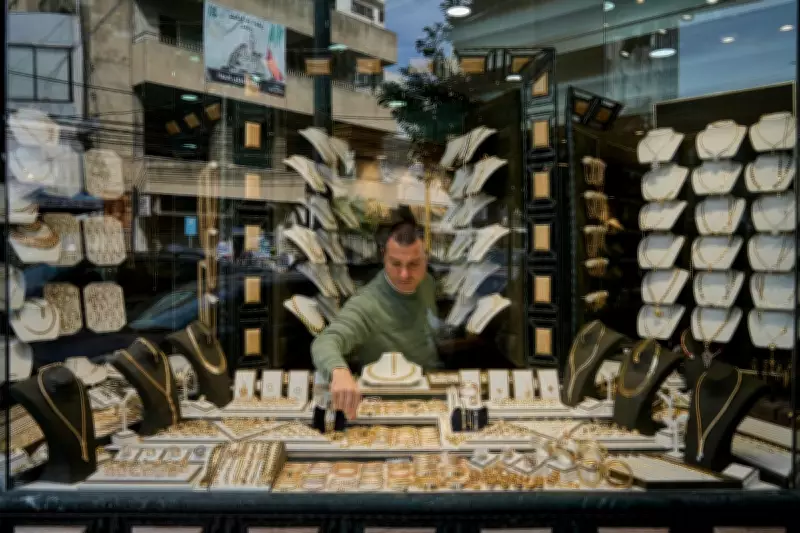
Outside one of Beirut's gold markets, Alia Shehade strolls along some of the storefronts. She says as a woman, her gold jewelry collection has made her feel safe in the middle of the financial crisis, referring to an Arabic saying that translates to "an adornment and treasure." "If a woman is in a tough situation... she can sell her gold. And when gold prices go up, then she's the winner," she said. But she refuses to sell any of hers.
When looking at the reluctance to sell gold among both the citizens and the authorities, Zoughaib observed: "I think this just tells us just how important that gold is in the psychology of people. They are not even able to imagine a use case for it beyond being a hedge."





