

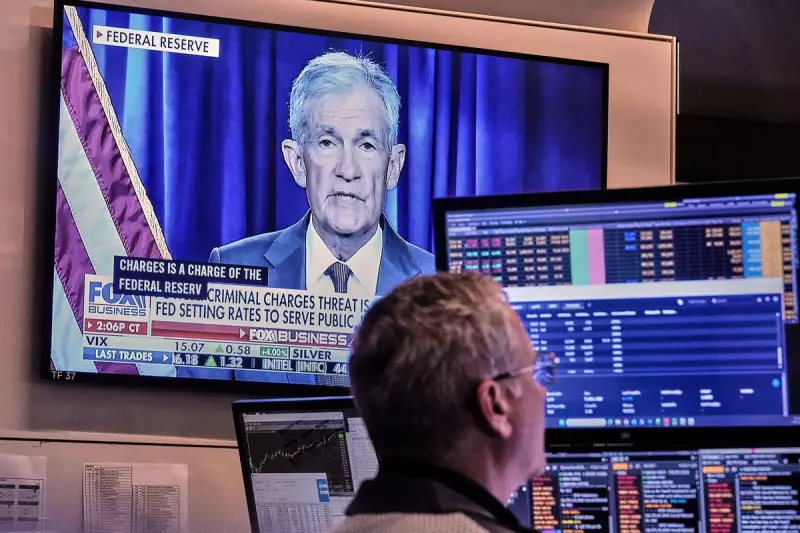
Federal Reserve Expected to Maintain Interest Rates Amid Political Tensions
The Federal Reserve is poised to keep its key short-term interest rate unchanged at approximately 3.6% during this week's policy meeting, marking a period of stability following three consecutive quarter-point reductions last year. This decision comes as Chair Jerome Powell seeks to pivot the central bank's focus back to core economic indicators, after enduring two weeks of intense political and legal pressure from the Trump administration.
Powell's Emphasis on Economic-Driven Decisions
Fed Chair Jerome Powell has publicly stated that the recent subpoenas from the Justice Department, part of a criminal investigation into his testimony regarding a $2.5 billion building renovation, are "pretexts" intended to penalise the Fed for not implementing rate cuts as aggressively as President Donald Trump desires. This investigation marks the first time a sitting Fed chair has faced such scrutiny, prompting Powell to issue an unusually public rebuke.
Now, Powell must transition from a contentious dispute with the White House to reinforcing that the Federal Reserve's monetary policy decisions are guided solely by economic data, not political considerations. Claudia Sahm, a former Fed economist and chief economist at New Century Advisors, noted that Powell will be "under even more pressure to underscore, 'everything we’re doing here ... is all about the economics.'" She added, "'We didn’t think about the politics.'"

Regular Meeting Flow Despite External Pressures
Michael Gapen, chief U.S. economist at Morgan Stanley and a former Fed staffer, indicated that despite the external scrutiny, the Federal Open Market Committee is expected to conduct its interest rate deliberations with customary regularity. "The meetings have a regular flow to them," Gapen explained. "There are presentations that are made, there are discussions that have to be had. ... Some of these other broader-based attacks on the Fed don't really come up."
This week's gathering, one of eight scheduled annual meetings, will be overshadowed by the recent revelation of the Justice Department's subpoenas. Additionally, the Supreme Court recently deliberated on whether President Trump can dismiss Fed governor Lisa Cook over allegations of mortgage fraud, which she denies. No president has ever removed a governor in the Fed's 112-year history, and during oral arguments, justices appeared inclined to allow Cook to remain in her position pending case resolution.
Economic Indicators Supporting a Hold on Rates
Several economic factors justify the Fed's anticipated decision to maintain current interest rates. The unemployment rate decreased in December after rising for much of the previous year, suggesting potential stabilisation in the labour market. Claims for unemployment benefits have remained at historically low levels, indicating that widespread layoffs have not materialised.
Conversely, inflation remains elevated, with the Fed's preferred measure showing prices increased by 2.8% in November compared to the previous year, up from 2.6% in November 2024. This persistent inflationary pressure reduces the impetus for immediate rate cuts.
Economists generally agree that unless businesses begin significant job cuts or the unemployment rate rises substantially, the Fed is unlikely to reduce rates for at least several months. If inflation gradually declines throughout the year as projected, the central bank may consider implementing cuts during the spring or summer months. Wall Street investors currently anticipate only two quarter-point rate reductions this year, based on futures pricing.
Potential Economic Growth and Future Policy
Many economists predict economic growth could accelerate in coming months, providing further rationale to postpone rate cuts. Michael Gapen estimates that tax refunds might be approximately 20% higher this spring compared to last year, as the Trump administration's tax cuts take full effect, potentially averaging around $3,500 per refund.

The U.S. economy expanded at a robust 4.4% annual rate during the July-September quarter last year, with similar healthy growth likely in the final quarter. Should this solid economic performance continue, Fed officials will probably monitor whether hiring accelerates accordingly, further diminishing the necessity for additional rate reductions.
The three rate cuts implemented last year were designed to bolster the economy following a sharp slowdown in hiring during the summer and autumn, triggered by President Trump's April tariffs imposed on numerous countries. With signs of labour market stabilisation and persistent inflation, the Federal Reserve appears committed to a patient, data-driven approach to monetary policy, despite ongoing political pressures.





