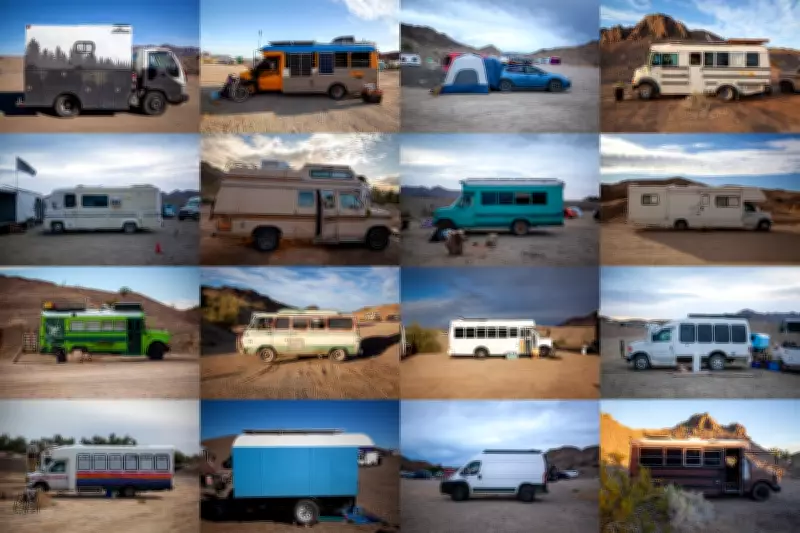
Every autumn across North America, a migration begins. It is not of birds or fish, but of humans. They go by many names: nomads, drifters, snowbirds, boondockers, van dwellers. Some travel for warmth, others for freedom and community. For a growing number, the migration is economic.
Among them is 55-year-old Derek Hansler, a chef known as D Rock. He summers in New Hampshire, parking his 2003 Van Terra shuttle bus in driveways, visiting family. He picks up gigs for cash, but the season is more about service and volunteering. When the leaves turn crimson, he heads 3,300 miles southwest to Quartzsite, Arizona.
In Seattle, Stephanie Scruggs and Gustavo Costo prepare southward. After three years on the road, they traded two vans for a half-finished bus named Magpie. Stephanie, diagnosed with terminal brain cancer five years ago, left her restaurant job. Gustavo, laid off during the pandemic, bought a van and taught himself to code.

Retiree Theresa Webster finishes her volunteer season at an Oregon campground. In return, she gets a rare legal place to park. She packs Old Yeller, her 1977 Dodge van, and heads south to Quartzsite.
Quartzsite, or Q-town, is a small desert outpost on Interstate 10. According to the 2020 census, its population is 2,413. But as winter approaches, thousands pour into the vast stretches of open desert surrounding it—public land managed by the Bureau of Land Management (BLM).
Here, a person can live for little or nothing. The BLM's long-term visitor areas (LTVAs) allow camping from September 15 to April 15 for $180. That includes trash collection, vault toilets, and a dump station. For less than a single night in many hotels, one can legally live on public lands for seven months.
Many LTVA visitors are traditional snowbirds with homes elsewhere. But for a growing number, the permit is a legal foothold in a housing system that has shut them out. Housing costs have climbed faster than incomes. The wage needed to afford a modest two-bedroom rental exceeds $30 an hour. The US is missing over 7 million affordable rental units. In place of traditional housing, a parallel system has emerged: people living in cars, vans, trucks, RVs, and buses.
Dr. Graham Pruss, executive director of the National Vehicle Residency Coalition, calls them an "economic refugee class"—displaced not by conflict but by rents and wages. He describes "settlement bias": treating familiar dwellings as legitimate and unfamiliar ones as suspect. "If you park an RV on private space and pay rent, that's a mobile home park. Move it 100 feet onto the street, we call that homelessness."
Public lands are the lifeline. Mary Feuer, a longtime resident, says, "When the money runs out, they literally support us."
I arrived in Quartzsite in February, pitching my tent near a sparse stand of creosote. My nearest neighbor lived in an aging RV with a sign: Camp Quityerbitchen. The scale of La Posa LTVA unfolds over miles of dirt roads, with three BLM rangers, 10 volunteer hosts, and 50 volunteers overseeing operations.
At the 9am meditation bonfire, 22 people huddled against the warmth. Stories moved around the fire—trauma, poems, comfortable silence. D Rock stood by his new $6,000 shuttle bus. He runs through the day's offerings: 9am meditation, 10am AA meeting, an awakening circle. He lives on $10,000 a year. "I do not in any way feel homeless. I have a home on wheels."
Later, we depart for VanAid, a 10-day gathering 60 miles south. There, hobby mechanics, carpenters, and nomads share tools and knowledge. Stephanie and Gustavo sit outside Magpie. Stephanie lives on disability. Gustavo works temporary contracts. They chase weather where they can leave butter out of the fridge.
At VanAid, D Rock's chuckwagon serves chili to workers. "I can't build like those guys, but I can keep them from having to stop." Pruss hands out coffee. He says, "This is all done without economic exchange. These people are creating pathways where they don't exist."

Federal law requires BLM lands to be managed for multiple use. Nowhere does it mention affordable housing, yet in practice, LTVAs function as a social pressure valve. Permits at La Posa rose from 4,308 in 2019 to 10,300 in 2025—more than doubling. The BLM's business plan notes a shift toward "subculture variants of RV culture": retrofitted vans, buses, and cars. It proposes raising rates from $180 to $600, the first change since 2008.
Norman Flowers, a 75-year-old volunteer, lives in a 1996 Dodge van. He sees more families and low-income visitors. Enforcement struggles with only two or three rangers for the entire district.
By late spring, the desert camps fold back into motion. Theresa maps her route to Oregon. Stephanie and Gustavo plan to trace the Trans-Canada Highway to Alaska. D Rock's bus is nearly complete, thanks to Goff, who received a plane ticket to Peru. As engines wake, hands wave farewell: "See you down the road!"