

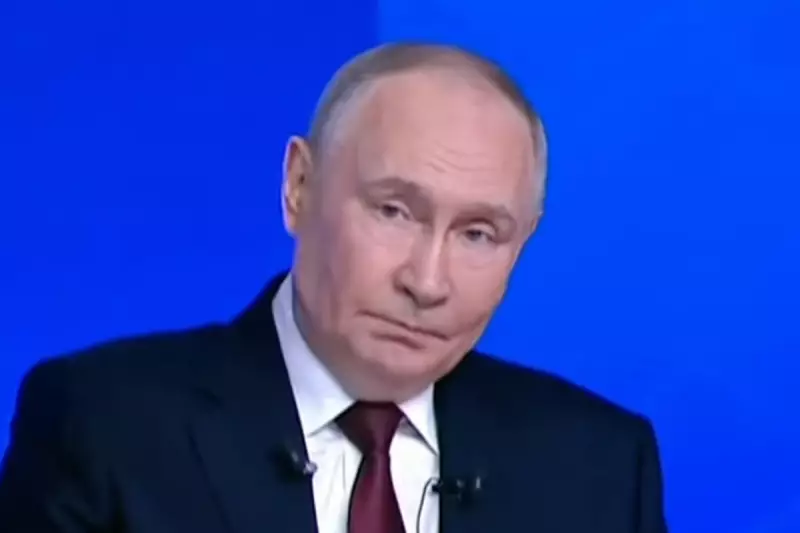
Vladimir Putin's meticulously staged annual press conference was punctured by sharp public anger over poverty and a stagnant economy, revealing the mounting hardships facing ordinary Russians after nearly four years of war in Ukraine.
Public Frustration Breaks Through the Script
The four-and-a-half-hour event, held on Friday and billed as a 'direct line' to the president, saw carefully vetted questions nonetheless expose widespread economic anxiety. One citizen's text message, displayed on screen, bluntly described the spectacle as 'not a direct line, but a circus'.
Another viewer asked pointedly: 'Why do ordinary people live worse than Papuans [citizens of Papua New Guinea]?' This sentiment was echoed in comments on a livestream, which called out Putin and other elites for living in 'mansions' while many struggle.

A medical student voiced concerns about starting a family due to low salaries for young professionals, warning 'We are losing young experts.' Putin's response, urging that career-building should not delay family life, was seen by analysts as out of touch with daily realities.
Economic Strain Amid War and Sanctions
The conference came as the European Union agreed a massive €90bn (£79bn) interest-free loan to fund Ukraine's military needs, while failing to agree on a plan to use £185bn of frozen Russian assets—a move Putin denounced as 'daylight robbery'.
Domestically, the economic picture is bleak. A mother of six, working as a kindergarten assistant, described how she and her driver husband must take on multiple extra jobs to cope with living costs. The family had lost all state benefits after exceeding the welfare threshold by a mere 249 roubles (£2.49).
Experts outlined the severe pressures. 'Russia's economy is suffering; inflation is 8 per cent, interest rates are 16 per cent, growth is slowing, budget deficits are soaring, real incomes are plunging, and consumer taxes are rising,' said Dr Bulent Gokay, Professor of International Relations at Keele University.
Cracks in the Controlled Facade
Despite heavy censorship, sarcasm and criticism filtered through. Messages complained of internet outages and rust-coloured water in Saransk. One viewer took aim at state censor Roskomnadzor, writing 'Block Roskomnadzor itself!' Another irreverently asked, 'Vladimir Vladimirovich, it’s Friday already – can we break out the booze?'
Analysts noted Putin's visible unease. 'Putin’s obvious discomfort in the face of these questions illustrates perfectly the pressure that the regime is under as its economic problems intensify,' said Dr Luke Cooper of LSE Ideas.
Dr Gokay noted that Putin downplayed concerns, prioritising defence and framing slow growth as a strategic choice for stability. However, he added, 'I doubt this explanation fully convinces the Russian people.'
The event also saw Putin field questions on topics from aliens to religion, and he apologised to a soldier's widow for pension delays. Yet the dominant theme was clear: a nation growing increasingly nervous about its living standards as the war's economic toll bites deeper.






