
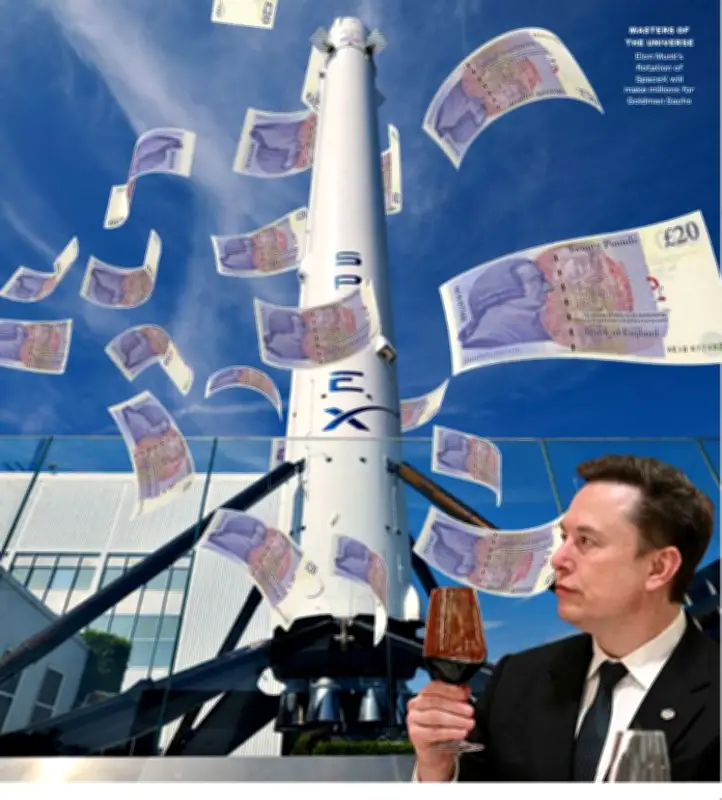
At a black-tie business dinner in Kensington, a former heavy-hitter from Goldman Sachs casually mentioned a figure that made me gulp: six percent. That, he explained, is the typical fee for the 'lead left' adviser on a major initial public offering. On Elon Musk's SpaceX listing—the largest in history at $75 billion, valuing the company at over $1.5 trillion—that would mean investment bankers raking in $4.5 billion. But he quickly added that a deal would likely reduce it to around two percent, still a staggering $1.5 billion. Goldman Sachs, leading a syndicate of 23 banks, would take the largest share.
On the 33rd floor of Goldman's Lower Manhattan headquarters, where its leaders reside, there was said to have been a quiet celebration. That seems odd, given the bank had long worked to land this plum assignment, seeing off its great Wall Street rival Morgan Stanley. Yet Goldman is an organisation where conspicuous consumption is frowned upon. Executives are instructed to avoid showy parties or extravagant behaviour in public. They do not discuss their earnings with each other; the size of individual bonus awards is known only to a few.
This suggests that Goldman does empathy well. Like many banks, it is conscious of its portrayal, wishing to be seen as in touch with ordinary people and social issues. Occasionally, though, the mask slips—as it did with Bill Winters last month. The chief executive of Standard Chartered referred to some of the thousands of his staff set to lose their jobs to artificial intelligence as 'lower-value human capital'. The bank, headquartered in London, was cutting 7,800 back-office positions, mostly in response to AI. 'It's not cost-cutting,' Winters said. 'It's replacing in some cases lower-value human capital with the financial capital and the investment capital we're putting in.'
After public criticism, Winters, who is paid £12.7 million a year, tried to explain: 'I said that lower-value roles are more vulnerable to automation, and that we have a responsibility to help colleagues move into higher-value roles.' In effect, he doubled down. His emotional quotient seemed to be through the floor. Cue more hostility and a further LinkedIn post: 'I have received a lot of support for the messages in my previous post but still get questions about my choice of words, which I know has caused upset to some of my colleagues. For that I am sorry.' An apology of sorts, but he did not address the point that caused such offence—not the impact of AI, but the fact he felt able to describe employees as 'lower-value human capital'. He just didn't get it, suggesting that in his rarified world, such dismissive language is entirely commonplace.
In their bubble, they are gods. They earn colossal amounts and are surrounded by courtiers and fawning admirers. When they gather, it is with fellow members of their gilded elite. Davos is an annual high point where they attempt to relate to the rest of the world and put it right. As Tom Wolfe laid bare in his brilliant and still very relevant 1987 novel Bonfire of the Vanities, they are masters of the universe—their universe.
The Winters comment, the backlash, and his reaction are all reminiscent of a previous episode when Lloyd Blankfein, then head of Goldman, said he did 'God's work'. During a 2009 interview with John Arlidge for The Sunday Times, Blankfein argued that banks serve a societal purpose. According to Forbes, Blankfein has amassed wealth worth $1.8 billion from that work. In his new memoir, Streetwise, Blankfein maintains he did not utter those words in the interview, claiming it was a joke by the lifts. But Arlidge gave his own account, saying the remark came 20 minutes into a formal, pre-arranged one-hour sit-down interview. 'I fact-checked the article with Goldman Sachs before publication, and they did not push back about the words or how, where, and when Lloyd said them,' Arlidge stated.
Blankfein's dismissive 'British reporter' label is deliberate. In his book, he reveals how he deals with reporters he dislikes: 'If you want to hurt a reporter, ignore him, indicate that you're unaware of his work. Oh, are you still writing? I didn't know you were. You haven't written anything in a long time, have you?'
It reminds me of another meeting with a top banker. When Sir Fred Goodwin was in his pomp, I was invited to see him at Royal Bank of Scotland's offices in Bishopsgate. As we sat in his vast room, Goodwin, who was paid £4.19 million in his final year and still receives a pension worth £600,000 a year, became visibly agitated by the sound of clinking glasses and laughter from the streets below. He stood up, walked to the window, gazed down, and asked: 'What's wrong with this town, why does no one do any work?' Goodwin loathed the sound of workers—or as Winters might say, lower-value human capital—winding down and enjoying themselves.




