
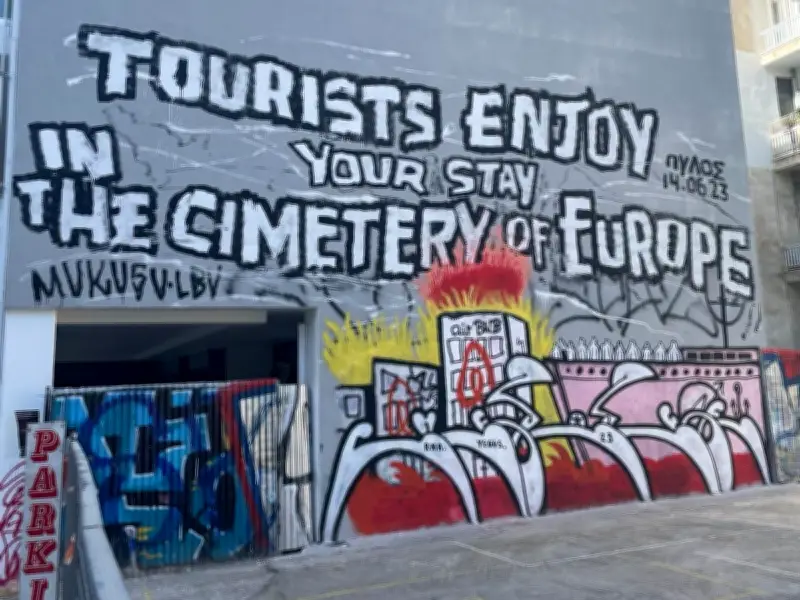
Athens Residents Pushed Out by Overtourism and Rising Costs
Stella, a member of a renters' union in Athens, says she thinks of leaving the Greek capital every day. "100% I will leave," she told a visiting journalist. Her sentiment reflects a growing crisis in one of Europe's most historic cities, where locals are being priced out and see their neighborhoods transformed beyond recognition.
Athens is a vibrant, energy-filled metropolis of nearly four million people, stretching to the Parnitha, Hymettus, Penteli, and Egaleo mountains on three sides and the sea on the other. Tourists flock to its iconic sites like the Parthenon and the National Archaeological Museum, which houses treasures such as the Mask of Agamemnon. The city also boasts about 60 open-air cinemas, including the Thision, where patrons can watch films with the Acropolis framed above the screen.
But for many Athenians, the city is becoming unrecognizable. Anti-tourist graffiti reading 'F**k Airbnb' is ubiquitous, and anti-Israel tags border on antisemitic. Tens of thousands of protesters regularly take over the streets on weekends. Stella notes, "Athens is becoming more and more unfriendly. The places we used to hang out, they’re being destroyed, one by one. Soon I won’t be able to recognise it."
From Anarchist Stronghold to Tourist Hub
In the years after the Greek debt crisis, the Exarcheia neighborhood was an anarchist stronghold, with squats housing asylum seekers and chains hounded out. But after Kostas Bakoyannis was elected mayor in 2019, police cleared the area of drug dealers and squatters, aiming to turn it into a 'model' neighborhood. Stella laments, "Exarcheia, where I work, used to be the most leftist area. It is famous for anarchy, but now it is a tourist area. It is a ghost of itself."
Athens' transformation has deeper roots. After independence from the Ottomans in 1833, the city grew from a ruined village of 4,000 to nearly four million today. Many live in polykatoikia apartment blocks built in the 1930s under the 'antiparochi' system, where locals exchanged land for a stake in new builds. These families remain major landlords, and many have turned to short-term rentals on platforms like Airbnb.
Housing Costs Soar Beyond Incomes
Looser property laws have enabled thousands of holiday lets in central Athens alone. According to the OECD, house prices in Greece rose 69% between 2017 and 2024, far outpacing income growth. Greeks now face the highest housing costs in Europe as a percentage of disposable income, exceeding 35%. From 2022 to 2023, rents surged 11% nationwide. Stella argues that encouraging Athenians to become holiday let landlords makes them less likely to support policies that curb the spread of such rentals.
If locals can no longer afford to live in Athens, the city loses its soul. "If those who make Athens the city that it is can no longer afford to live there, as many already can't, then it loses what makes it so great," the article concludes. The tension between tourism's economic benefits and its social costs remains unresolved, as Athenians like Stella consider leaving their home forever.




