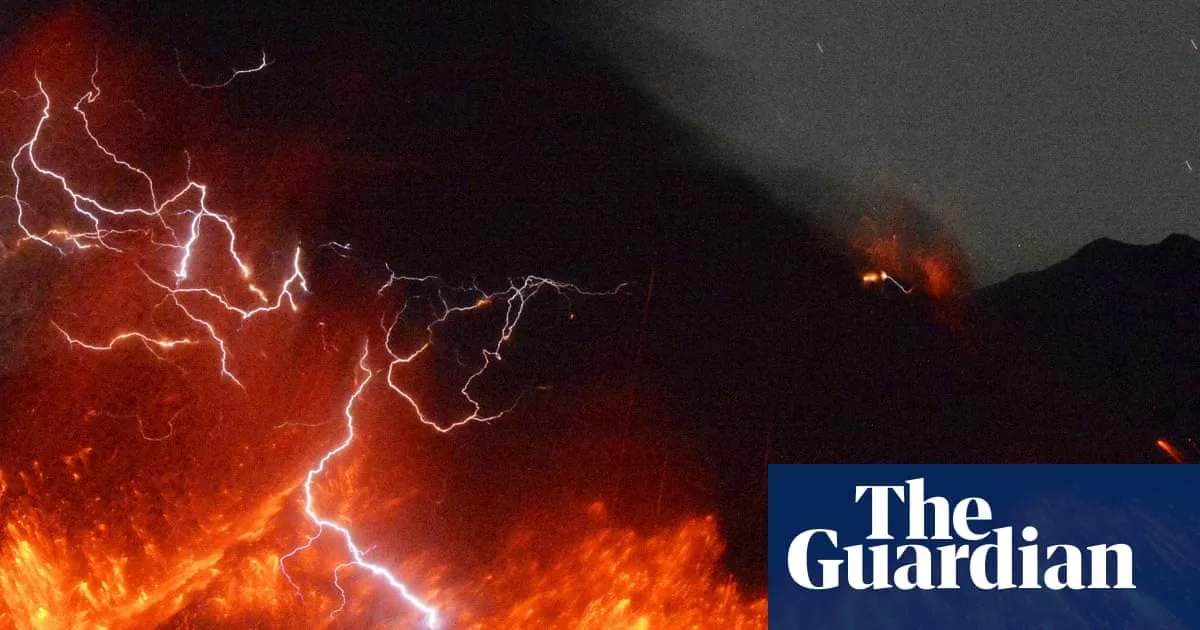
Scientists have moved a step closer to understanding volcanic lightning, one of the most spectacular atmospheric phenomena, which occurs amid the smoke and ash of an eruption. The intensity can be extreme: the Hunga Tonga-Hunga Ha‘apai eruption in Tonga in 2022 produced more than 2,600 lightning flashes per minute, stretching up to 19 miles (31km) above sea level.
Until now, the mechanism behind volcanic lightning has puzzled researchers. In ordinary storm clouds, electrical charge arises from collisions between ice crystals rising in updraughts and falling particles of soft hail, or graupel. The ice becomes positively charged and the hail negatively charged. However, volcanic plumes are dry and consist of ash and rock fragments, so it was unclear how they could become charged during collisions of similar rocky material.
New research published in Nature from the Institute of Science and Technology Austria reveals that the secret lies in a fine coating of carbon-rich molecules on the surface of silica particles. Perfectly clean silica particles did not tend to pick up charge, but when coated with carbon, charge transfer occurred during collisions.
The effect can be produced simply by heating the silica, as normal air contains enough carbon-containing molecules to create surface contamination. The intense heat and updraught of a volcanic plume create the ideal conditions for charging, leading to the spectacular lightning displays seen during major eruptions.