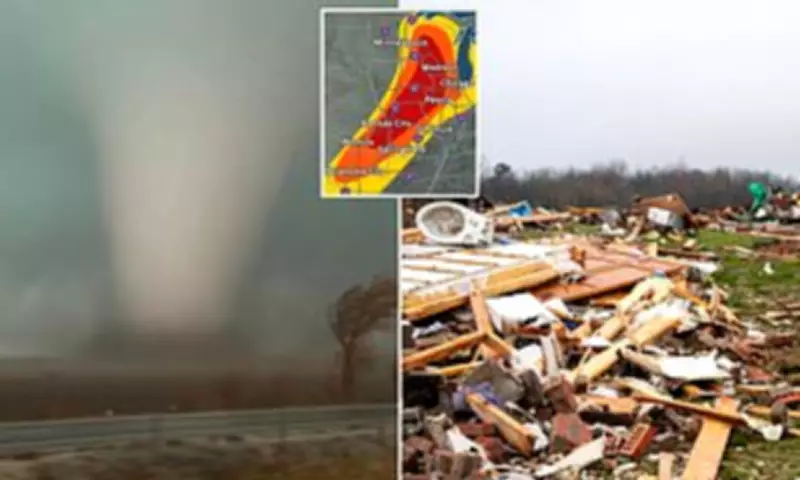
A destructive and expansive storm system is poised to sweep across the American Midwest, triggering tornado warnings for tens of millions of residents from Minnesota down to Texas. This colossal weather event is forecast to unleash severe thunderstorms, extreme wind gusts exceeding 70 miles per hour, damaging hail, and the threat of deadly funnel clouds beginning Friday afternoon and persisting through the night across eleven states.
High-Risk States and Major Cities in the Path
Meteorologists with AccuWeather have issued stark warnings, indicating that the highest risk of severe thunderstorms will be concentrated in Wisconsin, Iowa, Illinois, Missouri, and Kansas. Additionally, Minnesota, Michigan, Indiana, Oklahoma, Arkansas, and Texas lie directly in the storm's path, placing approximately 50 million individuals at risk of experiencing extreme thunderstorms and potential tornado touchdowns on Friday.
Major metropolitan areas, including Chicago, Minneapolis, St. Louis, Kansas City, Madison, Wichita, Oklahoma City, and Dallas, are expected to confront severe thunderstorms within mere hours. Forecasters have specifically highlighted that parts of Wisconsin, Minnesota, Iowa, and Illinois face the most elevated risk of tornado formation on Friday night.

Expert Warnings and Emergency Preparedness
AccuWeather Senior Meteorologist Dan Pydynowski emphasized the critical need for vigilance in a public statement. 'People in the path of these storms should stay alert and be ready to act,' he urged. 'Make sure your phone is charged, alerts are on, and your storm shelter or safe place is ready and stocked with emergency supplies. Never drive on flooded roads, especially at night.'
This multi-day storm system is predicted to spread dangerous weather conditions further into the Northeast over the coming weekend, amplifying the widespread threat.
Understanding the Tornado Threat and Recent Impacts
Tornadoes are violently rotating columns of air that descend to the ground, typically forming during severe supercell thunderstorms. Their strength varies dramatically, from weaker versions causing minor roof damage to monstrous funnels capable of obliterating well-built homes, flipping vehicles, and uprooting trees in seconds.
The current severe weather outbreak is part of an active pattern. Approximately three dozen tornadoes have already been reported between Monday and Thursday across the Plains states and Upper Midwest. Large, damaging hail and other extreme conditions have been observed as far east as Vermont and New Hampshire.
The week-long storm front has already caused significant disruption, leaving over 10,000 customers without power in Tennessee after severe thunderstorms swept through Nashville on Thursday.
Meteorological Conditions Fueling the Outbreak
The extreme conditions are being fueled by a large, slow-moving weather system stationed over the central United States. This system is pulling warm, humid air northward from the Gulf of Mexico, while a cold front and powerful upper-level winds create the perfect atmospheric recipe for severe weather development.
'This multiday outbreak will peak this afternoon through tonight. The atmosphere is primed for destructive storms across the central US,' Pydynowski added.
Flooding Concerns and Extended Weekend Risks
Beyond thunderstorms, hail, and tornadoes, Pydynowski warned that areas already grappling with severe flooding this week, including Wisconsin and Michigan, will likely endure further water damage on Friday. 'More storms will only make it worse. Some roads have been underwater for days. More areas could flood tonight into this weekend,' he cautioned.
In response to the escalating threat, governors in Michigan and Wisconsin declared states of emergency on April 15 as initial storms caused isolated tornadoes and river overflows. The National Weather Service has issued new flood warnings across both states for Friday.
The severe weather threat is expected to shift eastward on Saturday, placing western New York, Pennsylvania, Ohio, West Virginia, Kentucky, Tennessee, and Mississippi at a moderate risk for severe thunderstorms.

The AccuWeather team noted, 'By Sunday, the severe weather potential is likely to have passed its peak, but some gusty thunderstorms may extend from the northern Gulf Coast to the Atlantic Coast.' Forecasters warn the weekend storm could disrupt travel, cause additional power outages, and sever supply routes across the Plains, Midwest, and Northeast for days.
The Shifting Landscape of Tornado Alley
The US tornado season typically spans from March to June, peaking in May. Historically, the region known as 'Tornado Alley'—a hotspot for such extreme weather—was centered on Texas, Oklahoma, Kansas, and Nebraska.
However, recent studies indicate that changing weather patterns and a warming climate are shifting this tornado zone further east, impacting more states than ever before. AccuWeather's newest predictions for April 2026 show the highest tornado threat risk moving into Iowa, Illinois, Missouri, Kentucky, Tennessee, Mississippi, Alabama, and Arkansas.
This eastward expansion means increased impacts for Mississippi, Alabama, Tennessee, Kentucky, Arkansas, Illinois, Indiana, Missouri, and Iowa, reflecting a significant meteorological shift from traditional patterns.