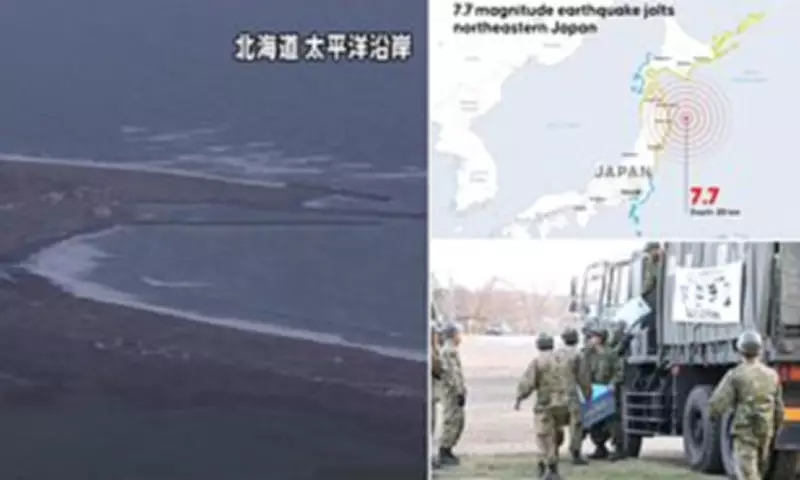
The Japan Meteorological Agency issued a critical special advisory on Monday, warning citizens of a significantly increased risk for earthquakes measuring magnitude 8.0 or stronger. This urgent warning followed a powerful 7.7-magnitude earthquake that rattled the country's northern regions and prompted immediate tsunami alerts along the Pacific coastline.
Immediate Seismic Threat and Tsunami Response
The agency stated unequivocally that 'the likelihood of a new, huge earthquake occurring is relatively higher than during normal times.' This advisory specifically targeted northern Japan, coming just hours after the substantial 7.7-magnitude tremor struck at 4:53 pm local time in Pacific waters off Iwate prefecture. The earthquake's force was substantial enough to shake large buildings in Tokyo, hundreds of kilometres from the epicentre, which was located six miles deep in the ocean.
Initial measurements placed the quake at magnitude 7.4, but this was subsequently revised upward to 7.5 and finally to 7.7 as more data became available. Chief Cabinet Secretary Minoru Kihara reported no immediate serious injuries or significant damage during a news conference, though authorities emphasized the need for extreme caution.

Evacuation Orders and Tsunami Observations
Earlier on Monday, Japanese authorities had urgently instructed civilians to evacuate coastal areas in anticipation of tsunami waves reaching up to three metres (10 feet). The Meteorological Agency recorded a 70cm wave at Kuji port in Iwate at 5:32 pm local time, followed by an 80cm wave just two minutes later. Broadcasters like NHK flashed urgent 'Tsunami! Evacuate!' warnings across screens as ships were seen sailing out of Hachinohe port in Hokkaido to avoid the incoming waves.
Japanese media reported that tsunami warnings extended to Aomori, Miyagi, and Fukushima prefectures, though these waves were expected to be smaller at approximately three feet tall. Aerial footage captured massive waves consuming significant portions of Japan's coastline, while bullet train services in Aomori were halted due to the tremors.
Government Response and Nuclear Safety
The prime minister's office established a crisis management team immediately following the earthquake. During a press conference, the prime minister emphasized: 'For those of you who live in areas for which the warnings have been issued, please evacuate to higher, safer places such as higher ground.' Japanese soldiers were deployed to assist affected areas, with several seen operating in Iwate prefecture.
Nuclear safety remained a paramount concern following the earthquake. Officials from the Tokyo Electric Power Company confirmed no changes in radiation levels at the Fukushima power plants and reported no abnormalities at the Higashidori nuclear power plant in Aomori or the Onagawa plant in Miyagi. A recyclable-fuel storage company similarly reported no issues at its interim storage facility for spent nuclear fuel in Aomori prefecture.
Historical Context and Seismic Vulnerability
Japan's position as one of the world's most seismically active countries cannot be overstated. The archipelago sits atop four major tectonic plates along the western edge of the Pacific 'Ring of Fire,' experiencing approximately 1,500 tremors annually and accounting for about 18 percent of the world's earthquakes. While most are mild, their impact varies significantly based on location and depth.
The memory of the 2011 magnitude-9.0 earthquake and subsequent tsunami, which left 18,500 people dead or missing and caused the devastating Fukushima nuclear meltdown, remains fresh in national consciousness. More recently, in 2024, the JMA issued its first special advisory for a potential 'megaquake' along the Nankai Trough—a nearly 500-mile-long undersea trench where the Philippine Sea plate subducts beneath Japan's continental plate.
Government estimates suggest a quake in this trough could kill up to 298,000 people and cause $2 trillion in damage. Although the 2024 advisory was lifted after a week, it triggered panic-buying of staples and widespread travel cancellations. A second 'megaquake' advisory followed in December 2025 after a magnitude-7.5 tremor struck off the northern coast, causing tsunami waves up to 28 inches and injuring over 40 people.

International Implications and Preparedness
The U.S. National Weather Service confirmed that no tsunami threat existed for California, Alaska, Washington, Oregon, or British Columbia in Canada following Monday's earthquake. Meanwhile, a Cabinet Office official stressed during a televised briefing: 'While it is uncertain whether another major earthquake will actually occur, we ask that you take disaster preparedness measures based on the principle that you are responsible for your own safety.'
Footage from across Japan showed the earthquake's widespread effects: signs and hanging lights swaying violently in cafes, chandeliers flashing and swinging erratically, and coastal areas being inundated by powerful waves. As the nation remains on high alert, authorities continue to monitor the situation closely, emphasizing evacuation protocols and personal safety measures for those in vulnerable coastal regions.