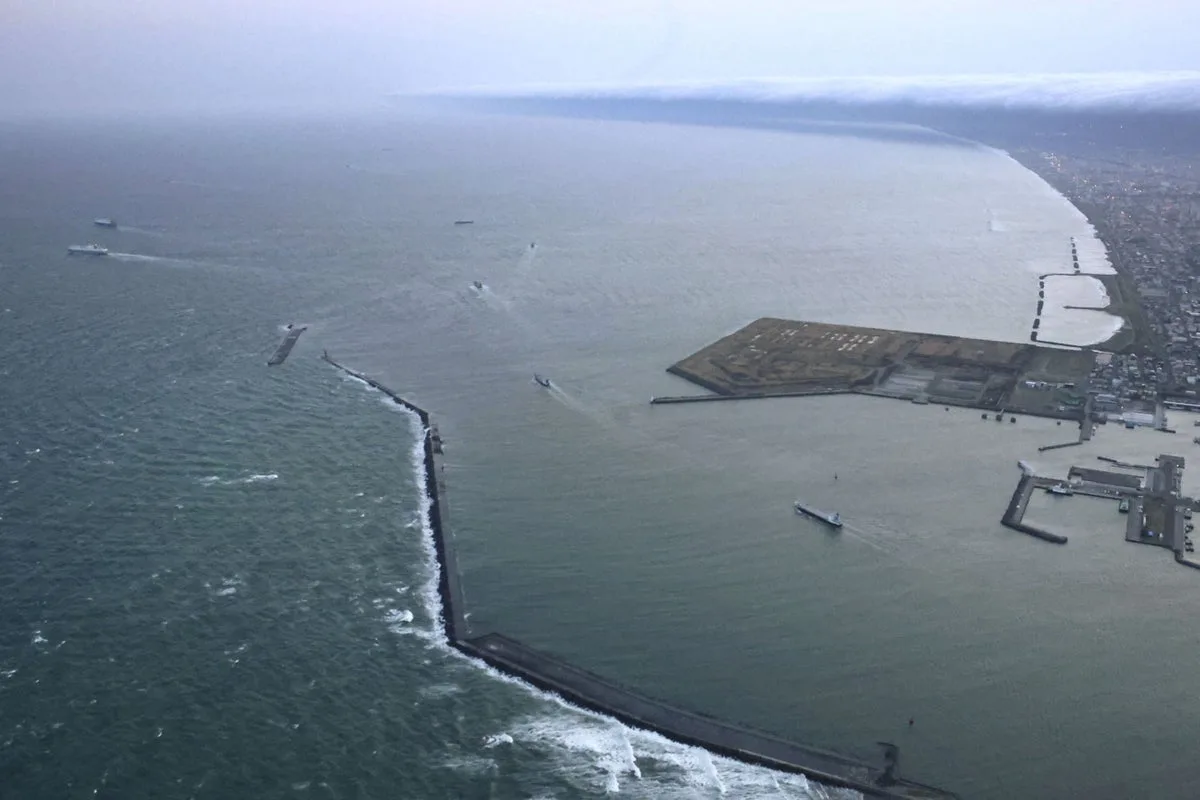
Japan has lifted all tsunami warnings and advisories issued after Monday's powerful 7.7-magnitude earthquake, which struck off the northeastern coast. The highest tsunami waves recorded were around 80cm in Iwate prefecture. Authorities warned that the risk of another, even more powerful earthquake would remain for up to a week, with the likelihood of a magnitude 8.0 or higher megaquake “higher than during normal times”.
The earthquake hit at 4.53pm local time (7.53am GMT), with an epicentre in the Pacific Ocean at a depth of about 20km, 330 miles (530km) from Tokyo. The Japan Meteorological Agency initially issued tsunami warnings, the second-highest alert, expecting waves of one to three metres. These were later downgraded to advisories and finally lifted by midnight local time.
No deaths or major damage were reported, but government spokesperson Minoru Kihara said 100 homes lost power. More than 170,000 people were advised to evacuate across several prefectures, though those orders have since been lifted. Local media reported minor injuries during evacuations, including an elderly woman in Hokkaido who likely fractured her arm, and an octogenarian man who broke his leg in Iwate.
Bullet train services were halted for several hours before resuming, and some motorways closed due to tremors felt as far as Tokyo. The government urged people to have a go-bag ready amid the heightened risk. The JMA said the chance of a magnitude 8 or greater earthquake was about 1% for the coming week, ten times higher than the normal probability of 0.1%.
The International Atomic Energy Agency reported no abnormalities at Japan's nuclear facilities. The earthquake evokes memories of the 2011 Tohoku disaster, which killed 18,000 and caused a Fukushima meltdown. Japan, situated on the Pacific “Ring of Fire”, experiences about 20% of the world's magnitude 6 or higher quakes.