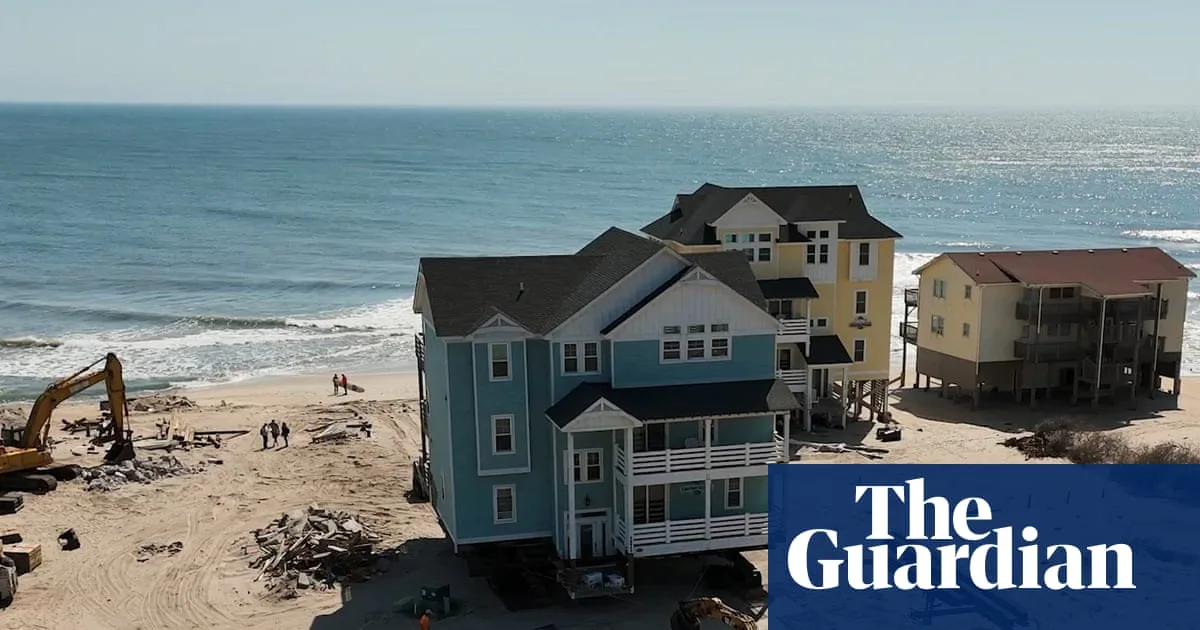
On Hatteras Island, North Carolina, the pace of coastal erosion has forced homeowners to resort to moving entire houses on wheels to escape the encroaching Atlantic Ocean. Since September, 19 homes have been lost to waves that tore them from their pilings, crashing into other structures before breaking up. Barry Crum, a lifelong resident and the island's main house mover, has been inundated with requests, with over a dozen homes scheduled to be moved or raised higher on stilts.
“It’s never been this busy,” said Crum. “I’ve seen a lot but I hadn’t seen this kind of erosion this quickly before. I’m glad I can do this to help, but it stinks what’s happened in the community.” One house being moved, Cape Point Retreat, was recently jacked onto girders and wheeled a few hundred feet back from the waves.
Coastal erosion has long been a feature of the Outer Banks, a string of shifting barrier islands where some areas lose over 10 feet of land annually. The Cape Hatteras lighthouse was moved in 1999 after losing more than 1,000 feet of land. However, recent erosion has staggered locals, wiping out the entire beach and sand dunes of Buxton and swallowing part of a neighbourhood. On 30 September, five houses collapsed within 45 minutes.
“I could see the house leaning and then you could hear a crackling sound, like lightning,” said resident Hunter Hicks, who filmed a house collapse in February. “There were 10ft waves hitting it and then it started to fully fall and it sounded like a bomb went off. It’s hard to even describe the sound. The island is just getting smaller and smaller. If we don’t move these houses we will probably lose 20 more by the end of the year.”
Laura Moore, an expert in coastal change at the University of North Carolina, said the increasing pace of sea level rise makes the Outer Banks “kind of the canaries in the coalmine” for other east coast communities. “What we are seeing is a real scramble to try to address these changes,” she said. “But there is no easy solution. Sea level’s rising, we’re on a mobile landscape, there really is no long-term way to hold things in place up and down the entire eastern seaboard.”
Since 2020, 31 houses have been lost on Hatteras Island. Despite the losses, residents show resilience, with the occasional severance of Highway 12 by water or sand leaving them marooned save for a lengthy ferry ride. The situation highlights the challenges of living on a dynamic landscape, as roads, homes and businesses were built on a naturally shifting environment.