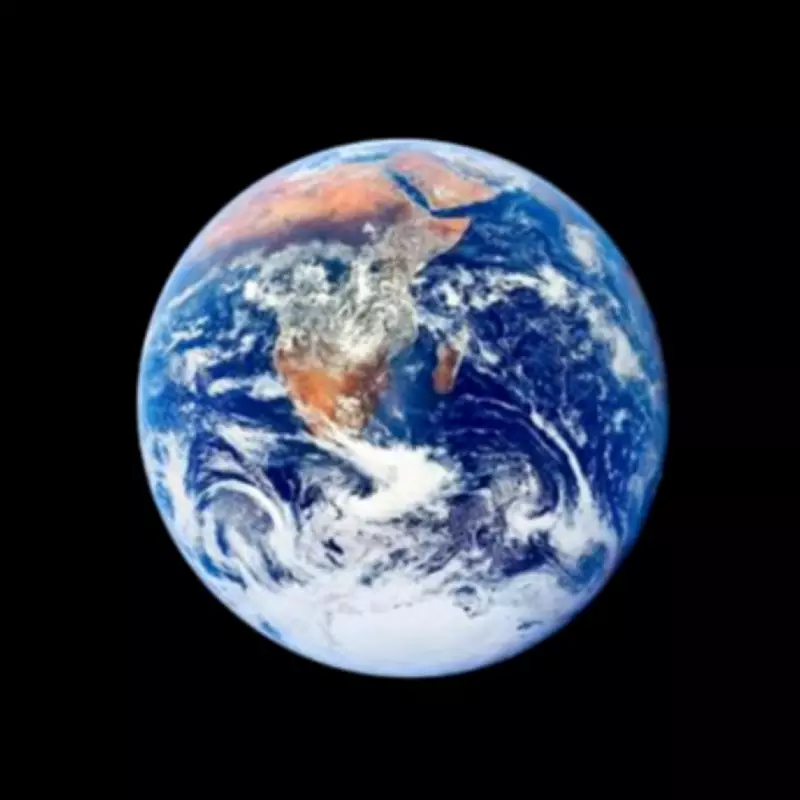
Earth's Rotation Decelerates, Paving Way for Longer Days
Scientists have unveiled a startling prediction: Earth's rotation is gradually slowing down, a phenomenon that could eventually extend the length of a day to 25 hours. This celestial slowdown, driven primarily by the gravitational interplay between Earth and the Moon, has been accelerating since the year 2000, though its effects remain imperceptible in daily human life.
The Lunar Brake Effect on Planetary Spin
The core mechanism behind Earth's deceleration is the constant gravitational tug-of-war with the Moon. As our planet rotates, the Moon's gravity exerts a braking force, similar to the dynamics that govern ocean tides. This interaction creates tidal bulges that do not align perfectly with the Moon, leading to friction between the ocean and seafloor. This friction effectively "steals" rotational energy from Earth, causing it to slow down while the Moon gains a slight speed boost.
Consequently, Earth is receding from the Moon at a rate of approximately 3.8 centimetres per year. Simultaneously, the length of a day increases by around 2.3 milliseconds each century. Although this increment seems minuscule, it accumulates significantly over time. NASA estimates that Earth could lose about 40 seconds per century, potentially falling an hour "behind schedule" by the end of the millennium.

Complex Factors Influencing Earth's Rotation
Earth's rotational slowdown is not uniform or easily predictable. Scientists highlight that non-tidal effects, including climate change impacts like global warming and polar ice cap melting, alongside the dynamics of Earth's molten core, introduce complexities. These factors make precise long-term forecasts challenging.
A NASA-funded study emphasises that the redistribution of large masses, such as ice and water, can further decelerate the planet. This mass shift causes Earth to wobble during rotation and alters its axis—a phenomenon known as polar motion. Both polar motion and the lengthening of days have been documented since 1900, with the slowdown rate intensifying post-2000 at a pace unprecedented in the prior century.
Surendra Adhikari from NASA remarked, "In barely 100 years, human beings have altered the climate system to such a degree that we're seeing the impact on the very way the planet spins."
Timekeeping Adjustments and Future Projections
To synchronise timekeeping with Earth's variable rotation, systems like Coordinated Universal Time (UTC) incorporate "leap seconds." The United States National Institute of Standards and Technology notes that this adjustment is standard across timekeeping methods. Currently, International Atomic Time—measured by 450 atomic clocks in 80 laboratories—diverges from UTC by 37 seconds, with the last leap second added in December 2016.
If current trends persist, scientists project that a 25-hour day could materialise in approximately 200 million years. This forecast assumes continued lunar influence and existing rotational patterns, though it acknowledges the role of anthropogenic factors like climate change in accelerating the slowdown.
While a day is conventionally 24 hours, NASA clarifies that Earth's orbit is not a perfect circle, resulting in slight daily variations. A sidereal day—the time for a complete Earth rotation—currently lasts about 23 hours and 56 minutes. The gradual extension toward 25 hours underscores a profound, albeit slow-moving, transformation in our planetary mechanics.