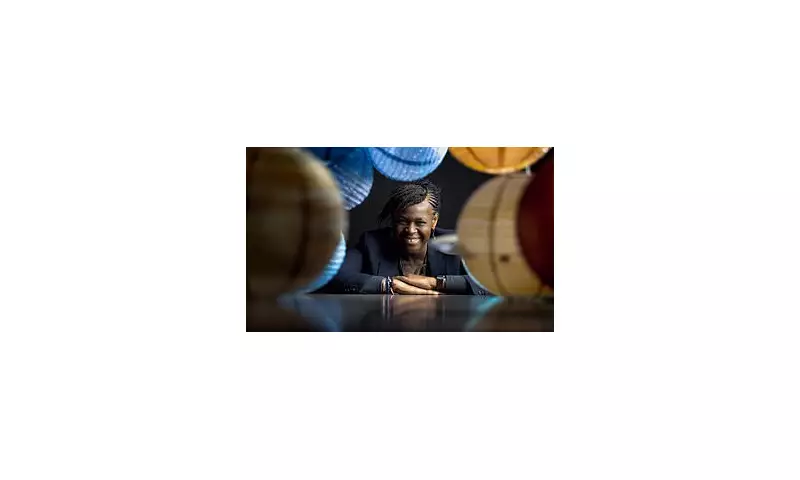
One of Britain's most prominent space scientists has declared she is 'absolutely convinced' that alien life exists and will be discovered within the next five decades. Dame Maggie Aderin-Pocock, a space scientist and science communicator from University College London, has made a bold prediction that humanity will achieve a 'positive detection' of life on another planet by the year 2075.
The Numbers Game: Why We Are Not Alone
Dame Maggie's conviction stems from the staggering scale of the cosmos. She points to the approximately 200 billion galaxies in the observable universe, each containing countless stars and planets. 'In the whole of the universe there are approximately 200 billion galaxies,' she explained. 'With so many stars, so many planets, why would [life] just occur here?'
This reasoning aligns with the famous Drake Equation, a theory first proposed in 1961, which suggests a high probability of extraterrestrial life based on the sheer number of potential habitats. Focusing on our own galaxy, Dame Maggie noted the Milky Way contains an estimated 300 billion stars, most of which are now believed to host orbiting planets.

Tantalising Glimpses and Concrete Evidence
The search is already yielding promising leads. Dame Maggie highlighted recent analysis of exoplanet K2-18b, located 124 light-years from Earth, where scientists detected atmospheric molecules that, on our planet, are persistently produced by living organisms. This discovery on the Hycean world – a planet with a hydrogen-rich atmosphere and a water ocean – was hailed as one of the most promising signs of life beyond our solar system.
Other potential biosignatures include unusual mineral markings found in Martian mudstones by NASA's Perseverance rover, which could be the chemical remnants of ancient microbial life. Despite these clues, Dame Maggie acknowledges the challenge lies in obtaining irrefutable proof. 'I think that's where the challenge lies – concrete evidence,' she said. 'But to put my money where my mouth is... I would say definitely in the next 50 years.'
Grey Sludge or Superior Intelligence?
While science fiction often depicts intelligent humanoid aliens, Dame Maggie suggests the reality of a first discovery may be more humble. 'Grey sludge is probably the most likely thing we're going to find,' she stated, referring to simple, microscopic life akin to marine phytoplankton.
However, she does not rule out the possibility of encountering more advanced beings. 'We might find something that does evolve and that can communicate – and of course, their technology might be far superior to ours,' she added, musing that such aliens might be observing humanity, 'hoping we'll "grow up" soon.'
Should life be found, she warns that planetary protection protocols will be paramount. Any samples, particularly those brought back from Mars, must be 'totally isolated' from Earth's biosphere to prevent contamination, a process for which facilities are already being developed.
Dame Maggie made these predictions in an interview ahead of presenting the 2025 Royal Institution Christmas Lectures, titled 'Is there life beyond Earth?'. The prestigious lectures will air on BBC Four and iPlayer from December 28th to 30th. Looking beyond mere discovery, she envisions a future where humanity becomes a 'space-faring people', using the perspective of space to unite our world by showing a planet without borders.
'It's the stuff of science fiction, literally,' she concluded, 'but science fiction does become science fact.'