In a stunning astronomical discovery, scientists have observed the dramatic reawakening of a colossal black hole after an estimated 100 million years of dormancy. The event, likened to a 'cosmic volcano' erupting, unleashed plumes of superheated plasma with enough raw power to alter the very structure of its host galaxy.
The Violent Rebirth of a Galactic Giant
The supermassive black hole, catalogued as J1007+3540, resides at the heart of a massive galaxy cluster brimming with intensely hot gas. Using a powerful combination of the Low Frequency Array (LOFAR) in the Netherlands and India's upgraded Giant Metrewave Radio Telescope (uGMRT), an international team captured unprecedented radio images of this violent rebirth. Their findings are detailed in the journal Monthly Notices of the Royal Astronomical Society.
Lead researcher Dr Shobha Kumari of Midnapore City College in India described the spectacle: 'It's like watching a cosmic volcano erupt again after ages of calm.' The images reveal a fierce battle at the galactic core, where the explosive jets from the black hole contend with the immense, crushing pressure of the surrounding cluster environment.

Unravelling the Secrets of a 'Messy Eater'
While nearly every galaxy harbours a supermassive black hole in its centre, few exhibit such spectacular outbursts. These celestial behemoths, with masses millions of times greater than our Sun, possess gravitational pulls so fierce that not even light can escape their event horizon.
Typically dormant, a black hole becomes 'active' when it begins to feed on surrounding clouds of gas. As matter spirals inward at tremendous speed, friction heats it to extreme temperatures. This process eventually forces the black hole to shoot out a jet of magnetised, superheated plasma, earning them the nickname 'messy eaters' as they eject much of the infalling material.
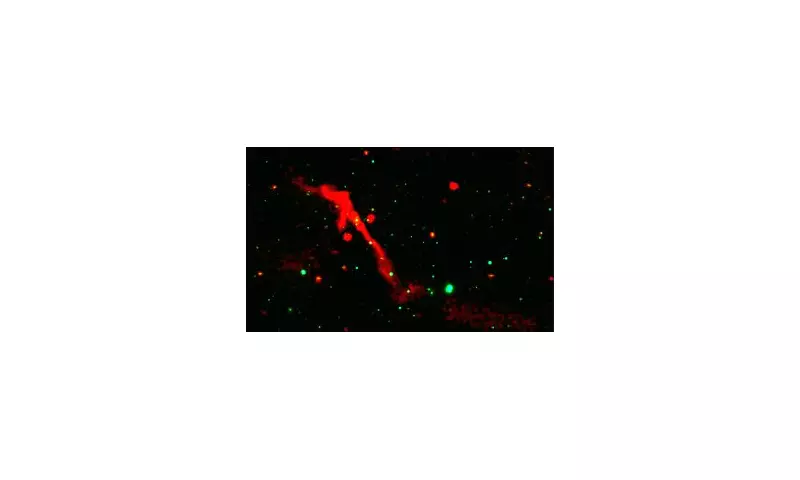
In the case of J1007+3540, the eruption is monumental. The observed plumes of cosmic lava span an incredible one million light-years, making them nearly ten times wider than our entire Milky Way galaxy.
A History Written in Ancient Plasma
The radio observations did more than capture a single event; they unveiled the black hole's violent history. Just outside the bright, compact jet signalling the recent awakening, astronomers detected a cocoon of older, faded plasma.
This debris is the remnant of past eruptions, squeezed and distorted over eons by the hostile cluster environment. Dr Kumari explains this layering effect: 'This dramatic layering of young jets inside older, exhausted lobes is the signature of an episodic Active Galactic Nucleus – a galaxy whose central engine keeps turning on and off over cosmic timescales.'
The imagery shows the jet's northern lobe compressed into a curved shape, visibly shoved sideways by the intense pressure of the surrounding gas, illustrating the constant 'messy, chaotic struggle' at the galaxy's core.
This discovery raises intriguing questions about our own galactic home. The supermassive black hole at the centre of the Milky Way, Sagittarius A*, is currently dormant. However, scientists theorise a similar eruption could occur if it becomes active, potentially reshaping our local universe. While Earth would likely be shielded from radiation, a direct hit from such a jet could be catastrophic.
Fortunately, researchers believe such an event is not imminent and may only happen when the Milky Way collides with the Large Magellanic Cloud in approximately 2.4 billion years. For now, the awakening of J1007+3540 stands as a profound testament to the dynamic and explosive nature of our cosmos.