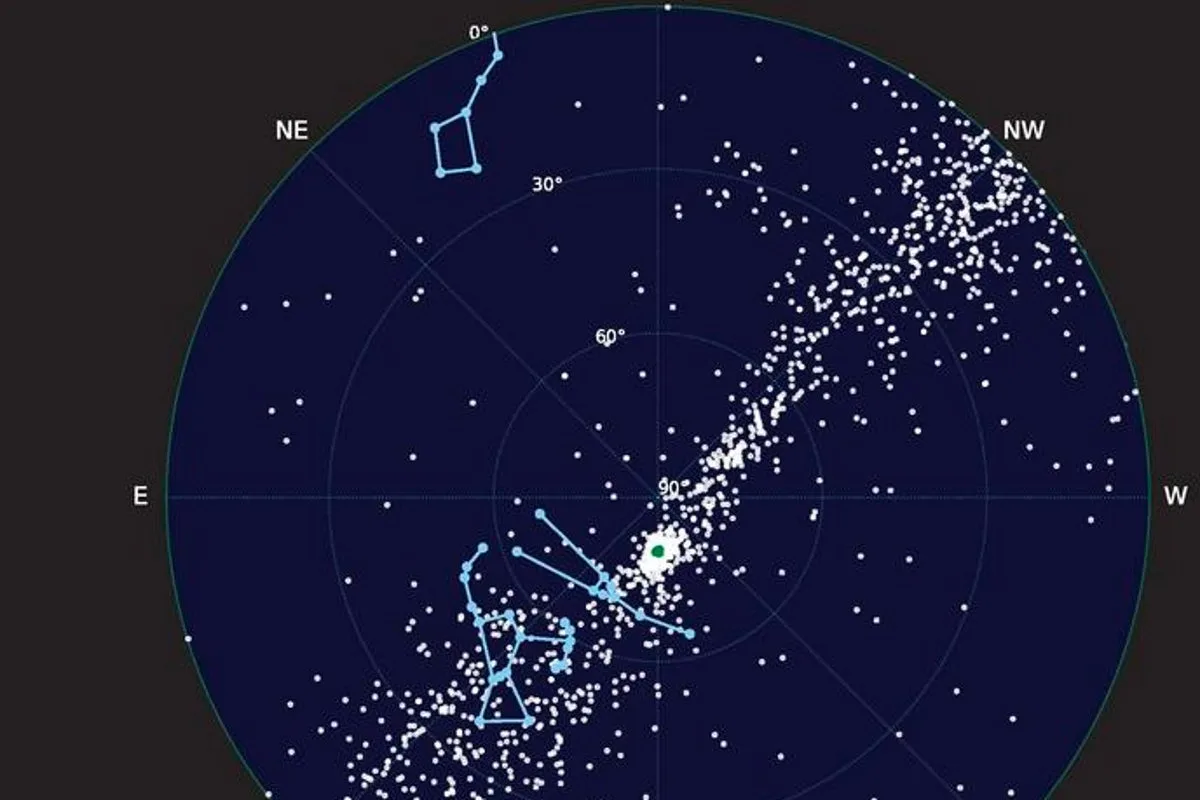
Astronomers have discovered that the Pleiades star cluster, also known as the Seven Sisters, is far larger than previously estimated. New data from the European Space Agency's Gaia and NASA's Tess satellites reveal that the cluster contains thousands of additional 'sibling' stars, making it 20 times bigger than current estimates.
The study, published in The Astrophysical Journal, redefines the Pleiades as the dense core of a vast stellar association rather than a small cluster of seven stars. Researchers have named this structure the 'Greater Pleiades Complex', which spans at least 600 parsecs (about 31 trillion kilometres per parsec).
The team identified 'stellar bridges' made of streams of gas connecting the Pleiades with other young star clusters. By measuring the rotation of stars, they created a new framework for mapping our cosmic neighbourhood, allowing them to detect scattered stellar groups that traditional methods miss.

Andrew Boyle, an astronomer from the University of North Carolina at Chapel Hill, said: 'This study changes how we see the Pleiades – not just seven bright stars but thousands of long-lost siblings scattered across the whole sky.'
The Pleiades hold cultural significance, appearing in the Old Testament, the Talmud, and being celebrated as Matariki in New Zealand, as well as featuring in the Subaru logo. Researchers hope future studies will help trace the origin of our Sun, potentially revealing it was born in a much larger stellar family.