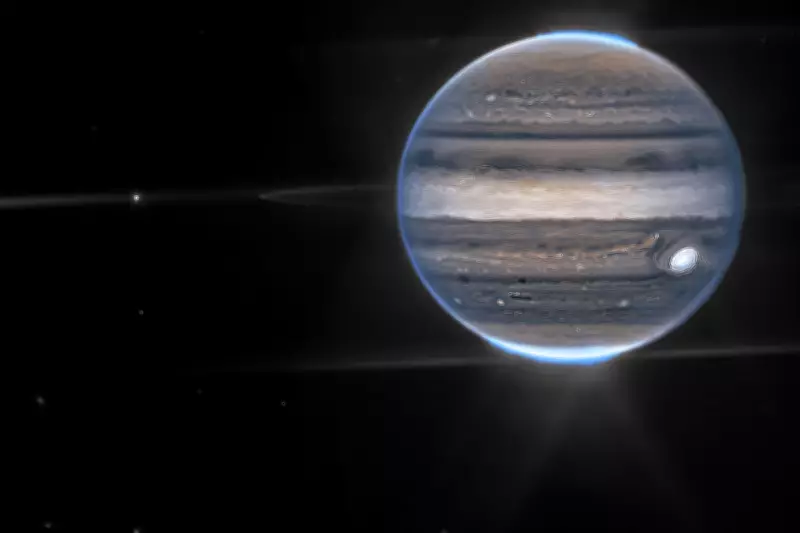
NASA's Juno Mission Uncovers Jupiter's True Dimensions in Groundbreaking Discovery
NASA's robotic Juno spacecraft has delivered a startling revelation about Jupiter, the solar system's colossal gas giant. According to new, highly precise data, Jupiter is actually smaller than scientists had previously believed. While it remains undeniably the largest planet in our solar system, these refined measurements provide a deeper and more accurate understanding of its complex interior structure and overall shape.
Precise Measurements Reveal a Smaller, More Oblate Jupiter
The latest observations from the Juno mission indicate that Jupiter's equatorial diameter measures 88,841 miles (142,976 kilometres). This represents a reduction of approximately 5 miles (8 kilometres) compared to earlier estimates derived from historical data. Similarly, the planet's diameter from the north to south pole is now calculated at 83,067 miles (133,684 kilometres), which is about 15 miles (24 kilometres) less than previously thought.
Like Earth, Jupiter is not a perfect sphere but is flattened at its poles, a shape known as an oblate spheroid. The new data confirms that Jupiter is even more oblate than previously known. Its equator is about 7 per cent larger than its polar diameter. For context, Earth's equator is only 0.33 per cent larger than its diameter at the poles, highlighting Jupiter's significantly more pronounced flattening.

How Juno's Extended Mission Enabled the Discovery
Previous measurements of Jupiter's size relied on data collected by NASA's Voyager and Pioneer spacecraft during flybys in the late 1970s. Juno, launched in 2011, has been orbiting Jupiter since 2016, continuously transmitting a wealth of raw data back to Earth. The mission's extension in 2021 enabled scientists to conduct the specific, targeted observations required to fine-tune these planetary measurements.
A key technique involved tracking Juno as it passed behind Jupiter from Earth's vantage point. "When Juno passed behind Jupiter from Earth's perspective, its radio signal traveled through the planet's atmosphere before reaching Earth," explained planetary scientist Eli Galanti of the Weizmann Institute of Science in Israel, lead author of the study published this week in the journal Nature Astronomy.
"Measuring how the signal changed due to Jupiter's atmospheric composition, density and temperature allowed us to probe the atmosphere and determine the planet's size and shape with high precision. Interestingly, this geometrical configuration did not occur during Juno's prime mission, so these experiments were not originally planned," Galanti added.
Why Jupiter's Precise Size Matters for Solar System Science
Jupiter, the fifth planet from the sun, is of immense scale, capable of containing all the other planets in the solar system, including more than 1,300 Earths. Composed primarily of hydrogen and helium, with traces of other gases, its vibrant, striped appearance is dominated by powerful winds and vast storms like the Great Red Spot.
Beyond revising its size and shape, Juno has been gathering crucial data on Jupiter's atmosphere, internal structure, magnetic field, and magnetosphere. These new, precise measurements are invaluable to scientists because Jupiter's radius—half its diameter—serves as a fundamental reference point in models of the planet's interior and atmospheric structure.
"Jupiter is the largest planet in the solar system and contains most of its planetary mass, so understanding its composition and internal structure is central to understanding how the solar system formed and evolved," Galanti stated. "Jupiter likely formed early, and strongly influenced the distribution of material, the growth of other planets and the delivery of volatiles to the inner solar system, including Earth."
Volatiles, such as water, carbon dioxide, and ammonia, evaporate easily. Their delivery to the inner solar system, home to the four rocky planets, was crucial. As Galanti noted, these substances "supplied Earth with water and key ingredients for its atmosphere and for life." This discovery not only redefines our knowledge of Jupiter but also refines our understanding of the solar system's formative processes.