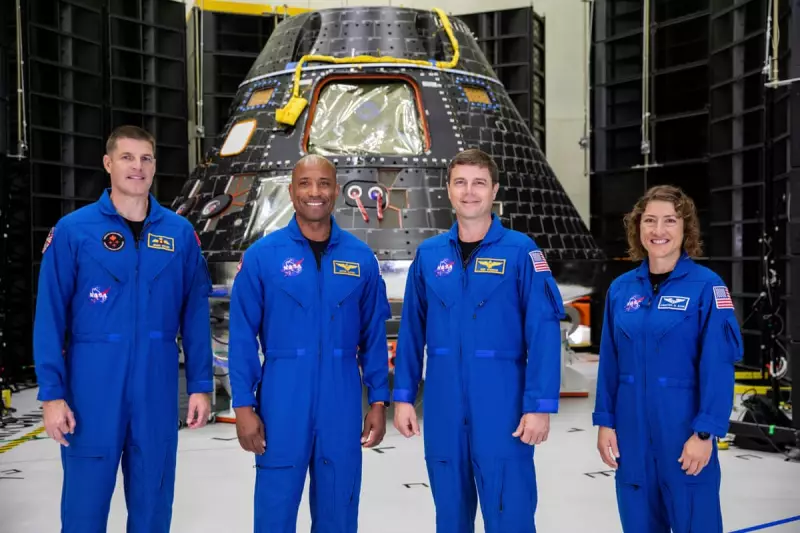
NASA is on the cusp of a monumental return to deep space, preparing to launch its most powerful rocket ever built on a mission to send astronauts around the moon for the first time in more than half a century. The Artemis II mission is currently scheduled for launch from Kennedy Space Center in Florida as early as 6 February, embarking on a staggering 685,000-mile round trip.
The Crew and the Historic Journey
The four astronauts selected for this landmark flight are NASA's Reid Wiseman, Victor Glover, and Christina Koch, alongside Canadian Space Agency astronaut Jeremy Hansen. This mission will see Koch become the first woman and Glover the first person of colour to travel beyond low Earth orbit. While the crew will not land on the lunar surface, their 10-day voyage will mark the first human journey to the moon's vicinity since Apollo 17 in 1972.
NASA Administrator Bill Nelson has hailed the mission as "probably one of the most important human spaceflight missions in the last half-century." The flight serves as a critical crewed test for the Space Launch System (SLS) rocket and the Orion capsule, paving the way for Artemis III, which aims to land astronauts near the lunar south pole as early as next year.

Technical Preparations and the Road to the Launchpad
Standing nearly 100 metres tall, the combined SLS and Orion stack is an engineering marvel. The rocket carries enough liquid propellant to fill an Olympic-sized swimming pool, generating the thrust needed to reach speeds of up to 24,500mph. The first major step is the rollout, where NASA's colossal Crawler-Transporter 2 will carry the 5,000-tonne vehicle from the assembly building to the launchpad on a four-mile journey lasting up to 12 hours.
Following the rollout, engineers will work through a rigorous preflight checklist, including a "wet dress rehearsal" where the rocket is loaded with over 700,000 gallons of propellant for a practice countdown. The team has been addressing final technical issues, including a bent cable in the flight termination system and a faulty valve on the Orion capsule. John Honeycutt, chair of the Artemis II mission management team, emphasised that crew safety is the absolute priority, stating, "We're going to fly when we are ready."
A Test Flight with Global Implications
This mission is fundamentally a test flight. Once in space, the crew will perform two Earth orbits before the Orion capsule separates. The astronauts will then manually pilot Orion to approach and retreat from the rocket's discarded upper stage, testing handling for future docking operations. During the voyage to the moon and back on a figure-of-eight trajectory, they will practise emergency procedures and test a radiation shelter designed for protection against solar flares.
The mission is seen as a pivotal step towards sustained lunar exploration and future journeys to Mars. David Parker, former head of the UK Space Agency, called it "a big deal" and a step towards a long-held dream. The endeavour also carries the weight of a modern space race, with NASA keen to maintain a lead as China pursues its own lunar landing ambitions for 2030.
With the launch window opening on 6 February and 14 backup dates identified through to mid-April, the world watches as NASA prepares to write the next chapter in human space exploration. As Jeff Radigan, Artemis II's lead flight director, acknowledged, "This is a test flight and there are things that are going to be unexpected." The anticipation is palpable, marking a thrilling and nerve-wracking return to a frontier not visited by humans for over five decades.