In a bid to conquer the navigational challenges of the Red Planet, NASA engineers are turning to one of the most extreme environments on Earth. The agency is conducting critical tests of next-generation drone technology within California's blistering Death Valley National Park, leveraging its otherworldly landscape to simulate flights across Mars.
Learning from Ingenuity's Challenges on Martian Dunes
The urgent need for this terrestrial testing stems directly from experiences on Mars itself. NASA's pioneering Ingenuity Mars Helicopter, which arrived with the Perseverance rover in 2021, completed an astonishing 72 flights before sustaining damage in January 2024. However, its final missions revealed a significant weakness. The helicopter's navigation system, designed to track visual features on the ground, became confused when flying over bland, featureless sand dunes.
"Ingenuity was designed to fly over well-textured terrain, estimating its motion by looking at visual features on the ground. But eventually it had to cross over blander areas where this became hard," explained Roland Brockers, a researcher and drone pilot at NASA's Jet Propulsion Laboratory (JPL) in Southern California. "We want future vehicles to be more versatile and not have to worry about flying over challenging areas like these sand dunes."

Death Valley: A Proving Ground for Extraterrestrial Exploration
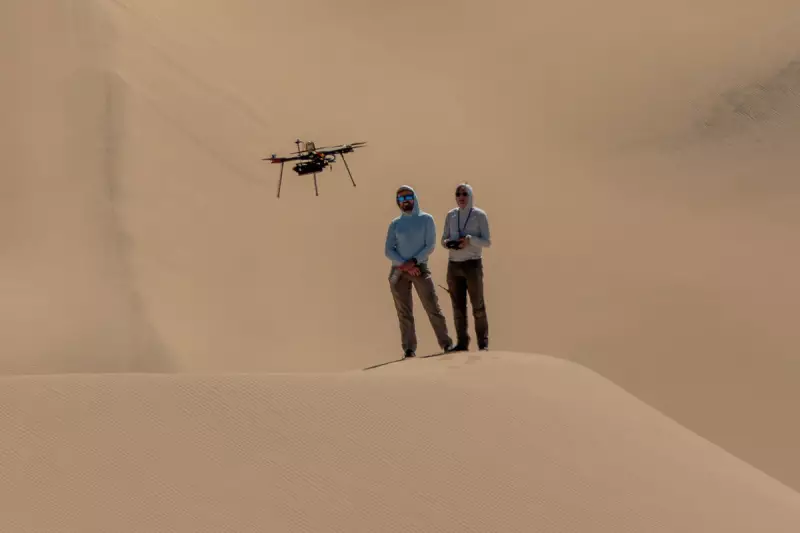
To solve this problem, NASA teams took to the air above the Mojave Desert in April and September 2025. They flew three research drones over the barren, rippling dunes of Death Valley, an area chosen for its stark resemblance to Martian terrain. This is not a new relationship; NASA has used Death Valley—famed as the hottest place on Earth—as a testing site since the 1970s during preparations for the Viking spacecraft missions.
The recent tests were conducted in scorching temperatures reaching up to 113 degrees Fahrenheit (45 degrees Celsius). Engineers focused on key sites including the park's Mars Hill, a surreal lava flow remnant, and the Mesquite Flats Sand Dunes. Their research yielded promising technical solutions, finding that employing different camera filters and new algorithms can help drones better track the ground and execute safe landings in difficult, textureless environments.
National Parks as Living Laboratories
The significance of these tests extends beyond engineering. Mike Reynolds, Superintendent of Death Valley National Park, emphasised the park's role as an active scientific resource. "It's a powerful reminder that the park is protected not just for its scenic beauty or recreational opportunities, but as a living laboratory that actively helps us understand desert environments and worlds beyond our own," he stated. The varied terrain of locations like the Dumont Dunes proved invaluable for testing.
A Broader Strategy for Martian Robotics
Death Valley is not the only national park aiding NASA's Martian preparations. In a parallel effort, researchers from NASA's Johnson Space Center in Texas tested a dog-like robot named LASSIE-M at White Sands National Park in New Mexico. This legged robot is envisioned as a future scout on Mars, capable of traversing rocky or sandy slopes too hazardous for wheeled rovers.
Meanwhile, teams at NASA's Langley Research Center in Virginia are developing the Mars Electric Reusable Flyer, a large drone with a propeller roughly the size of a small school bus. These diverse projects underscore a comprehensive strategy to create a new generation of autonomous vehicles capable of unlocking the secrets of Mars's most difficult landscapes, with help from some of Earth's most iconic protected spaces.