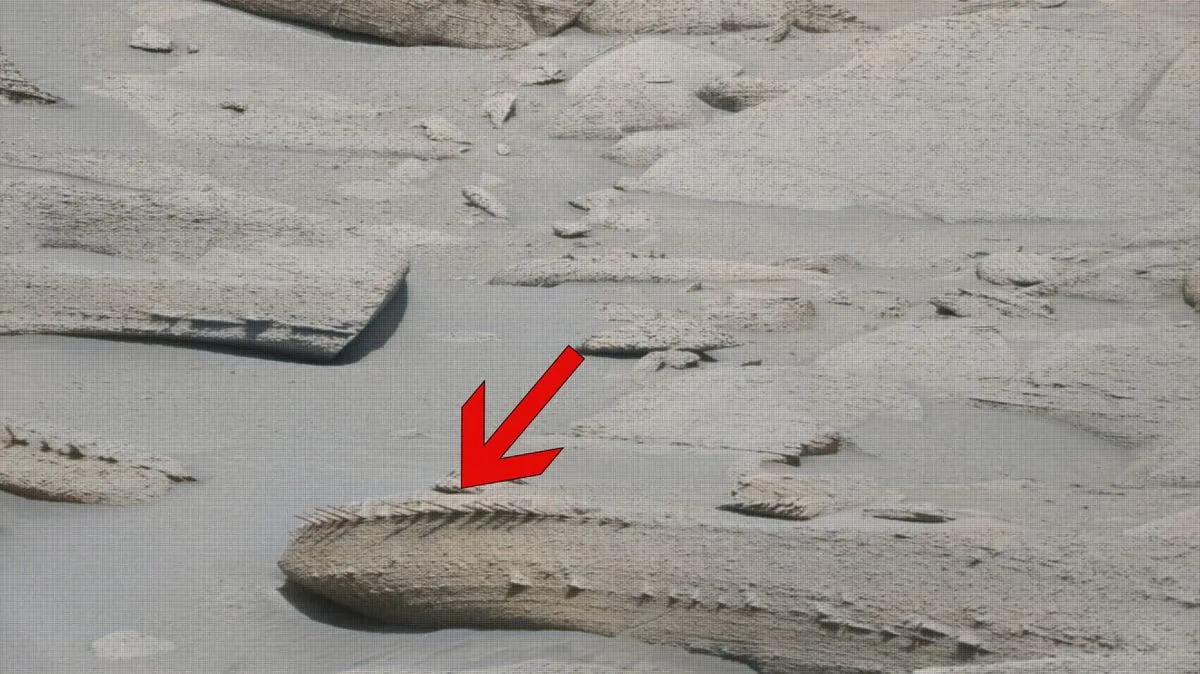
NASA's Mars Curiosity Rover has captured images of bizarre bone-like structures on the Red Planet, triggering excitement and speculation online. The photographs, taken on April 1 (Martian day Sol 3786) using the rover's mast camera and ChemCam, show strange protrusions from the rocky surface.
The images have prompted a range of theories, from fish bone fossils to the fossilised remains of a dragon-like creature. Astrobiologist Nathalie Cabrol said: "In 20 years of studying Mars, that's the most bizarre rock I have ever seen." Another observer commented on the unprecedented nature of the find.
Some social media users suggested the formations could be the result of wind erosion over millions of years. Martin Weil wrote that if wind blows over loose sand for sufficient eons, every geometric form might eventually be created. Others likened the structures to a fossilised fir tree branch or fish backbone.

One user, Liam Gunn, jokingly suggested it was "the back of a fossilised Martian dragon, curled up in its final resting place." Additional guesses included a crumbly fish vertebra, fish fossils, a mackerel fillet, and the skeleton of a prehistoric creature.
Curiosity, a car-sized rover, has been exploring Gale crater since August 2012 as part of NASA's Mars Science Laboratory mission. Its objectives include investigating Martian climate and geology and preparing for human exploration. The crater is a probable dry lake, 154 km in diameter and estimated to be 3.5-3.8 billion years old.
The rover's Mast Camera uses a telephoto lens for panoramic images, while its medium-angle lens provides lower-resolution panoramas. Previous images from Mars have also sparked speculation, including claims of mushrooms and lichen on the planet's surface.