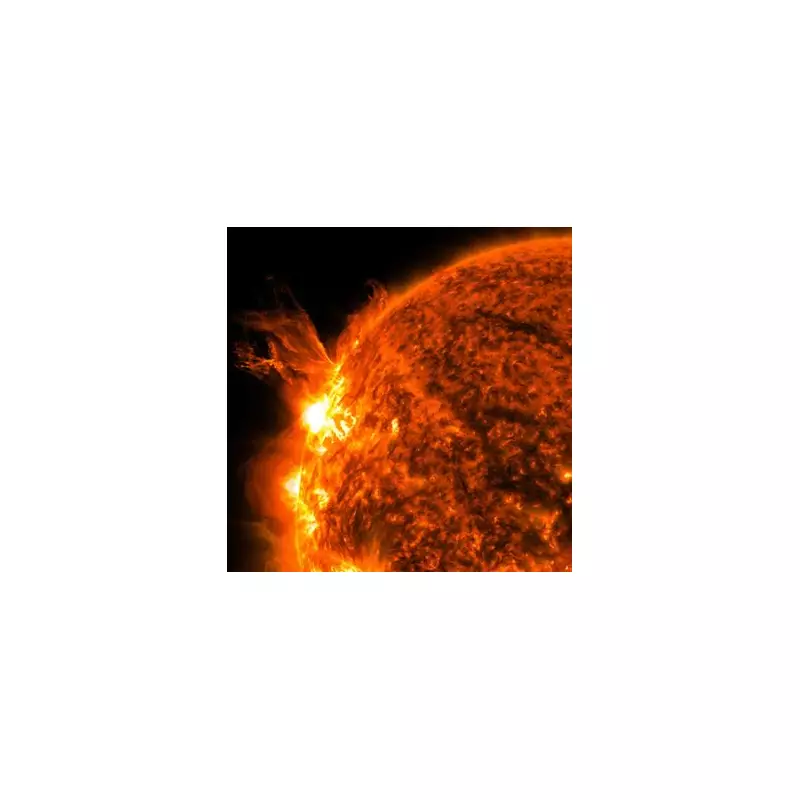
The US space agency NASA has issued a stark warning following a significant eruption on the Sun, which poses a tangible threat to critical infrastructure on Earth, including electrical power grids.
Powerful Solar Eruption Detected
NASA confirmed that the Sun emitted a strong solar flare which peaked at 9:49 p.m. Eastern Time on November 30, 2025. The event was classified as an X1.9 flare, placing it in the most intense category of solar eruptions known as X-class.
The blast of energy was captured by NASA's Solar Dynamics Observatory, a spacecraft dedicated to constant solar monitoring. Such flares are known to be precursors to coronal mass ejections (CMEs), which are vast explosions of plasma and magnetic field that can be hurled towards our planet.

Potential Impacts on Earth and Technology
While strong solar activity can produce breathtaking auroral displays, the technological consequences can be severe. NASA stated that flares and solar eruptions can directly impact radio communications, electric power grids, navigation signals, and pose risks to spacecraft and astronauts in orbit.
When a CME is directed at Earth, it can trigger a geomagnetic storm. According to the UK's Met Office, these storms have both physical and technological effects. Key risks include:
- Power Grids: Geomagnetically induced currents (GICs) can overload systems, potentially causing widespread blackouts during severe events.
- Communications & Navigation: High-frequency (HF) radio and Global Navigation Satellite Systems (GNSS), including GPS signals, can be disrupted or degraded.
- Satellites: Increased radiation and atmospheric drag from a heated thermosphere can affect satellite orbits and cause surface charging.
Understanding the Threat of Geomagnetic Storms
The Met Office explains that geomagnetic storms are caused by bursts of solar wind—streams of charged particles from the Sun—interacting with Earth's magnetosphere. A powerful burst from a CME can disturb this protective magnetic bubble, initiating a storm.
These storms can travel from the Sun to Earth in as little as 18 hours, though the journey may take up to 96 hours. Once they arrive, their disruptive effects can linger for several days, requiring sustained vigilance from space weather forecasters and infrastructure operators.
The recent X1.9 flare serves as a potent reminder of our planet's vulnerability to space weather, underscoring the importance of continuous monitoring and robust contingency planning for critical national infrastructure.