NASA's Planetary Defence Head Reveals Nightmare Scenario
NASA's head of planetary defence has disclosed what truly keeps her awake at night: tens of thousands of undetected 'city killer' asteroids lurking in space. Dr Kelly Fast, who leads efforts to find and track near-Earth objects such as asteroids and comets, has admitted that approximately 15,000 mid-sized celestial bodies remain unlocated, each potentially posing a significant threat to our planet.
The Regional Threat of Mid-Sized Asteroids
While an impact from one of these asteroids—defined as being at least 140 metres wide—would likely not destroy Earth entirely, Dr Fast emphasised they could 'really cause regional damage.' These mid-sized objects, though smaller than the kilometre-wide giants often depicted in films, represent a substantial danger due to their potential to devastate large areas upon collision.
Alarmingly, Earth currently lacks any ready means to deflect such an asteroid if it were discovered to be on a direct collision course. This vulnerability persists despite technological advancements, highlighting a critical gap in planetary defence preparedness.

The DART Mission: A Success Without Follow-Up
In 2022, NASA achieved a milestone with the Double Asteroid Redirection Test (DART) mission. The agency deliberately sent a spacecraft 6.8 million miles into space to crash into a mini moon called Dimorphos at 14,000 miles per hour, successfully altering its orbit. This mission was hailed as a groundbreaking demonstration of how to defend our planet by knocking incoming asteroids off their paths towards Earth.
However, Dr Nancy Chabot, a planetary scientist at Johns Hopkins University who led the DART mission, revealed a sobering reality. She stated that there are no other DART-like spacecraft currently ready to launch if an asteroid were suddenly identified as being on a collision trajectory with Earth. 'Dart was a great demonstration,' she said. 'But we don't have [another] sitting around ready to go if there was a threat that we needed to use it for.'
The Case of Asteroid YR4: A Close Call
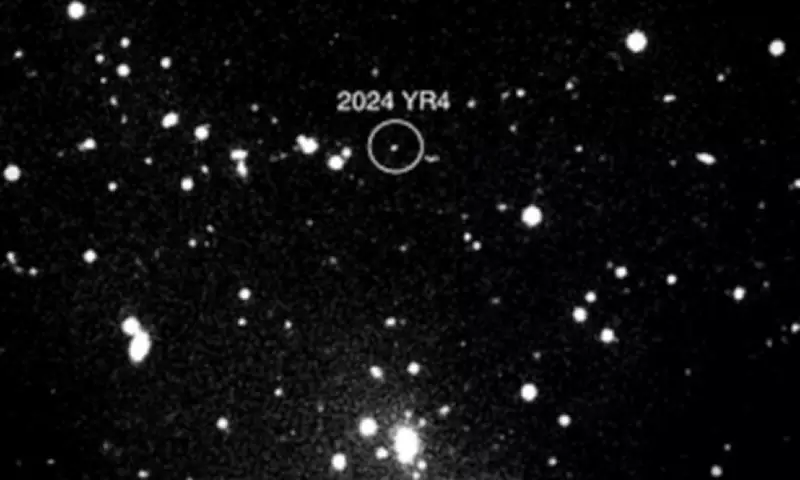
Dr Chabot referenced asteroid YR4, which measures up to 90 metres wide, as a recent example of the threat. Last year, this asteroid was initially deemed to have a 3.2 per cent chance of hitting Earth in 2032, setting off alarm bells within the scientific community. Eventually, this probability was downgraded to zero, meaning no defensive action was necessary.
'If something like YR4 had been headed towards the Earth, we would not have any way to go and deflect it actively right now,' Dr Chabot added. 'We could be prepared for this threat. And I don't see that investment being made.'
The Detection Gap: Thousands Remain Hidden
During a discussion at the American Association for the Advancement of Science (AAAS) conference in Phoenix, Dr Fast explained that while the largest asteroids—those over a kilometre in diameter—are relatively easy to detect and track, mid-sized ones present a greater challenge. It is believed that only 40 per cent of these mid-sized asteroids have been detected so far, leaving thousands of their locations unknown.
When asked what specifically keeps her up at night, Dr Fast replied: 'It's really the asteroids that we don't know about. We're not so much worried about the large ones from the movies, because we know where they are. And small stuff is hitting us all the time. Not so much worried about that. It's the ones in-between that could do regional damage. Maybe not global consequences, but they could really cause damage. And we don't know where they all are. It's not something that even with the best telescope in the world you could find.'
NASA's Ongoing Efforts and Future Missions
NASA has been tasked by the US Congress with finding more than 90 per cent of near-Earth objects larger than 140 metres in diameter. To achieve this ambitious goal, the agency is currently constructing a specialised space telescope designed to detect the majority of near-Earth asteroids and comets within the next decade.

This mission, known as the Near-Earth Object (NEO) Surveyor, is expected to launch next year. It will possess the capability to detect both bright and dark asteroids, the latter being particularly difficult to locate with current technology. 'We're searching skies to find asteroids before they find us, and get them before they get us,' Dr Fast concluded, underscoring the proactive approach needed to safeguard our planet.
Potential Methods for Asteroid Threat Elimination
While DART demonstrated one approach, several other concepts have been proposed over the years to negate the threat of an asteroid impact:
- Multiple Bumps: Scientists in California have been firing projectiles at meteorites to simulate methods of altering an asteroid's course. Research suggests that carbon-rich asteroids like Bennu might require several small impacts to change their trajectory effectively.
- Nuclear Option: Detonating a nuclear explosive near an asteroid is another idea, though it risks creating smaller, potentially dangerous fragments that could spin off towards Earth.
- Ion Beam Deflection: This method involves directing plumes from a space probe's thrusters towards the asteroid to gently push on its surface over a wide area, requiring a thruster firing in the opposite direction to maintain distance.
- Gravity Tractor: A concept that would deflect an asteroid without physical contact by using only its gravitational field to transmit an impulse, offering a slower but potentially precise alternative.
Professor Colin Snodgrass, an astronomer at the University of Edinburgh, noted: 'There have been a few concepts suggested, such as a 'gravity tractor' to slowly tow an asteroid away instead of pushing it with a kinetic impactor. But the kinetic impactor is definitely the simplest technology to use on the sort of timescale that is most likely to be of concern for this size of asteroid, i.e. years to decades warning time.'