Astronomers Uncover Metallic Wind Cloud Orbiting Enigmatic Celestial Body
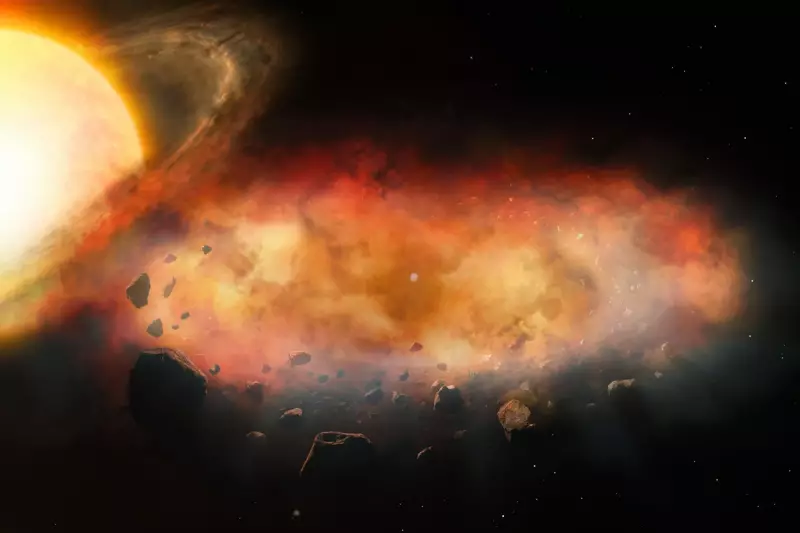
Astronomers have made a remarkable discovery of a massive cloud composed of metallic winds that is orbiting a mysterious object in deep space. This finding, announced by the U.S. National Science Foundation's NOIRLab, provides unprecedented insights into the dynamic processes occurring within mature planetary systems.
Unusual Dimming Event Leads to Groundbreaking Discovery
The detection originated when scientists observed an unusual dimming event affecting the star J0705+0612, located approximately 3,000 light-years from Earth. This sun-like star, estimated to be over two billion years old, experienced a dramatic reduction in brightness, becoming forty times dimmer than usual between September 2024 and May 2025.
"Stars like the sun don't just stop shining for no reason," explained Nadia Zakamska, a professor of astrophysics at Johns Hopkins University. "So dramatic dimming events like this are exceptionally rare and warrant detailed investigation."

International Telescope Collaboration Reveals Complex Structure
The international research team employed multiple observatories to study this phenomenon, including the Gemini South telescope in Chile, the Apache Point Observatory in New Mexico, and Chile's Magellan Telescopes. By comparing current observations with historical data, astronomers determined that the star's light was being obscured by a vast, meandering cloud of gas and dust stretching across approximately 120 million miles.
Most intriguingly, gravitational analysis revealed this cloud is bound to a second object orbiting the star. While the exact nature of this object remains unknown, observations confirm it possesses at least several times the mass of Jupiter, potentially making it a brown dwarf or low-mass star.
Advanced Instrumentation Uncovers Metallic Composition
Utilizing the Gemini South telescope's GHOST instrument, which analyzes objects based on patterns of light wavelengths, researchers studied the cloud for over two hours. This sophisticated technology revealed the cloud's composition includes multiple metallic elements, particularly iron and calcium, while also measuring its complex motion patterns.
"The sensitivity of GHOST allowed us to not only detect the gas in this cloud, but to actually measure how it is moving," Professor Zakamska emphasized. "That's something we've never been able to accomplish before in a system of this nature."
Theoretical Explanations and Cosmic Implications
Professor Zakamska has proposed a compelling theory suggesting the metallic cloud may have formed following a catastrophic collision between two planets within J0705+0612's planetary system. Regardless of its precise origin, this discovery offers scientists a rare glimpse into the transformative processes that continue to shape planetary systems long after their initial formation.
"This event demonstrates that even in mature planetary systems, dramatic, large-scale collisions can still occur," she reflected. "It serves as a vivid reminder that the universe is far from static - it represents an ongoing narrative of creation, destruction and profound transformation."
The astronomical community continues to investigate this enigmatic system, with researchers particularly interested in determining whether the central object represents a planet surrounded by a circumplanetary disk or a star with a circumsecondary disk. Either classification would represent an exceptionally rare astronomical find with significant implications for our understanding of cosmic evolution.