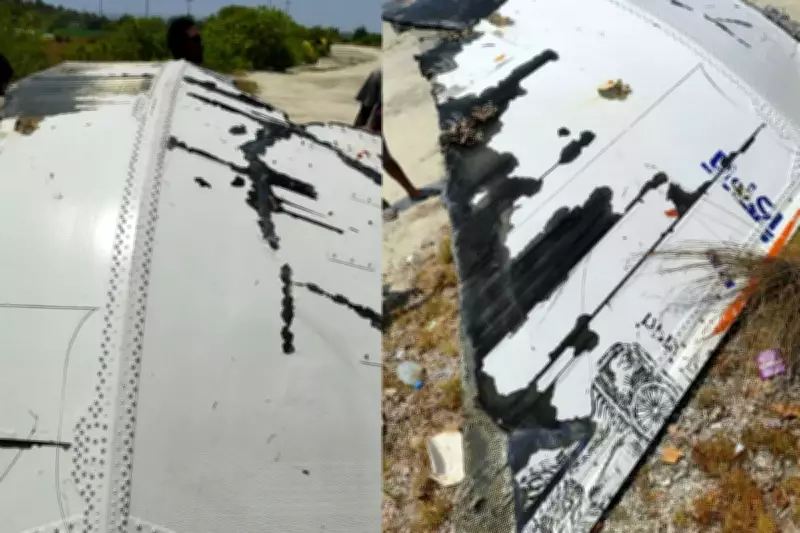
Debris from an Indian space rocket has been recovered on a remote, uninhabited island in the Maldives, raising concerns about the growing frequency of such incidents and the need for enhanced monitoring of designated splashdown zones.
Discovery by Local Fisherman
A resident of L Kunahandhoo, located in the Laamu Atoll of the Maldives, reportedly found the fragments while out fishing. The man brought the debris to Kunahandhoo, initially unaware of its origin as rocket parts.
"It was only after they were placed in the Kunahandhoo boatyard area and seen by some youths that it was realised they were parts of a rocket," said Ibrahim Shakeeb, president of the regional council, in a statement to local news outlets.

Identification and Analysis
Photographs shared by the Kunahandhoo Council show the debris bearing the logo of the Indian Space Research Organisation (Isro), along with visible scorch marks likely caused by re-entry into Earth's atmosphere. Writings on the fragments indicate they originated from a rocket launched in 2025.
Local authorities have collected the pieces for further analysis, while Isro has not yet issued an official statement regarding the discovery.
Expert Insights on Rocket Fairings
Numbers on the debris suggest it may have been part of an Isro payload fairing, a component designed to protect satellites during a rocket's ascent. These fairings are constructed from lightweight composite materials and are intended to burn and fall away when payloads separate in space, typically landing in the ocean far from human habitation.
However, ocean currents can sometimes carry such debris from their designated drop zones. As the fragments sink, they often break apart further, but strong surface currents in regions like the Indian Ocean have previously transported rocket parts to shores in Sri Lanka and Western Australia.
Historical Precedents and Safety Concerns
This is not the first instance of Indian rocket debris washing ashore. In recent years, a suspected piece of Isro's LVM3 rocket hardware was found on a beach near Trincomalee, Sri Lanka, and in 2023, a heavy rocket component believed to be from an Indian launch vehicle was discovered near Green Head in Western Australia.
While there have been no reported threats to people or wildlife from such incidents thus far, experts emphasize that the increasing occurrence highlights the need for closer monitoring of splashdown zones. They argue that as space launches become more frequent, proactive measures are essential to mitigate potential risks.
The discovery underscores ongoing challenges in space debris management and the importance of international cooperation in tracking and recovering components that stray from their intended oceanic landing sites.