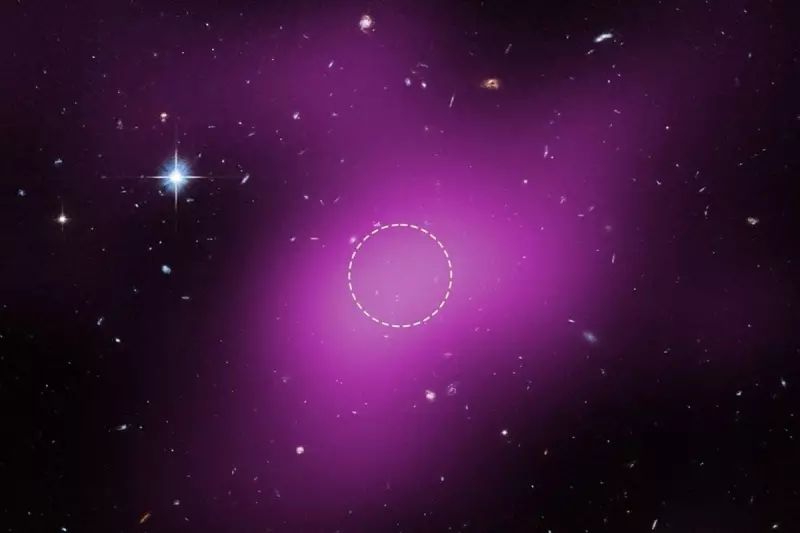
A groundbreaking discovery by astronomers using NASA's Hubble Space Telescope has revealed a new and mysterious type of cosmic object: a 'failed galaxy' composed almost entirely of dark matter.
A Cosmic Ghost: The Cloud-9 Discovery
Dubbed 'Cloud-9', this astronomical curiosity sits approximately 14 million light-years from Earth. Unlike any typical galaxy, it contains no stars whatsoever, appearing as a vast, dark cloud. This marks the first time such an object has ever been conclusively detected, offering scientists an unprecedented look at the building blocks of the cosmos.
The principal investigator of the research programme, Alejandro Benitez-Llambay from Milano-Bicocca University in Italy, described it as a tale of cosmic failure. "In science, we usually learn more from the failures than from the successes," he stated. "In this case, seeing no stars is what proves the theory right. It tells us that we have found in the local universe a primordial building block of a galaxy that hasn't formed."

A Window Into the Dark Universe
The object is scientifically classified as a Reionization-Limited H I Cloud, or RELHIC. Such entities have been theorised for years as potential remnants from the early stages of galaxy formation. Dark matter constitutes roughly 85% of all matter in the universe, yet it is notoriously difficult to study because it does not emit, absorb, or reflect light.
The pristine, starless nature of Cloud-9 is its greatest scientific gift. It allows researchers to examine a pure dark matter 'halo' without the interference of starlight. Andrew Fox from the Space Telescope Science Institute at the European Space Agency (ESA) emphasised its importance: "This cloud is a window into the dark universe. Cloud-9 gives us a rare look at a dark-matter-dominated cloud."
Implications and Future Research
The surprise finding, announced on Wednesday 7 January 2026, is expected to fundamentally improve our understanding of both the early universe and the enigmatic nature of dark matter itself. ESA researcher Rachael Beaton likened the discovery to finding "a few abandoned houses" among our galactic neighbours, suggesting such relics may be more common than previously thought.
This pivotal detection is likely to spur a new wave of astronomical surveys aimed at uncovering more of these dark, failed galaxies. By studying Cloud-9 and its potential siblings, scientists hope to unlock secrets about how galaxies assemble and why some, like this one, never quite manage to ignite.