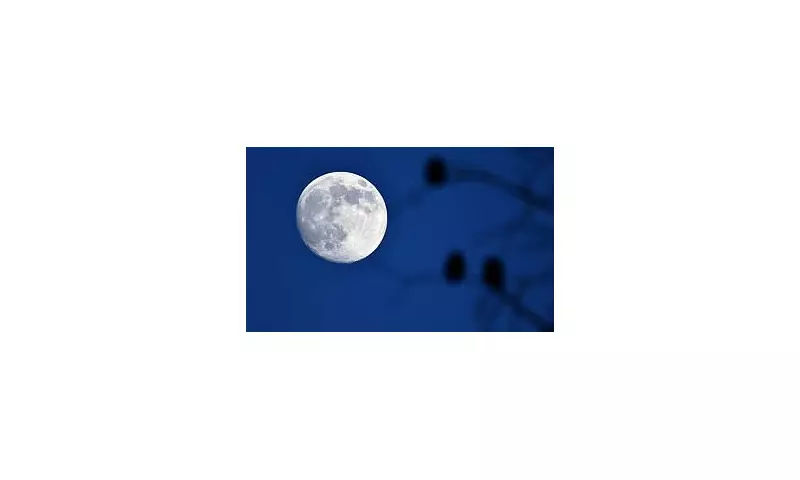
The UK is set for a spectacular celestial farewell to 2025 as the third and final supermoon of the year graces the night sky this evening. This festive full moon, known as the 'Cold Moon', will appear as a remarkably large and brilliant white orb, offering a breathtaking winter spectacle.
Why This Full Moon Is a 'Supermoon'
The extraordinary size and brightness are due to our lunar neighbour's proximity to Earth. Dr William Alston, an astrophysicist at the University of Hertfordshire, explains that the moon will be approximately 221,965 miles away just after 11pm GMT. This is significantly closer than the average lunar distance of 238,855 miles.
"The term supermoon is used to describe full moons that appear larger and brighter than typical full moons," said Dr Alston. "The December 2025 full moon will be the final supermoon of the year. It will genuinely be slightly closer and therefore appear larger and brighter."

This phenomenon occurs because the moon's orbit is elliptical, not a perfect circle. The point of closest approach is called 'perigee'. At perigee, the moon can appear up to 14 per cent larger and 30 per cent brighter than an average full moon.
Best Time and Places to View in the UK
The optimal moment to witness the moon at its fullest will be 23:14 UK time. However, the show begins much earlier. Stargazers can enjoy the moon rising in the east just after sunset (from around 15:53 GMT), initially glowing with a warm amber hue before turning bright white as it climbs.
"Generally, the moon is visible in daytime, but it will get better as darkness falls," Dr Alston added. For the best photographic opportunities and clearest views, seek out areas with minimal light pollution. High-altitude locations also provide an advantage by rising above low-lying haze and fog.
Prime UK viewing spots include:
- Primrose Hill in London
- Snowdonia National Park in South Wales
- Exmoor National Park in Devon
- South Downs National Park in Sussex and Hampshire
The Met Office forecast suggests cloud and rain will mainly affect northern England and Scotland, while clearer skies are expected elsewhere, albeit with potential frost and fog in eastern areas.
Viewing Tips and the Science Behind the Spectacle
While no special equipment is needed, a simple pair of binoculars or a small telescope can dramatically enhance the experience. Alan Jones, a telescope expert at 365 Astronomy, notes that modest telescopes can reveal stunning details of the moon's dimpled surface.
"Telescopes with modest apertures, such as a 4-inch refractor or a 6-inch Newtonian reflector, can provide stunning views of the moon," he advised. "If using a telescope, always aim to observe the moon when it's high in the sky to minimise distortion caused by Earth's atmosphere."
This year featured only three supermoons: on October 7, November 5, and finally December 4. The tradition of naming full moons dates back centuries, with December's dubbed the 'Cold Moon' due to the long nights and winter chill. The next supermoon is scheduled for January 3, 2026.